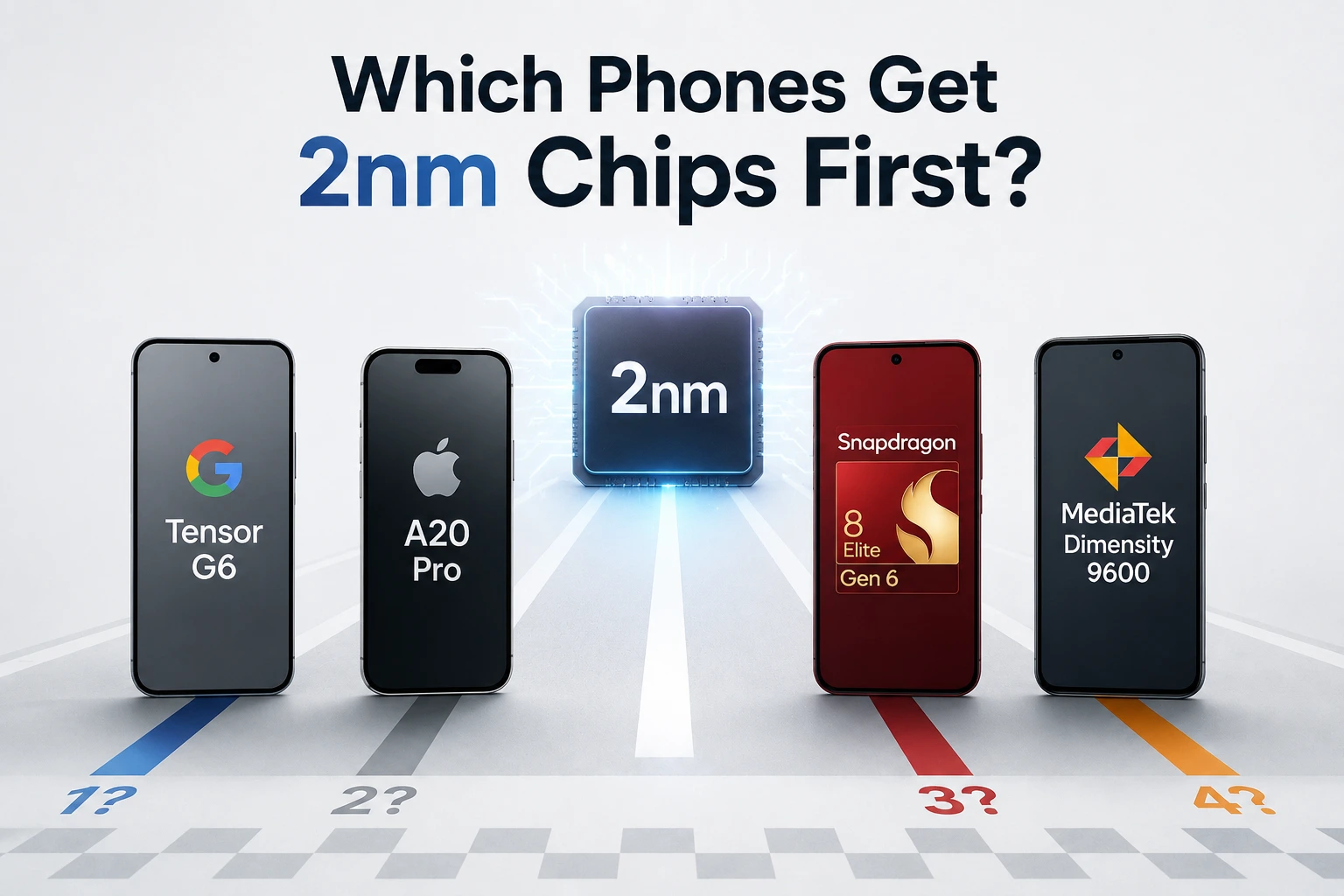
Silicon giants are aggressively hyping the shift to 2nm for late 2026. While Apple, Qualcomm, and MediaTek battle for TSMC's top-tier node, Google quietly bypassed the fight with its August launch of the Tensor G6. But beyond the bragging rights, will this shrink actually change your daily phone experience? That is the one question marketing glosses over.
This isn't a spec-sheet ranking. It's what's happening behind the wafer allocation meetings, the foundry contracts, and the thermal engineering decisions that never make it into a keynote.
Apple's A20 Pro is set to be the first 2nm chip to actually ship in a retail phone, arriving in the iPhone 18 Pro around September 9, 2026, on TSMC's base N2 node. Qualcomm's Snapdragon 8 Elite Gen 6 Pro follows about two weeks later at the Snapdragon Summit in Maui (September 22–24), built on the more refined N2P process, with MediaTek's Dimensity 9600 Pro expected in the same window. Google's Tensor G6, despite months of 2nm rumors, stayed on a refined 3nm node — so it's sitting this generation out entirely. Being "first" barely matters here, though. Wafer type, core configuration, and cooling design will decide which chip actually feels faster and lasts longer, not the date it launched.
The 2026 Scoreboard: Who's Actually Shipping What
| Chip | Node | Foundry Process | Expected Launch | First Phones |
|---|---|---|---|---|
| Apple A20 Pro | 2nm (N2) | TSMC, base N2 | ~Sept 9, 2026 | iPhone 18 Pro, Pro Max, Fold |
| Snapdragon 8 Elite Gen 6 Pro | 2nm (N2P) | TSMC, enhanced N2P | Sept 22–24, 2026 | Xiaomi 18 series, OnePlus 16 |
| Dimensity 9600 Pro | 2nm (N2P) | TSMC, enhanced N2P | ~Sept 2026 | Vivo X500 Pro, Oppo Find X10 |
| Google Tensor G6 | 3nm (refined) | TSMC, N3P | Shipped Aug 12, 2026 | Pixel 11 series |
Notice the gap. Apple gets a full two weeks of "first 2nm phone chip" bragging rights before anyone else even announces theirs, but it's running the plain N2 process, not the sharper N2P version Qualcomm and MediaTek reserved. That distinction sounds small. It isn't, and we'll get into why below.
What "2nm" Actually Changes Behind the Silicon
Node names stopped describing a literal transistor measurement over a decade ago. "2nm" is really shorthand for a manufacturing generation built around Gate-All-Around (GAA) nanosheet transistors, replacing the FinFET design every 3nm chip on the market still uses. We went deep on this exact mechanic in our 2nm vs 3nm phone processor breakdown, and the short version matters here too: GAA wraps the gate completely around the current channel instead of just three sides, which gives engineers tighter control over leakage — the main enemy of both battery drain and heat buildup.
According to TSMC's own N2 technology page, that translates into roughly 10–15% more performance at the same power draw, or up to 25–30% lower power at the same performance, versus their previous 3nm generation. N2P, the enhanced follow-up node Qualcomm and MediaTek are both using, pushes those numbers slightly further and adds better power-delivery capacitors on top.
Why the Same Label Doesn't Mean the Same Chip
Here's the part that trips people up every single generation: two chips can both say "2nm" and still perform very differently, because the node only sets a ceiling. Execution decides how close each chipmaker actually gets to it. We watched this happen already this year with Samsung's Exynos 2600, the first 2nm phone chip to ship — and it lost several benchmark rounds to the 3nm Snapdragon 8 Elite Gen 5 because of lower clocks and early yield problems. The lesson carries directly into this next round.
Chip by Chip: What's Really Different
Apple A20 Pro — First to Ship, Not Necessarily First to Win
The A20 Pro is expected to land in the iPhone 18 Pro, Pro Max, and Apple's first foldable iPhone around September 9, 2026, using TSMC's base N2 node with a new Wafer-Level Multi-Chip Module (WMCM) packaging design that places DRAM beside the processor instead of stacked on top of it. Leaks point to roughly 15–18% faster performance and around 30% better power efficiency over the A19 Pro, plus new super-high-performance metal-insulator-metal capacitors that stabilize power delivery under sustained load.
Apple's real advantage isn't the node itself — it's capacity. As we noted in our own 2nm vs 3nm comparison, Apple reportedly locked up over half of TSMC's early 2nm wafer allocation for this generation, which is exactly the kind of scarcity dynamic we broke down in how export controls and foundry access are reshaping global chip power. Getting first access isn't just a bragging point, it's the difference between shipping on schedule and getting stuck behind someone else's order.
Snapdragon 8 Elite Gen 6 Pro — Later, But on the Sharper Process
Qualcomm's flagship splits into two SKUs this year: the standard SM8950 and the Pro-tier SM8975, both reportedly on TSMC's N2P node, with a 2+3+3 Oryon CPU cluster (two prime cores, three performance, three efficiency). The Pro variant reportedly pairs an Adreno 850 GPU with LPDDR6 memory, while the standard chip gets Adreno 845 and stays on LPDDR5X. Die size actually grew slightly to around 134mm² despite the denser process, which usually signals the company packed in more silicon real estate for AI blocks rather than chasing a smaller footprint.
Qualcomm's chip won't hit shelves until phones like the Xiaomi 18 and OnePlus 16 launch in late 2026, weeks after Apple's iPhone event. But N2P, being the more mature, refined version of the 2nm family, could genuinely out-perform Apple's base-N2 A20 Pro on paper once real benchmarks land — a rematch of the exact dynamic we tracked in our Tensor G6 vs Snapdragon efficiency comparison, where node maturity mattered more than the label on the box.
Dimensity 9600 Pro — MediaTek's Most Aggressive Swing Yet
MediaTek is chasing the exact same N2P node with a near-identical 2+3+3 layout, using new ARM Cortex-C2 cores nicknamed "Canyon" for the prime cluster. Leaks describe peak clocks brushing close to 5GHz, an Immortalis "Magni" GPU with hardware-level frame interpolation baked directly into the silicon (rather than a software layer), and LPDDR6 support on the Pro tier. Early Geekbench estimates floating around put multi-core scores ahead of both Apple and Qualcomm's chips, though 5GHz clocks on a phone-sized thermal budget is exactly the kind of claim that tends to colapse under sustained gaming loads without serious vapor-chamber cooling.
The standard, non-Pro Dimensity 9600 is rumored to fall back to a 3nm N3P process instead, which mirrors Qualcomm's own Pro/standard split and hints at just how tight TSMC's 2nm supply really is this year.
Tensor G6 — The Chip That Didn't Show Up
This is the twist most coverage glossed over. Google spent months letting 2nm rumors run wild before the Pixel 11 launched, then confirmed the Tensor G6 is built on a refined 3nm process, not 2nm at all. If you want the full breakdown of why Google made that call and what it means for battery life and thermals, we covered it in detail in Tensor G6 vs Snapdragon: Can Google Finally Win on Efficiency? The short version: Google is betting on AI efficiency and modem fixes rather than a bleeding-edge node this cycle, which leaves Tensor G7 as the earliest realistic 2nm candidate from Google, likely in 2027.
Performance, Efficiency, and Heat: What You'll Actually Notice
| Factor | A20 Pro (N2) | Snapdragon 8 Elite Gen 6 Pro (N2P) | Dimensity 9600 Pro (N2P) |
|---|---|---|---|
| Battery life gain | Meaningful, especially idle/standby | Meaningful, strongest under sustained load | Meaningful, but 5GHz clocks eat into headroom |
| Sustained gaming | Solid, helped by WMCM thermal separation | Likely strongest on paper (Adreno 850) | Highest peak clocks, biggest throttling risk |
| Everyday use (calls, apps, browsing) | No noticeable difference vs A19 Pro | No noticeable difference vs Gen 5 | No noticeable difference vs 9500 |
| Wafer cost impact | Passed on via higher iPhone 18 Pro pricing | Pushes SoC cost past $300/unit | Similar cost pressure on Pro-tier phones |
The pattern across all three: battery life and sustained performance improve in ways you'll genuinely feel during a long gaming session or a heavy travel day. Day-to-day scrolling, texting, and calling won't feel any different, because every flagship chip from the last three years is already overpowered for that kind of use.
AI Capabilities: The Real Battleground
None of these companies are chasing 2nm purely for phone speed anymore — AI compute is the actual driver. Apple's WMCM packaging and larger Neural Engine footprint are aimed squarely at running Apple Intelligence locally without draining the battery. Qualcomm's Gen 6 Pro reportedly adds dedicated Matrix ALU blocks for what it's calling AI Frame Fusion, blending AI upscaling with frame generation at the hardware level. MediaTek's approach leans on a doubled Compute Matrix Engine for on-device machine learning tasks. Even Google's 3nm Tensor G6, despite skipping the node jump, still leads on raw AI efficiency-per-task thanks to its TPU redesign, a point we explored fully in our Tensor G6 efficiency deep dive. Node size helps AI workloads run cooler for longer, but architecture and software optimization still decide who wins the actual feature race.
Production Challenges Nobody Puts on a Slide
TSMC's entire 2026 2nm capacity is reportedly already booked, and a single 2nm wafer costs around $30,000–$33,000, roughly 50% more than a 3nm wafer. That cost isn't absorbed quietly — Counterpoint Research estimates it could push premium Android phone prices up $150–$200 this year alone, and Apple's own supply-chain rumors point to a similar squeeze on the iPhone 18 Pro line. This scarcity is exactly the kind of geopolitical and supply-chain story we mapped out in Can China Really Compete in the 2nm Chip Race?, where access to TSMC's newest nodes is increasingly treated as a strategic resource, not just a purchase order. If you're also watching component costs stack up elsewhere, our look at DDR5 vs DDR4 pricing pressure in 2026 shows this isn't isolated to logic chips — memory is squeezing margins right alongside the node itself.
Pros and Cons of Chasing 2nm First
Pros
- Real, measurable battery life gains under heavy and sustained use
- Cooler thermals during long gaming or camera sessions, meaning less throttling
- More on-chip room for dedicated AI hardware blocks
- Longer runway before the next node jump is even needed
Cons
- Higher wafer costs get passed straight to retail pricing
- Early-node yields can be inconsistent, as Samsung's Exynos 2600 already showed this year
- Being "first" (Apple) doesn't guarantee being "best" (a refined N2P chip can outperform base N2)
- Everyday use cases won't feel meaningfully different from a well-tuned 3nm chip
Alternatives: Who Should Actually Wait?
If you want the newest node the day it exists
The A20 Pro in the iPhone 18 Pro is your earliest option, full stop. Just know you're getting Apple's first-generation N2 execution, not the more mature N2P variant.
If you play graphically demanding games
Wait for independent sustained-performance testing on the Snapdragon 8 Elite Gen 6 Pro and Dimensity 9600 Pro. Peak benchmark numbers rarely predict how a chip behaves after 30 straight minutes of gameplay, something we've seen play out repeatedly, including on laptop-class ARM silicon in our Snapdragon X2 Elite vs Apple M-Series gaming comparison.
If you'd rather build a whole new gaming rig instead
Node wars aren't exclusive to phones — the same "smaller number, real gains, real cost" tradeoff shows up across PC hardware too. Our guide to building the best CPU, RAM, motherboard and GPU combo in 2026 covers that exact balancing act.
If you just want a great phone without paying an early-adopter tax
A mature, well-optimized 3nm flagship, including this year's Tensor G6, remains an excellent, often cheaper choice. Nodes only matter once real benchmarks confirm the gains, not on launch day hype.
Finally : Apple's A20 Pro will technically be the first 2nm phone chip on shelves, but "first" and "best" are two different prizes this year. Qualcomm and MediaTek's N2P chips, launching just weeks later, use a more refined version of the same node family and could realistically edge out Apple in raw sustained performance. Google isn't even entering this round. If you want the newest silicon on day one, the iPhone 18 Pro wins by default. If you want the most optimized 2nm execution, wait two to three weeks for independent Snapdragon 8 Elite Gen 6 Pro and Dimensity 9600 Pro reviews before deciding.
Frequently Asked Questions
Which phone actually gets a 2nm chip first?
Apple's A20 Pro, expected in the iPhone 18 Pro around September 9, 2026, is set to be the first 2nm chip in a retail phone. Snapdragon 8 Elite Gen 6 Pro and Dimensity 9600 Pro follow within weeks, both on TSMC's more refined N2P process.
Is the Tensor G6 a 2nm chip?
No. Despite pre-launch rumors, Google confirmed the Tensor G6 uses a refined 3nm process (TSMC N3P), not 2nm. It shipped August 12, 2026, in the Pixel 11 lineup.
What's the real difference between N2 and N2P?
N2 is TSMC's first-generation 2nm process; N2P is an enhanced follow-up with further efficiency and performance tuning. Apple's A20 Pro reportedly uses base N2, while Qualcomm and MediaTek's 2026 flagships use N2P, which could give them a slight edge in real-world benchmarks.
Will 2nm phones cost noticeably more?
Yes. A 2nm wafer reportedly costs around $30,000–$33,000, roughly 50% more than a 3nm wafer, and that cost is expected to raise retail prices across the iPhone 18 Pro line and 2nm-powered Android flagships.
Should I wait for a 2nm phone instead of buying now?
Only if maximum efficiency matters more to you than price. A well-reviewed 3nm flagship remains a strong, often more affordable choice, and first-generation 2nm chips can carry early yield or thermal quirks worth waiting out.
Which chip will actually perform best once phones ship?
Too early to say with certainty. Node access decides potential, not results — architecture, clock strategy, and cooling design will determine the real winner, the same way a well-tuned 3nm chip beat a rushed 2nm one earlier this year.



Comments 0
Be the first to comment!