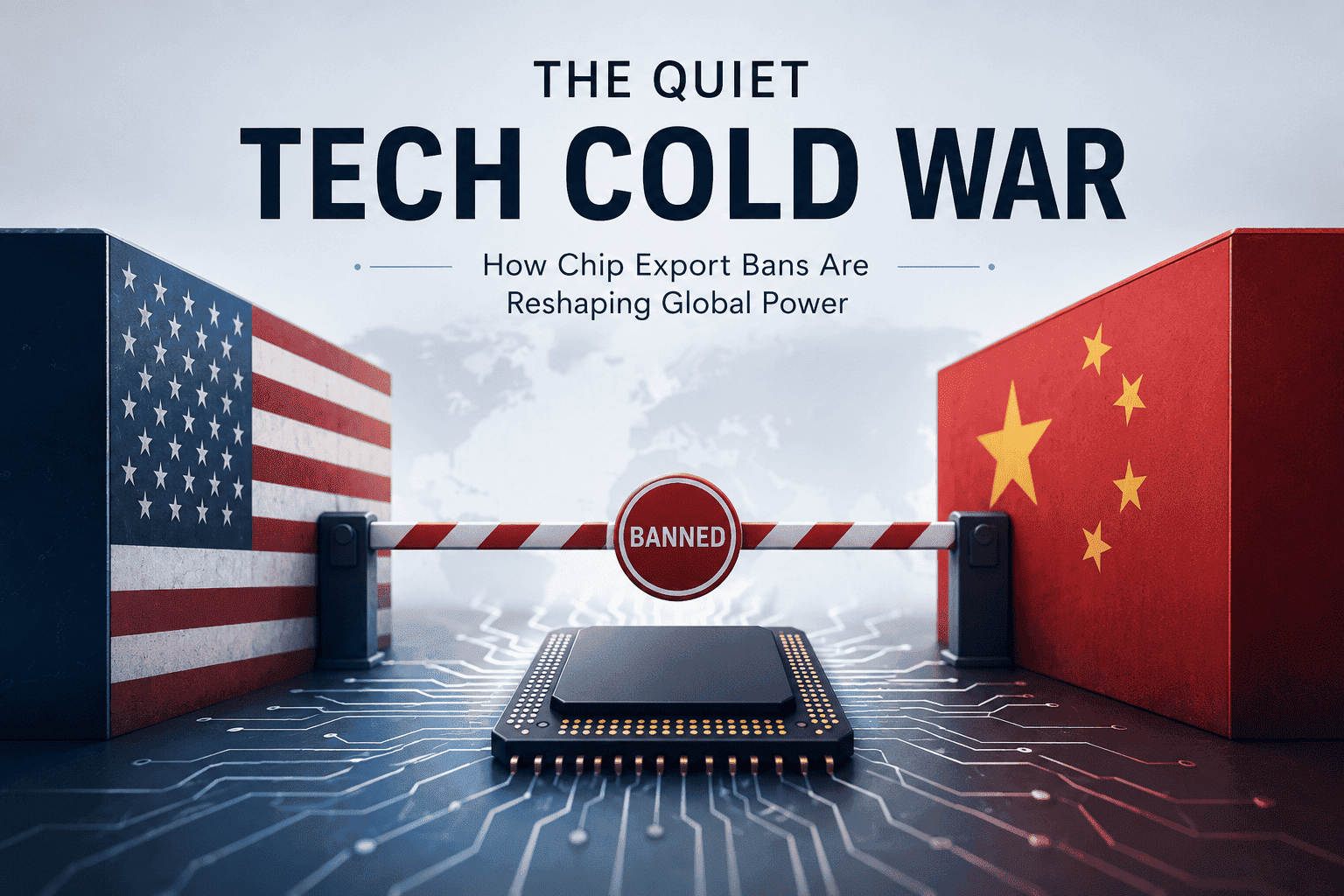
Somewhere in a nondescript office building in Washington, a licensing officer decides whether a single shipment of processors is allowed to leave the country. That one signature can move stock prices, slow down an AI lab on the other side of the planet, or quietly reroute a supply chain worth billions. Most people never see this happen. But it's happening constantly, and it's reshaping who gets to build the future.
This is the quiet tech cold war — a conflict fought not with soldiers but with export licenses, entity lists, and tiny slivers of silicon barely bigger than a fingernail.
MMM SO What's Really Going On?
Governments — mainly the United States, alongside allies like the Netherlands, Japan, and South Korea — restrict which advanced chips and chipmaking tools can be sold to rival countries, primarily China. The goal is to slow down a rival's ability to build cutting-edge AI systems, advanced weapons, and next-generation supercomputers. In practice, the rules keep shifting, companies find workarounds, and the restrictions ripple into everything from AI training runs to the price of your next laptop.
Why a Piece of Silicon Became a Geopolitical Weapon
Chips used to be a commercial story: who makes the fastest processor, who wins the smartphone market, who ships the best graphics card. That changed once it became clear that the same processors powering video games and cloud servers are also the engines behind modern AI models, missile guidance systems, and surveillance networks.
A chip doesn't care what it's used for. The exact same GPU that trains a chatbot can also help simulate a nuclear weapon design or crunch data for a military targeting system. Once policymakers realized that, semiconductors stopped being just a tech product and became something closer to enriched uranium — a dual-use material that's tightly, and sometimes clumsily, controlled.
If you follow global news and how nations compete for power, this is one of the clearest examples in decades of technology and geopolitics colliding in real time.
The Chokepoint Strategy
Nobody actually makes an advanced chip alone. The process is split across dozens of countries: chip design happens mostly in the US, the extreme ultraviolet lithography machines that etch circuits come almost entirely from one Dutch company, the actual fabrication is concentrated in Taiwan and South Korea, and packaging often happens in Southeast Asia. This is called a chokepoint strategy — instead of trying to ban a rival from having chips outright, you control the handful of narrow points every chip has to pass through.
It's a bit like trying to stop a river not by blocking the whole valley, but by damming the one narrow canyon it has to flow through.
Behind the Scenes: How an Export Ban Actually Works
Most articles talk about "chip bans" like they're a single switch someone flips. In reality it's a slow, bureaucratic, and constantly negotiated process. Here's roughly what happens:
- A performance threshold is set. Regulators define a technical line — measured in computing power or memory bandwidth — above which a chip is considered too advanced to export freely.
- Companies redesign chips to sit just under the line. This is exactly what happened when Nvidia engineered China-specific versions of its top chips to legally slip under the restriction.
- Regulators move the line again. Once a workaround chip becomes popular, the threshold gets redrawn, and the cycle repeats.
- Entity lists expand. Specific companies, foundries, and even research labs get added to blacklists that ban them from receiving controlled technology at all.
- Enforcement catches up later. Investigations into diverted shipments, shell companies, and third-country transshipment routes often surface months or years after the fact.
The official rulebook behind all of this is maintained by the U.S. Bureau of Industry and Security, the agency that actually writes and enforces these export regulations.
Who Controls What: The Global Chip Chokepoints
| Country / Region | What They Control | Why It Matters |
|---|---|---|
| United States | Chip design (Nvidia, AMD, Intel), export licensing rules | Sets the rules of the game and designs the most advanced AI accelerators |
| Taiwan | Advanced chip fabrication (TSMC) | Produces the overwhelming majority of the world's most advanced logic chips |
| Netherlands | Extreme ultraviolet lithography machines (ASML) | Without these machines, nobody can manufacture cutting-edge chips at scale |
| South Korea | Memory chips (Samsung, SK Hynix) | Controls a huge share of the DRAM and NAND that every data center needs |
| Japan | Chipmaking materials and specialized equipment | Supplies critical inputs the rest of the industry can't easily replace |
| China | Rare earth elements, domestic foundry buildout (SMIC), assembly | Retaliates by restricting materials the rest of the world needs, and races to build its own supply chain |
How This Actually Affects AI Development
AI models don't get smarter for free — they need massive clusters of high-end chips training for weeks or months. When a country's labs can't legaly access the newest processors, they either fall behind on raw compute or get creative.
China's response has been a mix of both. Some Chinese firms leaned on smuggled or gray-market chips routed through third countries. Others accelerated domestic alternatives from companies like Huawei, which has pushed its own AI accelerators as a substitute for restricted Nvidia hardware. The result isn't that AI development stopped — it's that it split into two increasingly separate ecosystems, each optimized around whatever hardware it can actually get.
The Unexpected Side Effect
Restrictions meant to slow a rival down have, in more than one case, accelerated their push for self-sufficiency. Export bans created a strong domestic incentive to stop depending on foreign chips entirely — which, longer term, could reduce the very leverage the restrictions were built on.
Military Technology: The Part Nobody Talks About Openly
The consumer-facing story is about chatbots and GPUs. The quieter story is about targeting systems, radar processing, autonomous drones, and simulation software used in weapons design — all of which lean on the same class of advanced processors. This is the actual national-security justification governments give for these controls, even when the public debate focuses almost entirely on AI chatbots and gaming cards.
Restricting chip access doesn't just slow a rival's next smartphone chip — it can directly limit how fast a country can iterate on missile guidance software, satellite systems, or next-generation radar. That's why these rules get treated with the same seriousness as arms control, not ordinary trade policy.
What It Means for Everyday Consumer Electronics
You don't need to work in defense policy to feel the ripple effects. Export controls and the countermeasures they trigger tend to show up in ordinary products a few different ways:
- Higher prices on high-end GPUs and laptops as manufacturers absorb tariffs, compliance costs, and shifting supply chains.
- Slower rollout of new hardware in restricted regions, since companies sometimes delay launches until licensing is sorted out.
- Regional product splits — the same phone or laptop brand selling a noticeably different, toned-down chip depending on which country you're in.
- Memory shortages that ripple into everything from game consoles to budget smartphones, since restricted regions also compete harder for the same memory supply.
If you follow the latest hardware and PC gaming news, you've probably already noticed graphics card pricing swinging around for reasons that have nothing to do with the actual cards themselves.
Pros and Cons of Chip Export Bans
| Pros | Cons |
|---|---|
| Slows a rival's access to the newest AI and military-grade hardware | Pushes that rival to build independent, harder-to-monitor domestic alternatives |
| Gives allied nations leverage in trade and security negotiations | Hurts revenue for chipmakers who lose access to a huge market |
| Can be tightened or loosened as a bargaining tool | Rules change so often that companies struggle to plan long-term investment |
| Signals a clear national-security stance to allies and adversaries | Encourages smuggling, shell companies, and third-country diversion schemes |
Verdict Box: Is This Actually Working?
Short answer: partially, and unevenly. Export controls have clearly forced China to spend enormous resources chasing domestic chip self-sufficiency rather than freely buying the best hardware on the open market — that's a real cost. But they haven't stopped Chinese AI progress outright, and enforcement gaps keep surfacing years after rules are written. The bans are less a wall and more a speed bump that occasionally gets rebuilt taller, then quietly patched with a detour around it.
Alternatives to Outright Bans
Export bans aren't the only tool on the table, and policymakers know it. A few alternative approaches keep coming up in the debate:
1. Tiered Licensing Instead of Blanket Bans
Rather than banning a chip outright, regulators allow limited, monitored sales under strict volume caps and end-use certification — essentially a controlled trickle instead of a closed tap.
2. Allied Coordination
Because chipmaking is so globally distributed, one country acting alone rarely works. Coordinating rules across the US, Netherlands, Japan, and South Korea closes far more loopholes than unilateral action.
3. Reshoring and "Friend-shoring"
Massive subsidies aim to build fabrication capacity inside allied countries so the whole industry depends less on any single chokepoint, Taiwan included.
4. Tariffs Instead of Hard Bans
Some policymakers prefer taxing advanced chip exports heavily rather than banning them, which keeps some revenue and market access flowing while still slowing volume.
Frequently Asked Questions
What is a chip export ban, in simple terms?
It's a government rule that blocks or restricts companies from selling certain advanced processors, or the tools used to make them, to specific countries or companies considered a national-security risk.
Why does the US control chip exports to China specifically?
Because advanced chips power both cutting-edge AI and military technology, and US officials view unrestricted access as a direct boost to a strategic rival's defense and intelligence capabilities.
Do export bans actually stop China from getting advanced chips?
Not completely. They slow legitimate access and raise costs significantly, but smuggling networks, redesigned "compliant" chips, and rapid domestic manufacturing investment all chip away at the restrictions' effectiveness over time.
How do chip bans affect regular consumers?
Mostly through pricing and availability — tariffs, compliance costs, and shifting supply chains tend to filter down into the cost of GPUs, laptops, and other electronics, even for buyers who have nothing to do with the geopolitics.
Which companies are most affected by chip export restrictions?
Nvidia and AMD face the most direct commercial impact since they design the highest-end AI accelerators. TSMC, Samsung, and SK Hynix are affected differently — through licensing requirements tied to their fabrication plants in China.
Is this considered a "cold war"?
Analysts increasingly describe it that way — not open conflict, but a sustained, strategic competition fought through technology access, trade policy, and industrial capacity rather than direct military confrontation.
Final Verdict
The chip export battle isn't a side story to global politics anymore — it's becoming one of the main storylines. Every new rule, workaround, and counter-rule reshapes who gets to build the most powerful AI systems on earth, and that increasingly determines economic and military advantage for decades to come.
For most readers, the takeaway isn't which country "wins." It's that the device on your desk, the AI tool you used this morning, and the price tag on your next graphics card are all quietly downstream of decisions made in licensing offices most people will never hear about.
Sources: U.S. Bureau of Industry and Security, Congressional Research Service via Congress.gov, Council on Foreign Relations, CNBC, and Al Jazeera.



Comments 0
Be the first to comment!