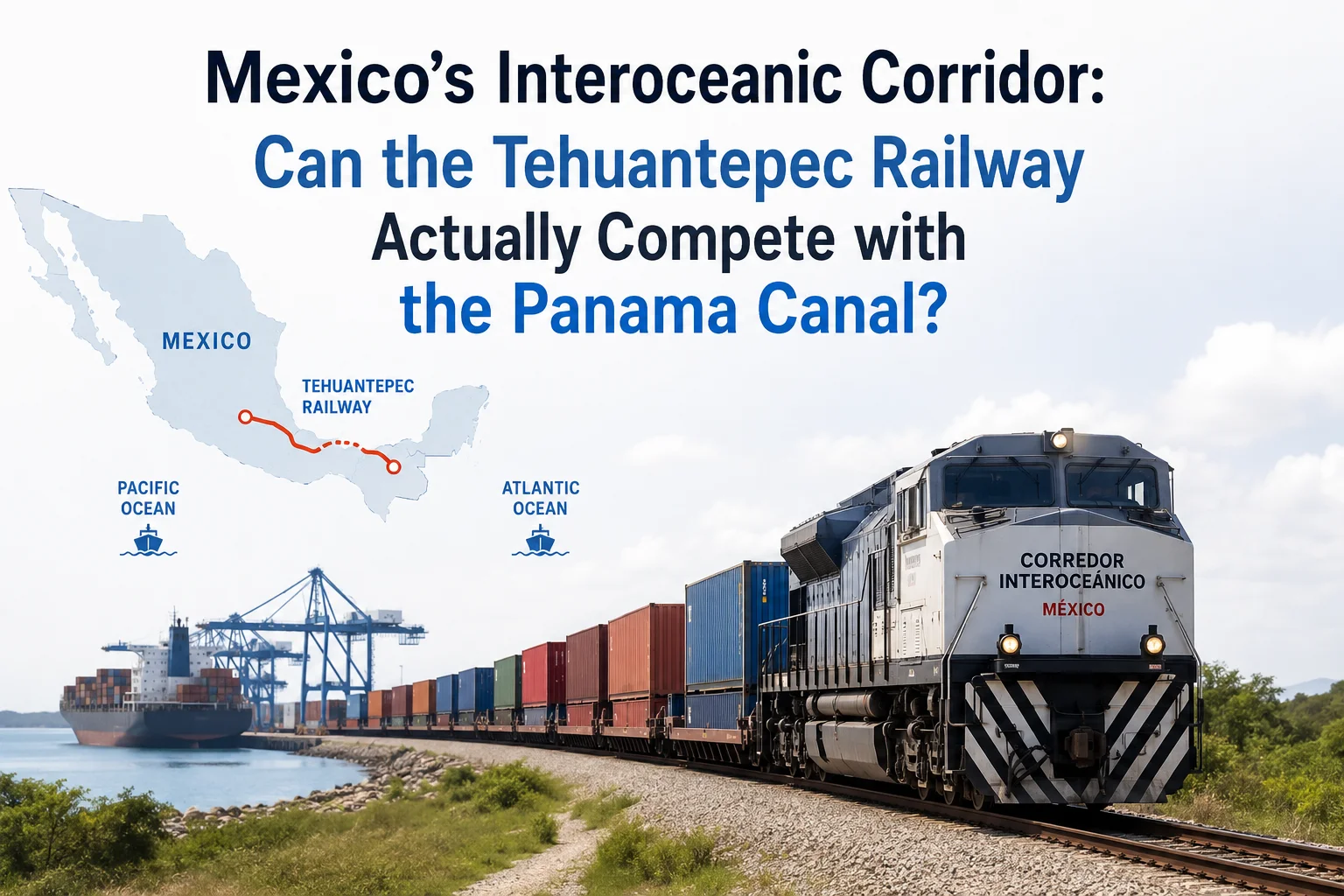
Somewhere in southern Mexico there's a train that isn't just a train. It's the closest thing North America has to a shortcut around one of the most stubborn engineering marvels on the planet — the Panama Canal. And before anyone gets excited, no, nobody is dragging a container ship over dry land on wheels. That's the first mistake almost every headline about this project makes, and it's exactly why the real story is more interesting than the "Mexico builds Panama Canal killer" version you've probably seen shared around.
The honest version involves cranes, customs stamps, two seperate ships, a Mexican Navy logistics unit, and a drought in Central America that just would not go away. Let's actually unpack it.
What Mexico Actually Built (and What It Didn't)
The Interoceanic Corridor of the Isthmus of Tehuantepec, known locally as the CIIT, is a 303-kilometer (188-mile) rail line connecting the Pacific port of Salina Cruz, Oaxaca, with the Gulf port of Coatzacoalcos, Veracruz. It runs across the narrowest strip of land in Mexico, which is exactly why colonial-era Spain and later 19th-century engineers kept eyeing it as a canal site and never pulled it off.
This time it's rail, not a waterway. Freight trains on the line can move roughly 5,200 tonnes of cargo per train across 65 railcars. The wider project — officially due for full completion around mid-2026 according to statements from President Claudia Sheinbaum — also includes port expansions at Salina Cruz and Coatzacoalcos, two more ports (Dos Bocas and Puerto Chiapas), highway upgrades, and around a dozen industrial parks branded as "Development Poles for Wellbeing." One detail that surprises a lot of people: the whole platform is run by Mexico's Secretariat of the Navy, not a private rail operator or a civilian port authority.
Why Panama Is Suddenly Vulnerable Again
Here's the part that makes this comparison timely instead of theoretical. In late August 2026, the Panama Canal Authority announced it would cap daily transits starting September 4, walking back an earlier promise not to restrict traffic this year. Neopanamax lock slots are being limited to nine per day, older Panamax locks to 25, dropping to 23 by mid-September. NOAA is forecasting a strong El Niño event through late 2026 and into 2027, and the canal's administrator has openly said this dry season could last longer than the historic 2023–2024 drought that cut daily transits as low as 18 ships in February 2024.
That earlier drought is still the reference point everyone in shipping uses. Gatun Lake — the freshwater reservoir that literally floats ships through the locks — dropped to 79.6 feet in August 2023, forcing the Panama Canal Authority to slash both daily transits and vessel draft limits for the better part of two years. Toll surcharges followed. So did long queues of ships waiting offshore, sometimes over 200 at once.
Panama's Transit Cap Timeline (A Pattern Worth Watching)
| Period | Daily transit cap | Trigger |
|---|---|---|
| Normal operations | 36–40 vessels | Standard capacity |
| August 2023 | 32 vessels | First 2023 El Niño drought cuts |
| September 2023 | 31 vessels | Continued rainfall deficit |
| November 2023 | 24 vessels | Gatun Lake near record lows |
| February 2024 | 18 vessels | Record-low daily cap |
| Mid-2025 | ~35 vessels | Recovery after lakes refilled |
| September 4, 2026 | 34 vessels | New El Niño watch, precautionary cap |
| September 15, 2026 | 32 vessels | Further tightening as forecasts worsen |
Notice the pattern: Panama isn't broken, but it's clearly nervous, and it's acting before the water actually runs low this time instead of waiting for a crisis. That caution is precisely what's giving Mexico's corridor its opening — not because the train is faster, but because shippers hate not knowing.
Head-to-Head: Two Very Different Machines
| Factor | Panama Canal | Interoceanic Corridor (CIIT) |
|---|---|---|
| Distance | ~82 km (51 miles) of waterway | 303 km (188 miles) of rail |
| Core transit time | 8–10 hours, ship never stops | ~9–15 hours by rail, plus port handling on both ends |
| Annual volume today | ~13,400 vessels; ~600 million tons of cargo | Target of ~1.4 million containers/year once ramped up |
| Max vessel size | Up to ~17,600 TEU (Neopanamax locks) | Not applicable — cargo is transloaded, not the ship itself |
| Main weakness | Fresh water dependency, El Niño droughts | Double cargo handling, port and rail capacity still scaling |
| Investment scale | $5.7B in FY2025 revenue alone | ~$2.8B for the rail line; ~$7.5B for the full corridor |
Why a Train Isn't a Canal, No Matter How Fast It Runs
This is the "behind the scenes" part that gets glossed over in most coverage. A ship crossing Panama never touches its cargo — containers stay stacked, sealed, and untouched from Shanghai to Savannah. Cargo crossing Mexico's isthmus has to be craned off a ship at Salina Cruz, loaded onto rail cars, hauled 188 miles, craned back onto a different ship at Coatzacoalcos, and re-documented for a second leg of ocean transit. Every one of those handoffs adds cost, paperwork, insurance liability, and a chance for something to go wrong.
It's a similar dynamic to how global supply chains have quietly rebuilt themselves around physical chokepoints that most people never think about — a handful of narrow crossings that the entire system quietly depends on, and that become a very big deal the moment something interrupts them.
The Real-World Test: Hyundai's 900 Vehicles
The best evidence the corridor actually works came from an unglamorous test run this spring. Hyundai Glovis shipped 900 vehicles from South Korea to Salina Cruz, loaded them onto 50 specially built BI-MAX rail wagons, and moved them across the isthmus to Coatzacoalcos in roughly nine hours. From there, a second vessel carried the cars to Brunswick, Georgia — Korea to the US East Coast in about 72 hours total. It was the first real international commercial test of the corridor at scale, and it worked. That said, vehicles are relatively easy cargo to transload compared to a stack of 40-foot containers, which is an important distinction shippers keep bringing up.
Where Mexico Actually Has an Edge
- No water dependency — rail doesn't care about rainfall in a Central American watershed.
- Shorter final-mile distance to major US Gulf and East Coast ports compared to a full Panama transit for some Asia-to-US cargo.
- Fits neatly into the nearshoring wave already reshaping supply chains, the same logic pushing companies to diversify manufacturing the way India and Vietnam are competing for Apple's supply chain instead of leaving everything in one place.
- Tax incentives and industrial parks along the route are pulling in manufacturing investment on their own merits, independent of whether the rail line ever beats Panama on price.
- Works as an insurance policy, not unlike how chipmakers are building fabs outside Taiwan as an expensive hedge against geopolitical risk rather than expecting those plants to replace the original ones.
Where Panama Still Wins, Hands Down
- Scale. Panama moves roughly 600 million tons of cargo a year; the corridor's own container target is a fraction of that.
- One continuous transit beats two ship legs plus a rail leg for almost any cost calculation involving standard containers.
- Decades of shipping-line schedules, terminal contracts, and crew familiarity are already built around Panama.
- It handles mega-ships. Nothing about rail transloading works for a 17,000-TEU containership's full load in one go.
- Panama isn't standing still either — the Panama Canal Authority is reportedly auctioning rights to two new ports inside its own zone specifically to stay competitive against alternatives like this one.
The Container Math That Actually Matters
Numbers put this in perspective fast. Panama's own ports handled 9.9 million TEU in 2025. The canal itself carried over 600 million metric tons of cargo across roughly 13,400 vessel transits. The CIIT's stated ambition is around 1.4 million containers a year once fully operational — meaningful, but nowhere close to a replacement figure. This is a pressure valve for overflow and a diversification play, not a rival at Panama's scale, at least not for a long while.
Customs, Cargo Handling, and the Boring Stuff That Decides Everything
The parts that actually determine whether a shipping line commits to this route rarely make headlines. Mexican customs procedures on both coasts, crane and yard capacity at Salina Cruz (still being expanded), how well the corridor's rail gauge and scheduling integrates with US freight networks heading north, and who's liable for cargo during each handoff — these are the details freight forwarders lose sleep over. Land disputes during construction near the rail corridor also had to be resolved with local communities, something the previous administration publicly acknowledged when the line opened in 2023.
So, Can It Actually Compete?
Verdict: Not as a replacement — as a release valve, yes, and an increasingly useful one. The corridor won't take meaningful market share from Panama for full containerships anytime soon; the transloading penalty is too real and the scale gap too wide. But for automotive cargo, general freight, and shippers who got burned by 2023–2024 draft restrictions and want a second option that doesn't depend on rainfall, Mexico now offers something that genuinely didn't exist three years ago. Reliability, not raw speed, is the corridor's actual selling point.
What Shippers Should Actually Watch
- Track Panama Canal Authority draft and transit announcements each El Niño season — they now move faster and more cautiously than in 2023.
- Treat the corridor as strongest for vehicles, refrigerated cargo, and general freight, not as a fit for megacontainership volumes.
- Watch Salina Cruz port crane and berth upgrades closely; the rail line was finished well before the ports fully caught up.
- Factor in double transloading costs and documentation time when comparing quoted "transit time" numbers between the two routes.
- USMCA-driven nearshoring investment, not canal competition, is quietly the bigger long-term story behind the corridor's industrial parks.
- For Asia-to-Europe trade, this corridor changes nothing — Suez and the Cape of Good Hope remain the relevant alternatives there, not Mexico.
So no, nobody actually rolled a cargo ship across Mexico on rails, and nobody's trying to. What's happening instead is quieter and, honestly, a bit more useful: a second option finally exists for a route that used to have exactly one. Whether that occured a decade too late or right on time probably depends on how the next El Niño season plays out.

Comments 0
Be the first to comment!