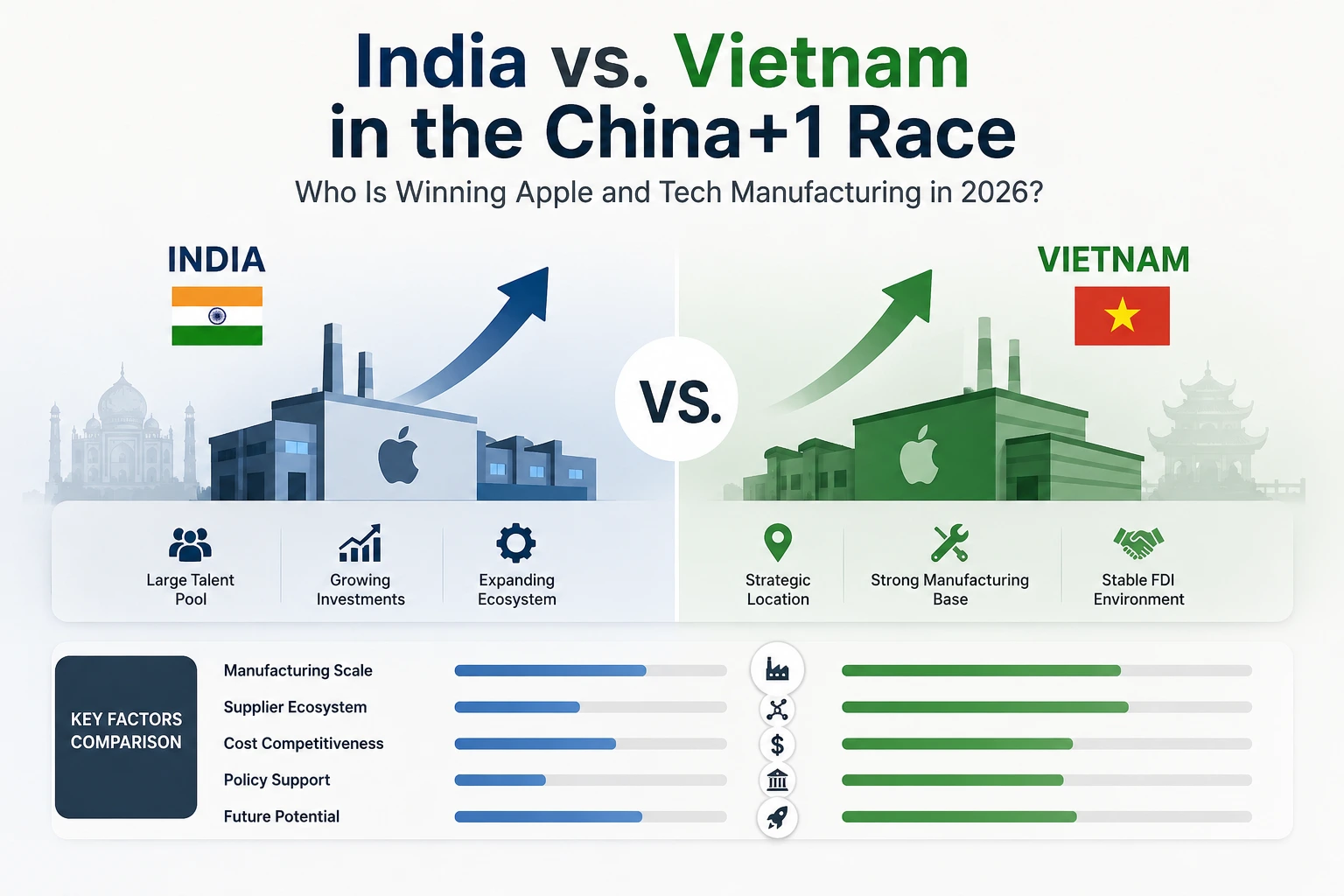
Walk into a Foxconn plant in Sriperumbudur, Tamil Nadu, and you'll find workers snapping aluminum unibodies onto logic boards that, five years ago, only ever existed in Zhengzhou. Walk into a Luxshare facility in Bac Ninh, Vietnam, and you'll find an almost identical scene — except the boxes leaving the loading dock say AirPods, not iPhone. Apple didn't pick a single winner in the China+1 race. It handed India and Vietnam two completely different jobs, and in 2026 both countries are quietly getting very good at theirs.
This isn't another "China is losing, everyone else is winning" piece. It's a look at what the actual production numbers say, product by product, and why the India-vs-Vietnam question doesn't really have one answer.
Okay let's jump to Fast Answer First
India is winning the iPhone. Vietnam is winning almost everything else Apple makes. India's share of global iPhone assembly climbed from roughly 14% in 2024 to about 23% in 2025, and is tracking toward 26–28% by the end of 2026. Vietnam, meanwhile, already builds an estimated 65% of the world's AirPods, around a fifth of iPads and Apple Watches, and has just been picked as the launch base for Apple's first new smart-home product line. Neither country has replaced China — they've each taken a specific slice of it.
Now The China+1 Race, in One Sentence
Companies aren't leaving China, they're refusing to depend on only China — a strategy we broke down in detail in our earlier look at why global supply chains are quietly shifting away from China. Apple is simply the clearest, best-documented example of that strategy in action, because unlike most manufacturers, Apple actually tells investors roughly where its products come from.
India's Playbook: Win the iPhone, Win the Headlines
The Numbers Behind India's Climb
Apple assembled about 55 million iPhones in India in 2025, up from 36 million the year before — a 53% jump, according to Bloomberg. Out of Apple's total global output of roughly 220–230 million iPhones a year, that puts India at close to a quarter of the entire lineup. Industry trackers now put India's 2026 share somewhere between 26% and 28%, up from 23% in 2025 and just 14% in 2024, while China's own share of iPhone assembly fell from 83% to 74% over the same stretch.
Behind those numbers sits real infrastructure, not just spreadsheet reshuffling. Foxconn opened a $500 million component and assembly campus in Bengaluru, Karnataka in August 2026, and Tata Electronics — an Indian conglomerate that didn't even make phone components a few years ago — has since absorbed both Wistron's and Pegatron's Indian operations. That's a genuinely unusual move: a domestic company effectively buying its way into Apple's supply chain rather than Apple simply outsourcing to more foreign contract manufacturers.
Why Apple Is Paying More to Build in India — On Purpose
Producing an iPhone in India still costs somewhere between 5% and 10% more than producing the same phone in China, mainly because India's component ecosystem — screws, connectors, sub-assemblies — is still maturing. Apple is absorbing that gap anyway, and the tariff math explains why: iPhones assembled in China have faced import duties as high as 55% entering the US market at points in 2026, while India-assembled units have been assessed closer to 10%, according to Tech Wire Asia. When a tariff gap that wide sits on top of hundreds of millions of units a year, a 5-10% higher factory cost stops looking like a problem and starts looking like a rounding error.
None of this happened by accident. India's Production-Linked Incentive scheme, run through the Ministry of Electronics and IT, has offered manufacturers a 4-6% incentive on incremental electronics sales since 2020, and the government has since layered on a separate component-manufacturing scheme worth billions more, according to the Press Information Bureau of the Government of India. It's industrial policy doing exactly what it was designed to do.
Vietnam's Playbook: Own Everything That Isn't an iPhone
AirPods, iPads, Watches, and Now a Brand-New Product Line
Here's the thing most "India vs Vietnam" headlines skip: the iPhone barely exists on Apple's official "Made in Vietnam" product list. What does exist there is almost everything else. By the end of 2025, Vietnam was on track to produce roughly 65% of the world's AirPods, about 20% of iPads and Apple Watches, and around 5% of MacBooks, according to Vietnam Briefing. Apple now works with more than 35 suppliers in the country, up from just 18 in 2016, making Vietnam its largest production base in Southeast Asia and the fourth-largest globally, behind only China, Taiwan, and Japan.
Foxconn alone has poured roughly $4 billion into five Vietnamese localities and employs around 80,000 workers there. A newer Bac Giang facility, backed by a $508 million investment, is being built specifically to mass-produce MacBooks and iPads at a capacity of up to 16 million devices a year. And in one of the more telling moves of 2026, Apple chose Vietnam — not India, not China — as the launch base for its first entirely new hardware category in years: an AI-enabled home security camera and a motorized "tabletop robot," reportedly assembled with help from Chinese EV maker BYD.
Vietnam's Quiet Advantage
Vietnam's edge isn't cheaper labor than India's — it's a head start. Companies started qualifying Vietnamese suppliers years before "China+1" became a boardroom phrase, partly as a hedge from earlier US-China trade disputes going back to 2018. That means Vietnam already has the unglamorous stuff most headlines never mention: trained line workers, customs relationships, and — critically — geographic proximity to Chinese component suppliers, since Vietnam's northern industrial belt sits right on the Chinese border. Tim Cook has said publicly that while most US-bound iPhones now trace back to India, nearly all US-bound iPads, Macs, Watches, and AirPods carry Vietnam as their country of origin.
India vs. Vietnam: Head-to-Head in 2026
| Category | India | Vietnam |
|---|---|---|
| Apple's main product | iPhone (~26-28% of global output) | AirPods (~65%), iPad & Watch (~20%), MacBook (~5%) |
| Cost vs. China | 5-10% higher | Competitive, often lower on labor |
| Key advantage | Huge workforce, PLI subsidies, lower US tariff exposure on finished phones | Mature electronics ecosystem, proximity to China, years of prior investment |
| Key weakness | Component base still maturing, subsidy programs need renewal | Still imports roughly 80% of components from elsewhere, including China |
| 2026 milestone | Foxconn's $500M Bengaluru campus; Tata absorbs Wistron and Pegatron's India units | Chosen as launch base for Apple's first new smart-home hardware line |
| Global manufacturing rank (Apple) | Fast-rising, second only to China for iPhones | 4th largest overall, after China, Taiwan, Japan |
Pros and Cons
India
- Pro: Massive, still-growing workforce and domestic market big enough to justify local capacity on its own.
- Pro: Government incentives directly targeted at exactly the products Apple builds.
- Pro: Lower tariff exposure on the single most valuable product Apple sells.
- Con: Still assembling more than manufacturing — many components still travel in from China or elsewhere first.
- Con: Higher per-unit costs than China, absorbed by Apple rather than by consumers, for now.
Vietnam
- Pro: Broadest product range of any China alternative — not just phones, but audio, wearables, laptops, and now smart-home devices.
- Pro: Years of head start means a more mature supplier and logistics base than India's.
- Pro: Physical proximity to China keeps the component supply chain short.
- Con: That same proximity is a dependency — roughly 80% of Vietnam's electronics components are still imported.
- Con: Smaller domestic workforce and market than India, which caps how far it can scale relative to its neighbor.
What China Still Controls
None of this makes China irrelevant — not even close. China still dominates the parts of the supply chain that are genuinely hard to relocate: advanced chip fabrication, precision components, and the sheer density of specialized sub-suppliers that took decades to cluster together. Huawei's ability to keep shipping a competitive 5nm chip despite years of US sanctions is a case study in exactly how deep that domestic capability now runs — we covered the mechanics of that in our piece on how Huawei built a 5nm chip despite US sanctions.
The same pattern shows up at the frontier of chipmaking, where China is racing to close the gap in leading-edge nodes, a story we tracked in our breakdown of the 2nm chip race between China and the West. And because export licensing rules can reroute a multi-billion-dollar supply chain overnight, it's worth understanding how chip export bans are reshaping global power before assuming any single country has "won" anything permanently.
So Who's Actually Winning?
Short answer: it's a split decision, and that's by design. India is winning the fight for Apple's single most valuable and most politically sensitive product, the iPhone, largely because tariff math and government subsidies both point the same direction. Vietnam is winning the fight for volume and product diversity — it simply makes more different kinds of things, and has been doing it longer. If you're grading strictly on "which country carries more of Apple's revenue," India is closing the gap fast. If you're grading on "which country is more deeply woven into Apple's actual operations," Vietnam still has the edge, at least for now.
Alternatives to Watch: The Countries Not Getting the Headlines
Mexico
Mexico isn't chasing Apple's electronics business the way India and Vietnam are — its pitch is speed and USMCA tariff advantages for automotive and appliance parts headed to the US. It's less relevant to Apple specifically, more relevant to the broader China+1 story we cover in our supply chain piece linked above.
Indonesia
Indonesia has the population and the government appetite to eventually compete with both India and Vietnam, but its electronics infrastructure and logistics network are still meaningfully behind. It's a name worth watching for 2027 and beyond, not 2026.
The Wildcard: Reshoring to the US
Politically popular, heavily subsidized in select sectors, and still nowhere close to reversing the underlying economics. Independent trackers have consistently shown reshoring lagging offshoring in most electronics categories — the cost gap remains too wide for anything beyond final-stage or highly automated assembly.
3 Ways to Actually Track This Shift Yourself
- Check the box, not the branding. Every Apple device lists its country of assembly on the packaging and in Settings → General → About. It's the single fastest way to see this trend playing out in your own hands.
- Watch Apple's quarterly earnings calls, not just press releases. Tim Cook now routinely references country-of-origin shifts directly on earnings calls, which is often where the real numbers surface before anyone reports on them.
- Follow supplier stock movements, not just Apple's. Foxconn, Tata Electronics, Luxshare, and Goertek all move on this news well before it becomes mainstream tech coverage.
Frequently Asked Questions
Does Apple still make iPhones in China?
Yes, and it still makes the majority of them there — China's share was around 74% in 2025. India is growing fast, but it hasn't come close to replacing China as the primary iPhone production base.
Is Vietnam better than India for tech manufacturing?
"Better" depends on the product. Vietnam has more experience and a broader product range across Apple's lineup; India has newer infrastructure but is scaling faster on the single highest-value product, the iPhone. Neither has actually overtaken the other overall.
Will India ever fully replace China for iPhone production?
Unlikely in the near term. Even optimistic industry forecasts only put India's share in the 30-35% range by 2027, and China's deep component ecosystem gives it advantages that are hard to replicate quickly, whatever the tariff situation looks like.
Why doesn't Apple just move iPhone assembly to Vietnam too?
It's partly happening at the margins, but India's sheer workforce size, government incentives, and lower finished-device tariffs currently make it the more efficient bet for iPhone specifically, while Vietnam's strengths line up better with Apple's smaller, more component-diverse products.
What does this mean for iPhone and Apple product prices?
Don't expect a dramatic swing either way in the short term. Apple has largely absorbed the cost difference of manufacturing outside China rather than passing it directly to consumers, though that could shift if tariff rules change again or if India's component base keeps maturing and closes the cost gap on its own.
Let's talk about final result
the real story here isn't a winner and a loser — it's specialization. India took the highest-stakes, highest-volume product and built an entire domestic policy apparatus around winning it. Vietnam took everything else and leaned on a head start nobody else had. Both strategies are working, and both still run straight through China for components neither country has fully replaced yet. That's the part most "India vs Vietnam" takes leave out, and it's exactly the pattern we've been tracking across the wider China+1 diversification story all year.
Sources: Bloomberg, Press Information Bureau, Government of India, Vietnam Briefing, Tech Wire Asia, and National Herald India.



Comments 0
Be the first to comment!