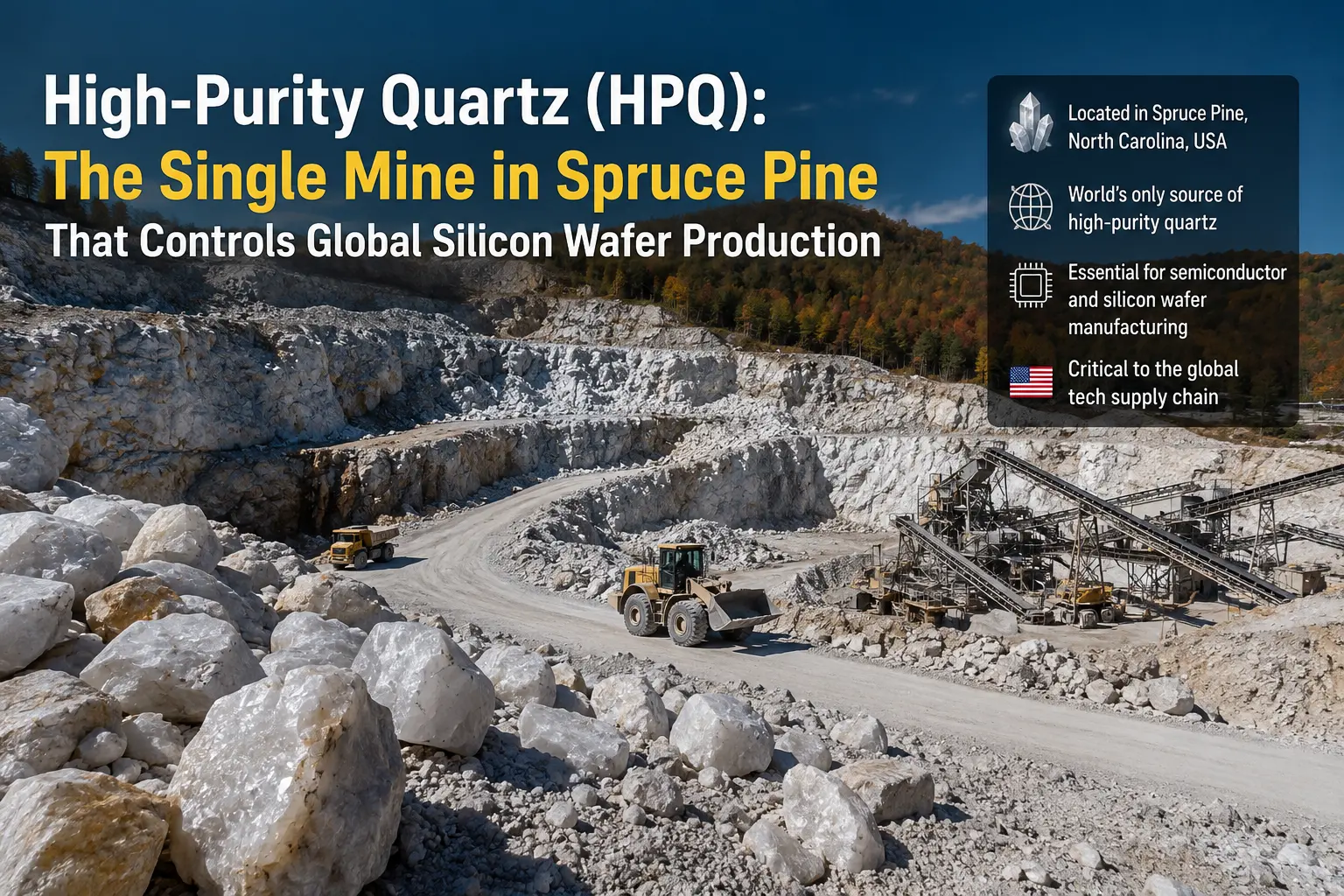
Somewhere in the misty hills of western North Carolina there's a road so unremarkable that most GPS apps wouldn't even suggest a detour to see it. No skyscraper. No flashing sign. Nothing that screams "this thing decides whether your next phone gets made." And yet, in a roundabout and slightly ridiculous way, it kind of does.
Welcome to Spruce Pine, population a few thousand, home to a mineral so boring-sounding that it's almost funny how much the entire semiconductor industry quietly depends on it.
The Rock That Nobody Brags About
Quartz is not exotic. It's one of the most common minerals on the planet, sitting in beach sand, kitchen countertops, and half the rocks you've ever stepped over without noticing. So why does one patch of Appalachian mountainside get treated like a national security asset?
Because almost none of that common quartz is pure enough for what modern chipmaking needs. Regular quartz is loaded with trace metals — iron, aluminum, sodium, potassium — at levels that are totally fine for glass or countertops but completely unacceptable when you're trying to grow a flawless silicon crystal.
Spruce Pine's quartz, once processed, routinely gets down to single-digit parts per million of metallic impurities. That is an almost absurd level of cleanliness for a rock pulled out of a mountain.
How Clean Is "Clean," Really?
| Quartz Grade | Typical Use | Metallic Impurity Level | Rough Price Range |
|---|---|---|---|
| Industrial silica sand | Glass, concrete, construction | Thousands of ppm | A few dollars per ton |
| Standard high-purity quartz | Optics, lab glassware, lighting | Roughly 20–50 ppm | Hundreds of dollars per ton |
| Semiconductor-grade HPQ | Crucibles for silicon wafer growth | Under 10 ppm, some grades near single digits | Several thousand dollars per ton and up |
These numbers are industry approximations, not published price sheets — the two companies that dominate this supply chain treat their output figures like state secrets, which is a theme you'll notice repeating throughout this whole story.
Why a Crucible Even Matters
Here's the part that surprises most people: the quartz doesn't end up inside your phone's chip. It never touches the final product at all. Instead, it becomes the crucible — the container that holds molten silicon during the process that actually creates the silicon ingot chips are sliced from.
That process is called the Czochralski method, named after the Polish scientist who accidentally invented it in 1916 (he dipped his pen into molten tin instead of an inkwell, according to the popular version of the story, and pulled out a thin thread of solid metal). Today it's how virtually every monocrystalline silicon ingot in the world gets made.
A chunk of polysilicon is melted at roughly 1,420°C inside a quartz crucible. A tiny seed crystal is dipped into the melt, then slowly pulled upward while rotating, over the course of about a week, dragging a column of perfectly ordered single-crystal silicon behind it. That ingot is later sliced into the wafers that become every processor, memory chip, and sensor you've ever used.
- Quartz mined and refined into HPQ sand
- HPQ sand fused into a crucible
- Crucible holds molten polysilicon at extreme heat for days
- Seed crystal pulled upward to form a single-crystal ingot
- Ingot sliced into wafers
- Wafers fabricated into finished chips
If the crucible leaches even trace amounts of the wrong element into that melt, the crystal structure gets disrupted and the resulting wafer is essentially garbage. This is why, as researchers have noted in a peer-reviewed review in Solar Energy Materials and Solar Cells, crucible chemistry is treated as one of the most sensitive variables in the entire crystal-growing process.
A 380-Million-Year-Old Coincidence
None of this was planned by anyone. What makes Spruce Pine's deposit special goes back roughly 380 million years, to the Devonian period, when granite magma pushed into ancient metamorphic rock in the region and cooled extremely slowly, deep underground, in an unusually dry environment.
That slow, water-poor cooling matters enormously. Most quartz forms with tiny fluid inclusions trapped inside the crystal — microscopic pockets of liquid carrying dissolved minerals that later contaminate anything the quartz touches when it's heated. Spruce Pine's pegmatite quartz grew with remarkably few of these inclusions, which is the geological accident behind its natural cleanliness.
It's the same tectonic collision that built the Appalachian Mountains, tied to the closure of the ancient Iapetus Ocean, so in a very literal sense, Spruce Pine's quartz and the mountains sitting on top of it were born in the same slow-motion continental crash.
Why Can't Norway or Brazil Just Copy It?
Both countries do have quartz deposits being explored for high-purity potential, and it's not that the geology is impossible to find elsewhere. The problem is scale and consistency. Spruce Pine's deposit is unusually large, unusually uniform, and has thirty-plus years of refining infrastructure already built around it. A new site would need years of exploration, permitting, and processing buildout before it could reliably hit semiconductor-grade purity at commercial volume — and that's assuming the geology cooperates at all, which isn't guaranteed.
Two Companies, One Very Quiet Industry
Almost the entire global supply of semiconductor-grade HPQ moves through exactly two operators in Spruce Pine: Sibelco, a Belgian company that grew its position through its Unimin and Covia acquisitions, and The Quartz Corp, a joint venture between Norway's Norsk Mineral and France's Imerys.
Industry estimates, including analysis referenced on Wikipedia citing BloombergNEF research, put the region's share of the world's high-purity quartz sand at somewhere around 80 percent of what the global semiconductor and solar industries need.
Neither company publishes annual production tonnage. Contractors who work inside the facilities reportedly sign confidentiality agreements, and the companies are known to rotate work across different crews so no single outside party gets a full picture of the operation. It's an oddly cloak-and-dagger vibe for an industry that, on paper, just digs up rocks.
Who Touches the Quartz Before It's a Chip
| Stage | Role | Example Companies |
|---|---|---|
| Mining & refining | Extract and purify raw HPQ | Sibelco, The Quartz Corp |
| Crucible manufacturing | Fuse HPQ sand into crucibles | Shin-Etsu Quartz Products, Momentive Technologies, CoorsTek |
| Crystal growth | Run the Czochralski process | SUMCO, Shin-Etsu Handotai, GlobalWafers |
| Chip fabrication | Turn wafers into finished chips | TSMC, Samsung, Intel |
If you're curious how that last stage actually works, we've broken down what a chip foundry actually is in plain terms elsewhere on the site — it's a good companion read to this one.
When the Storm Actually Hit
This isn't a hypothetical worry. In September 2024, Hurricane Helene tore through western North Carolina and directly hit Mitchell County. Both major operators halted work — Sibelco confirmed disruptions to its facilities, and The Quartz Corp told reporters it had no clear timeline for restarting operations after stopping on September 26th.
The story got picked up fast by outlets like NPR, partly because journalist and author Ed Conway, whose book "Material World" had already popularized the Spruce Pine story, pointed out that without this specific quartz, the crucibles simply can't be made the same way, and that purity genuinely is the whole game — a single atom out of place can derail an entire production run.
In the end, physical damage to the mines themselves was limited compared to the surrounding region, and operations restarted within weeks. But for a tense stretch, chip industry analysts and financial media were seriously modeling what a prolonged shutdown could do to global wafer supply. That's a strange amount of leverage for one Appalachian county to hold.
Trying to Build a Plan B
Synthetic quartz does exist. Companies including Japan Super Quartz already produce lab-grown crucible material as an alternative to natural HPQ.
- Pros of natural Spruce Pine quartz: naturally reaches extreme purity without expensive synthetic processing, decades of proven supply relationships, and it's still far cheaper than manufactured alternatives.
- Cons of natural Spruce Pine quartz: almost the entire global supply funnels through two companies in one county, production data is kept deliberately opaque, and the region is exposed to weather events like Helene.
Synthetic quartz typically costs somewhere in the range of five to ten times more than natural Spruce Pine material. For semiconductor wafers, chipmakers can often absorb that premium since the silicon ingot itself is a relatively small slice of a chip's total production cost. For solar panel manufacturing, which can require tens of tonnes of quartz per gigawatt of wafers produced, that markup is currently too expensive to make sense at scale.
Other approaches — crucible-free methods like Float-Zone silicon growth, or exploring silicon nitride and silicon carbide as crucible materials — are being researched, but none of them have reached the scale needed to seriously replace HPQ crucibles across the industry any time soon.
Things Worth Knowing Before You Repeat This At A Dinner Party
- Not all quartz counts as "high purity." Most beach sand and quarry rock never gets close to qualifying, no matter how clean it looks.
- Crucibles are largely single-use. Once a growth cycle finishes, the crucible is typically discarded rather than reused.
- It's not total impurity that matters most, it's specific elements — iron, aluminum, sodium, and potassium are the main culprits that ruin a silicon melt.
- This dependency isn't unique to chips. Solar panel manufacturers rely on essentially the same crucible material and the same handful of suppliers.
- Alternative deposits in Norway and Brazil are being explored, but neither has reached Spruce Pine's combination of scale, consistency, and existing infrastructure.
How This Fits the Bigger Chokepoint Pattern
Spruce Pine isn't really a one-off story. It fits a pattern that shows up across modern supply chains, where a huge, complex global industry quietly rests on a tiny, easy-to-overlook bottleneck. We've seen a version of this same dynamic in how rare earth refining gets concentrated in just one country, and again in the small handful of undersea cables carrying most of global internet traffic. Chips, magnets, and internet data all travel through surprisingly narrow physical bottlenecks once you trace them back far enough.
It also connects to the wider reshuffling happening in chip manufacturing itself, including TSMC's expansion outside Taiwan, since new fabs being built anywhere in the world still ultimately need wafers grown using crucibles that trace back to the same North Carolina mountainside.
High-purity quartz from Spruce Pine isn't glamorous, and it isn't rare in the way diamonds or rare earth elements are marketed as rare. It's rare in a much more inconvenient way — geologically uncommon at the exact purity level an entire global industry quietly requires, with almost no viable substitute at scale. Until synthetic alternatives get dramatically cheaper, or a new deposit gets developed to the same standard, this single stretch of Appalachian mountains will keep punching absurdly far above its weight.
One Last Thought
It's genuinely funny, in a slightly unsettling way, that the thing standing between "world has enough chips" and "world does not have enough chips" isn't some futuristic material science breakthrough. It's a few thousand acres of quartz-bearing mountain that's been sitting there, undisturbed, since long before anything resembling a human walked past it. Chip fabs get built for tens of billions of dollars, wrapped in the most advanced engineering humanity has ever produced — and every single one of them is, at the very start of the chain, quietly counting on a rock from a small North Carolina town nobody outside the industry had heard of until a hurricane made headlines.
As reported by The New York Times, locals in the area have grown used to their sleepy town occasionaly being described as the secret linchpin of the modern tech economy — a description that a Wharton professor once summed up even more bluntly, as covered by Tom's Hardware, by suggesting the modern economy effectively rests on a single road leading to a single facility.



Comments 0
Be the first to comment!