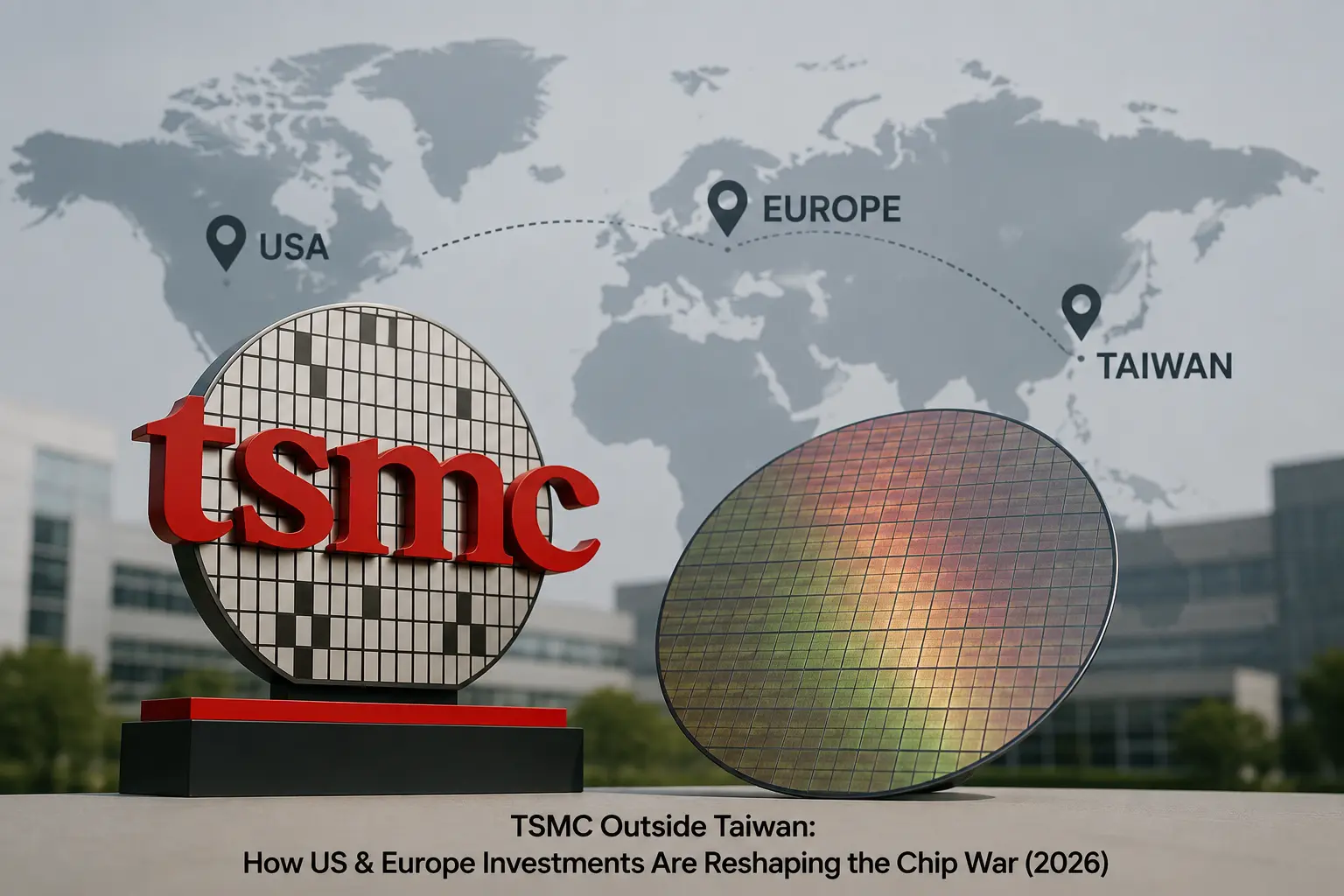
TSMC is not moving away from Taiwan — it is duplicating a slice of its capacity abroad while keeping every leading-edge node at home. By 2026, Arizona is producing 4nm chips profitably, Germany's Dresden fab is rising for older automotive nodes, and Japan's Kumamoto site just survived a magnitude-7.1 earthquake that reminded everyone why "diversification" still has limits. The real story isn't replacement. It's insurance, and insurance is expensive.
The news often says that TSMC is leaving Taiwan for the US, or that Europe is winning the microchip race. But these claims aren't really true. The real story behind the official announcements is much more complicated and interesting.
So Why TSMC Is Suddenly Building Everywhere But Taiwan
TSMC didn't wake up one day and decide to go global out of goodwill. Three forces pushed it there at the same time: Washington's CHIPS Act money, Apple and Nvidia demanding chips made closer to their biggest market, and a geopolitical risk premium that customers are now willing to pay for. As we broke down in our piece on the Taiwan Strait closure scenario for 2027, the entire industry is quietly pricing in the possibility that Taiwan's silicon corridor could be interrupted, even briefly.
That fear, more than any single subsidy check, is what convinced TSMC's board to approve a $265 billion commitment in Arizona alone. Governments didn't create this shift. They accelerated one that customers were already demanding.
Inside Arizona: What's Actually Happening on the Ground
Fab 21 in Phoenix is the closest thing the world has to a TSMC clone outside Taiwan, and it's further along than most people realize.
- Fab 1 has been in high-volume 4nm production since late 2024, making chips for Apple and Nvidia.
- Fab 2 finished construction ahead of schedule and is moving toward 3nm volume production, originally targeted for 2028 but pulled forward to the second half of 2027.
- Fab 3 broke ground in April 2025 and is aimed at 2nm and A16 process technology by the end of the decade.
- Fabs 4, 5, and 6, plus two advanced packaging facilities, began early construction stages in 2026 as part of the expanded $265 billion pledge.
The official TSMC Arizona project page now describes it as the largest foreign direct investment in a greenfield project in American history, and the NIST CHIPS program page confirms the $6.6 billion in direct federal funding tied to it.
The Surprising Yield Data Nobody Predicted
Here's the part that genuinely surprised industry watchers: TSMC's own U.S. president told a webinar audience that Arizona's production yields are running about 4 percentage points higher than comparable lines in Taiwan. That's not supposed to happen at a brand-new overseas site. Analysts attribute it to newer equipment generations, a smaller and more tightly monitored production run, and lessons imported directly from Taiwan's playbook rather than reinvented locally.
Cost is a separate question from yield, though, and this is where the story gets contradictory depending on who's talking. TSMC's own CFO told CNBC that construction costs in Arizona run four to five times higher than in Taiwan. Yet independent analysis firm TechInsights concluded that once you strip out one-time construction costs, actually processing a wafer in Arizona is only about 10% pricier than in Taiwan. Both numbers are true. They're just measuring different things: building the building versus running the line once it exists.
Arizona's Financial Reality Check
| Metric | Status in 2026 |
|---|---|
| Total investment | $265 billion (up from an initial $12 billion in 2020) |
| Year-one profit (Q1 2026) | Roughly NT$18.8 billion, more than all of 2025 combined |
| Prior cumulative losses (2021–2024) | Approximately $1.25 billion during the ramp-up phase |
| Reported yield vs Taiwan | About 4 percentage points higher, per TSMC's U.S. president |
| Direct jobs at full build-out | Around 6,000 across the first three fabs |
That swing from loss to profit inside a single year wasn't projected by anyone, and it partly explains why TSMC kept adding fabs to the roadmap instead of pausing after the first one.
Europe's Bet: Why Dresden Isn't Really a "Leading-Edge" Play
This is the detail most headlines skip entirely: TSMC's Dresden fab in Germany, operated through the joint venture ESMC with Bosch, Infineon, and NXP, is not chasing 2nm or 3nm chips at all. It's targeting 28/22nm and 16/12nm FinFET nodes, aimed squarely at automotive and industrial customers rather than AI accelerators or flagship smartphones.
The €10 billion-plus facility finished its main structural build in late 2025 and moved into system installation through 2026, with production targeted for late 2027 and full output of roughly 480,000 wafers a year expected by 2029. Germany is covering close to half the capital through European Chips Act state aid, a deal the European Commission confirmed as a milestone under its broader push to double the EU's chip market share by 2030.
Europe's strategy, in other words, isn't to out-compete Taiwan on cutting-edge silicon. It's to stop being entirely dependant on Asia for the unglamorous chips that keep cars, factory robots, and industrial sensors running. That's a real goal, but it's a much smaller one than the "Europe joins the chip war" framing suggests.
Japan's Kumamoto Gamble — and the Earthquake That Tested It
Japan's approach looks different again. JASM, TSMC's joint venture with Sony, Denso, and Toyota, already runs a first fab at over 55,000 wafers a month on mature 12nm to 40nm nodes. The second fab was originally planned for 6nm/7nm chips, but in early 2026 TSMC upgraded those plans to 3nm production, chasing surging AI chip demand, in a deal reportedly worth around $17 billion with fresh Japanese government backing.
Then reality intervened. On July 28, 2026, a magnitude-7.1 earthquake struck Kumamoto Prefecture directly, forcing JASM to evacuate and halt operations along with nearby Sony and Tokyo Electron plants. TSMC confirmed no structural damage to the fab itself, and analysts noted Kumamoto represents less than 3% of TSMC's total output, so the disruption was contained. But it was a live demonstration of exactly the kind of shock that "diversification" is supposed to prevent, happening at one of the diversification sites itself, as covered by TrendForce's on-the-ground reporting.
Separately, the second Kumamoto fab's construction timeline had already slipped roughly 18 months compared to earlier roadmaps, reportedly because TSMC redirected engineering resources toward Arizona. Details are on the record in TSMC's own JASM investment announcement. Building three regions at once means someone always waits longer than planned.
The Costs Governments Don't Put in the Press Release
Subsidies get the headline. What rarely gets equal attention is what TSMC gives up to take them.
What Governments Are Offering
- United States: $6.6 billion in direct CHIPS Act funding, up to $5 billion in loans, and 25% investment tax credits for Arizona.
- Germany/EU: Roughly €5 billion in state aid covering close to half of the Dresden project's capital cost.
- Japan: Billions in subsidies across both Kumamoto fabs, plus co-investment from Sony, Denso, and Toyota to de-risk the venture.
What It Actually Costs TSMC
- Four-to-five-times higher construction costs in the U.S. compared with Taiwan, per TSMC's own CFO.
- A recurring skilled-labor shortage; Arizona construction faced repeated delays tied to workforce and permitting issues before accelerating.
- Chip price increases of 5–10% across advanced nodes taking effect in 2027, partly to offset the overseas build-out, according to TechInsights' cost breakdown.
- Logistical complexity: wafers made in Arizona still travel back to Taiwan for dicing, testing, and packaging in many cases, since advanced CoWoS packaging capacity remains concentrated there.
None of this is a hidden scandal. It's simply the bill for redundancy, and someone always pays it, whether that's TSMC's margins, government treasuries, or ultimately the price tag on your next phone or GPU.
Technology Transfer and the Brain Drain Question
Every host government wants the same thing TSMC is reluctant to fully give: the process knowledge, not just the building. TSMC has consistently kept its most advanced nodes — the ones below 3nm — anchored in Taiwan, while sending mature or slightly-trailing nodes overseas first. Arizona's jump to 2nm by decade's end is the exception that proves the rule, and even that trails Taiwan's own roadmap by roughly two years.
The talent side cuts both ways too. Taiwanese engineers rotate through Arizona and Kumamoto to train local hires, but TSMC has also had to import senior staff, including former Bosch and Infineon executives now managing Dresden operations. Building an ecosystem of tier-1 suppliers within driving distance of a fab, the way Hsinchu operates, takes years that no subsidy check can shortcut.
Does This Mean Taiwan Is Losing Its Chip Crown?
Not by the numbers currently on the table. Taiwan still produces the overwhelming majority of the world's sub-3nm silicon and virtually all of its advanced CoWoS packaging capacity. Overseas fabs are adding volume, not replacing Taiwan's role as the place where the newest process node is proven out first.
| Region | Leading Node Available (2026) | Role in Global Supply |
|---|---|---|
| Taiwan (home base) | 2nm (N2) in volume, A16 next | Still the primary source of cutting-edge logic and packaging |
| United States (Arizona) | 4nm in volume; 3nm and 2nm coming by 2027–2029 | Growing fast, but a fraction of Taiwan's total wafer volume |
| Japan (Kumamoto) | 12nm–40nm now; 3nm planned for second fab | Automotive, sensor, and industrial chip supply for Japan |
| Germany (Dresden) | 28/22nm and 16/12nm | European automotive and industrial resilience, not AI silicon |
As we covered in our comparison of TSMC's N2 process against Samsung's SF2, the gap at the true leading edge is still measured in yield and engineering maturity, not just node names on a slide. That gap doesn't close just because a fab exists on new soil.
Alternatives: Is Anyone Actually Catching Up to TSMC?
Samsung Foundry and Intel Foundry are the two names usually floated as alternatives, and both have real momentum, but neither has matched TSMC's combination of yield, capacity, and customer trust at the bleeding edge. Rapidus in Japan is aiming for 2nm pilot production, backed heavily by the Japanese government, but it lacks TSMC's decades of mass-production experience. This is part of why the diversification conversation is bigger than any single company; it connects to the wider shift of global manufacturing away from single points of failure that's reshaping supply chains well beyond semiconductors.
Pros and Cons of TSMC's Overseas Expansion
Pros
- Reduces the catastrophic single-point-of-failure risk tied to Taiwan.
- Gives customers like Apple and Nvidia geographic options and negotiating leverage.
- Arizona turned profitable faster than almost anyone forecast.
- Strengthens political goodwill with Washington, Berlin, and Tokyo at a moment TSMC needs allies.
Cons
- Construction costs run several times higher outside Taiwan, and someone pays that difference eventually.
- Advanced packaging remains bottlenecked in Taiwan regardless of where wafers are etched.
- Natural disasters, like the July 2026 Kumamoto earthquake, show overseas sites aren't immune to disruption either.
- The newest nodes still launch in Taiwan first, by roughly two years in Arizona's case.
The Reality
Is TSMC really diversifying away from Taiwan, or just building backup capacity? It's backup capacity, and a genuinely useful one. Overseas fabs meaningfully reduce the odds of a total supply blackout, and Arizona in particular is performing better than expected on both yield and profitability. But Taiwan isn't being replaced. It's being insured. The most advanced chips, and nearly all advanced packaging, will keep coming from Hsinchu, Taichung, and Tainan well past 2030.
Frequently Asked Questions
Is TSMC moving its most advanced chip production out of Taiwan?
No. Arizona's roadmap trails Taiwan's own by about two years even at its most advanced planned node (2nm/A16 by the end of the decade), and Taiwan still holds the vast majority of sub-3nm and packaging capacity.
Why does TSMC's Germany fab use older technology than Arizona?
Dresden was built to serve European automotive and industrial customers, who mostly need mature 28nm-to-12nm chips rather than cutting-edge AI silicon, so TSMC matched the fab to that actual demand.
Will chips get more expensive because of these overseas investments?
TSMC has confirmed price increases of roughly 5–10% across advanced nodes starting in 2027, and industry reporting links part of that directly to recovering higher overseas construction costs.
Did the 2026 Kumamoto earthquake damage TSMC's fab?
No major structural damage was confirmed at the JASM site, though operations were paused for inspection. TSMC noted Kumamoto accounts for less than 3% of its total production capacity.
Can Samsung or Intel realistically replace TSMC as the leading foundry?
Not currently. Both are investing heavily, but neither matches TSMC's combined yield, scale, and customer ecosystem at the true leading edge, which is why fabless giants keep booking TSMC capacity years in advance.
Final Thoughts
The headlines make it sound like a race with a finish line: either TSMC "wins" by successfully replicating Taiwan abroad, or it "fails" and everyone stays exposed to a single strait. The reality behind the scenes is less dramatic and more useful — TSMC is buying optionality, one expensive fab at a time, while keeping its crown jewels exactly where they've always been. Whether that's enough insurance depends entirely on what happens in the Taiwan Strait long before any 2nm Arizona fab reaches full volume.

Comments 0
Be the first to comment!