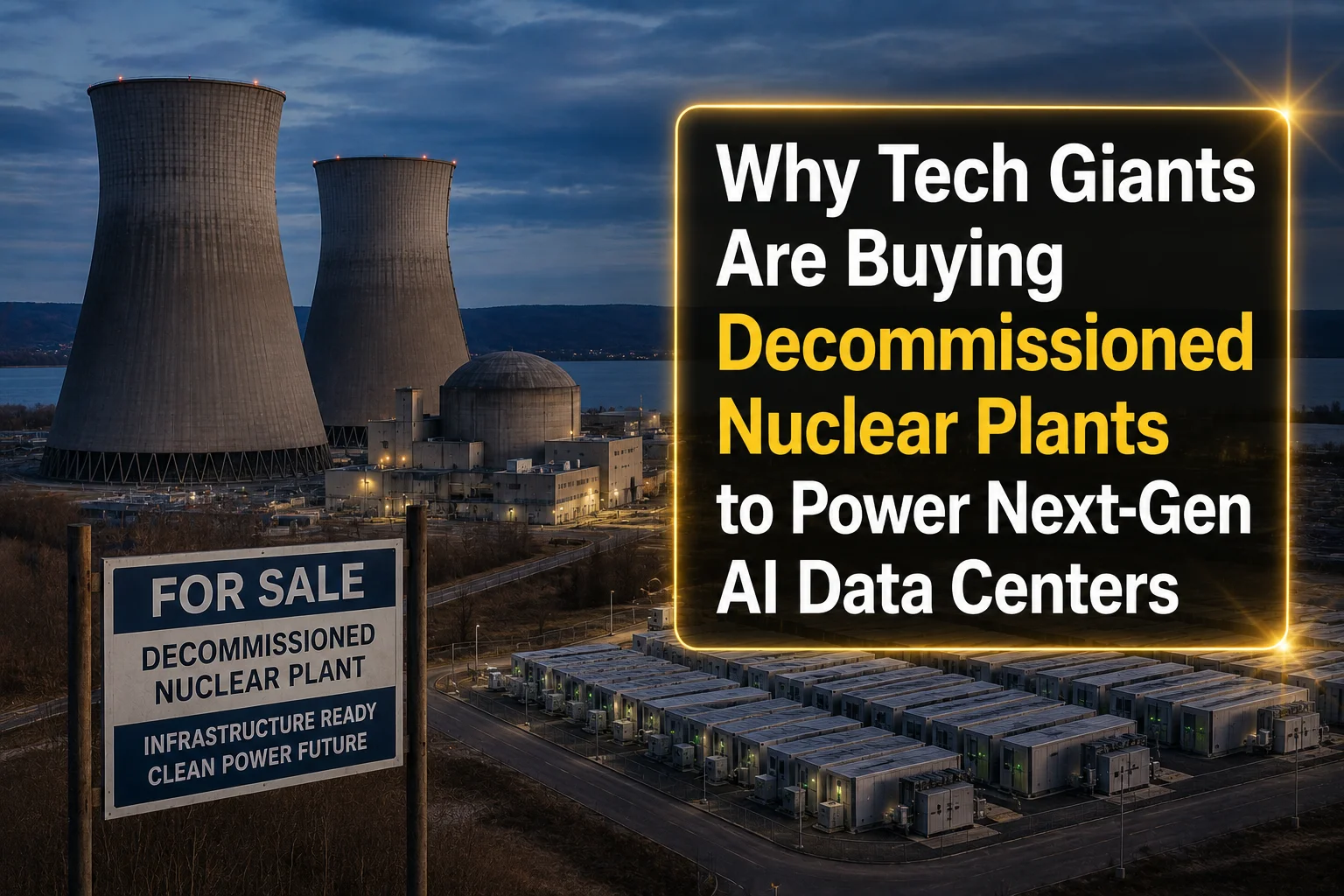
Picture a nuclear reactor that already cleaned out its locker, said goodbye to the crew, and settled into what everyone assumed was a quiet, permanent retirement. Then, sometime around 2024, a group of guys in hoodies who make chatbots show up at the gate with a truck full of money and say: "we need you back, the servers are hungry." That is, almost word for word, the real plot behind one of the strangest energy stories of the decade — and unlike most tech headlines, this one isn't exaggerated for clicks.
In Covert, Michigan, crews are literally reassembling a turbine that was half-disassembled for scrap. In Pennsylvania, a reactor that sits next to the site of America's worst nuclear accident is being rebuilt specifically to feed one company's AI ambitions. This isn't a metaphor about the AI boom needing power. It's a company bringing a dead power plant back from the grave, bolt by bolt.
The Number That Explains Everything
Before getting into reactors and regulators, it helps to see why anyone is even considering this. A normal server rack pulls somewhere around 5 to 10 kilowatts. An AI rack packed with GPUs pulls 50 to 100 kilowatts — roughly ten times more, in the same footprint. A single large training cluster running 50,000-plus high-end GPUs can draw 150 to 200 megawatts continuously, which is close to what a mid-sized city uses.
Zoom out further and the trend gets uncomfortable for grid planners. According to the International Energy Agency's Electricity 2026 report, global data center electricity use is on track to roughly double from about 485 terawatt-hours in 2025 to near 950 terawatt-hours by 2030. In the US alone, data centers could go from around 4-5% of national electricity consumption today to somewhere between 9% and 17% by the end of the decade, depending who you ask.
| Load Type | Typical Power Draw | Rough Comparison |
|---|---|---|
| Traditional server rack | 5–10 kW | A few large homes |
| AI-optimized GPU rack | 50–100 kW | A small apartment building |
| Large hyperscale AI cluster | 150–200 MW | ~150,000 average US homes |
| Single restarted reactor (e.g. Crane / Palisades) | 800–835 MW | A mid-sized city, running 24/7 |
Why the Grid Can't Just Grow Faster
The obvious question is: why not simply plug into the existing grid and buy more solar or gas? In practice, that queue is jammed. Per the IEA, more than 2,500 gigawatts of generation and storage projects are currently stuck waiting for grid connection worldwide, and building new transmission infrastructure typically takes 5 to 15 years — far longer than building the generation itself. In parts of the US, interconnection wait times now average close to five years, with some regions quoting seven to ten.
That mismatch between how fast AI companies want to build and how slow grids can expand is really the whole story. It's the same kind of physical-world bottleneck we've covered before when looking at how a handful of narrow undersea cable corridors carry almost all global internet traffic — a few chokepoints quietly deciding how fast the digital world can actually move, no matter how much software gets written.
Enter the "Zombie Reactor" Strategy
This is where decommissioned nuclear plants come in. A shuttered reactor site already has something almost impossible to build quickly today: high-voltage transmission lines running straight into the regional grid, industrial-grade cooling water access, land zoned for heavy generation, and — in many cases — a license that can be reinstated rather than applied for from scratch.
The clearest example is Three Mile Island Unit 1 in Pennsylvania, shut down in 2019 for economic reasons, sitting next to the infamous Unit 2 that partially melted down in 1979. Constellation Energy is spending roughly $1.6 billion to bring it back online, rebranded as the Crane Clean Energy Center, under a 20-year power purchase agreement with Microsoft reportedly worth around $16 billion. Target: commercial operation around 2027, generating about 835 MW dedicated almost entirely to Microsoft's AI data centers.
The more dramatic example is Palisades, an 800-plus megawatt plant in Covert, Michigan. Holtec International originally bought Palisades in 2022 to decommission it, then reversed course once demand forecasts from AI and advanced manufacturing started climbing. It's now attempting something that has literally never been done in US history: restarting a plant after it had already entered decommissioning. The company has missed its own restart date twice already, which says a lot about how unpredictable this process really is.
Why an Old Site Beats a Green Field, Even With the Headaches
- Transmission interconnection already exists — no multi-year queue.
- Cooling water systems and intake infrastructure are already permitted.
- The site is already zoned and community-accepted for heavy industrial power generation.
- Some equipment, staff expertise, and even the original operating license can sometimes be reactivated instead of rebuilt.
- Nuclear runs at a capacity factor above 90%, more than double what most solar or wind farms acheive on their own.
What Actually Has to Happen Behind the Scenes
Announcing a nuclear restart deal and actually flipping the switch are two very different timelines. Restarting a plant that has gone through decommissioning is not like flipping a breaker back on. Here's roughly what's involved, based on how the Palisades and Crane projects have played out:
- Engineering and safety assessment — inspecting the reactor vessel, steam generators, and containment for corrosion or degradation after years idle.
- NRC regulatory reinstatement — the US Nuclear Regulatory Commission built an entirely new inspection framework, IMC 2562, just to oversee this kind of restart, since it had never happened before.
- Physical refurbishment — replacing reactor head penetrations, cleaning and passivating primary systems, reinstalling turbines and generators that were partly stripped for parts or scrap.
- Fuel receipt and operator recertification — new nuclear fuel has to be delivered and inspected, and staff need to be re-certified by industry bodies like INPO.
- Environmental and water permitting — Holtec's own filings show Palisades alone is expected to draw around 25,000 gallons of water a minute once its planned small reactor units are added, which triggers its own separate review.
- Grid interconnection and PPA finalization — even with existing lines, the actual commercial agreement to sell power back to the grid or directly to a data center still needs regulatory sign-off.
Holtec has reportedly listed more than 5,000 individual remaining work items for Palisades even after major milestones were reached — routine, but far from trivial. That's the "behind the scenes" reality that press releases tend to skip.
The Companies, the Money, and the Megawatts
| Company | Deal / Plant | Capacity | Status (mid-2026) |
|---|---|---|---|
| Microsoft | Crane Clean Energy Center (ex-Three Mile Island Unit 1) | 835 MW | Restart underway, targeting 2027 |
| Holtec / multiple buyers | Palisades, Michigan | 800+ MW | First-ever full decommission-to-restart, delayed twice |
| Amazon | Susquehanna campus (Talen Energy) | Up to 960 MW behind-the-meter | Operating, under FERC procedural review |
| Meta | Vistra PPA (Perry, Davis-Besse, Beaver Valley) | ~2,600 MW, targeting up to 6.6 GW total | 20-year agreement signed, phased |
| Kairos Power + Tennessee Valley Authority | Multi-phase SMR rollout | Early-stage, first units years out |
Old Restart vs. New Build vs. Everything Else
| Option | Time to Power | Reliability | Biggest Risk |
|---|---|---|---|
| Restart decommissioned reactor | 2–4 years (optimistic) | Very high once running | Unknown equipment condition, repeated delays |
| New Small Modular Reactor (SMR) | 5+ years, commercial-scale still unproven | Expected high, unverified at scale | First-of-a-kind construction risk |
| New gas turbine plant | 1–3 years | High, but not carbon-free | Emissions targets, fuel price swings |
| Solar/wind + battery colocation | 1–3 years | Moderate, weather-dependent | Cannot match 24/7 baseload alone |
Pros and Cons of the Nuclear-for-AI Strategy
Pros:
- Round-the-clock, carbon-free baseload power that renewables can't match without massive storage.
- Reuses existing high-voltage transmission — bypassing the multi-year interconnection queue.
- Long-term power purchase agreements (often 20 years) give lenders and regulators confidence to fund the restart.
- Brings real jobs and tax revenue back to communities that lost them when the plant originally closed.
Cons:
- Restart timelines slip constantly — Palisades has already missed two publicly stated dates.
- Cost overruns are common in nuclear projects generally, and restarts add unknowns that brand-new builds don't have.
- Behind-the-meter deals raise fairness questions — critics argue nearby ratepayers may still be subsidizing grid backup that Big Tech benefits from without fully paying into it.
- Even combined, hyperscaler nuclear commitments total under 10 gigawatts, while Goldman Sachs estimates 85 to 90 gigawatts of new nuclear capacity is needed by 2030 to meet projected demand. Less than 10% of that is currently in development.
Verdict: Restarting old nuclear plants is a genuinely smart, fast-ish way to unlock reliable power for a handful of flagship AI campuses — but it's a patch, not a solution. It solves specific companies' specific power problems years faster than building new nuclear from scratch. It does not solve the industry-wide electricity gap on its own. Expect nuclear restarts to run alongside gas turbines, SMRs, and grid-scale batteries for at least the next decade, not instead of them.
Is This Really Just a Bigger Version of the Chip Shortage?
There's a pattern here that feels familiar if you've followed the semiconductor world. Chipmakers like TSMC also chase locations based on where power, water, and skilled labor already exist rather than building from zero everywhere — the same logic we broke down when looking at why TSMC is expanding fabs outside Taiwan and how chip foundries actually work behind the scenes. AI energy sourcing is following the same instinct: go where the hard infrastructure already exists, because building it from scratch takes too long. It's also worth noting that grid components, transformers, and reactor parts increasingly rely on materials tied to the same supply chains we covered in our piece on the rare earth refining chokepoint — one more reminder that AI's power problem and the chip supply chain are more connected than they look.
A Creative Thought Experiment
Here's a fun one: some of these old nuclear sites originally supported small "company towns" — housing, schools, and local economies built around the plant. If restarts succeed at scale, you could see a modern version of that idea reappear, except this time the company town isn't built around a reactor worker's paycheck. It's built around a data hall full of GPUs that never sleep, with the reactor just quietly doing the unglamorous job of keeping the lights — and the racks — on.
Important Things Worth Watching
- Track the restart date, not the announcement date. Palisades has slipped from "end of 2025" to "early 2026" to no firm date at all. Deals get press releases; electrons take longer.
- A signed PPA is not guaranteed power. Amazon's Susquehanna arrangement, worth $650 million, has already faced procedural pushback from federal regulators — even after the deal was signed and operating.
- Water matters as much as uranium. Palisades alone is projected to draw millions of gallons a day once expanded — a detail that rarely makes the headline but absolutely shapes local permitting.
- Local jobs sell the deal politically, not "AI." Pennsylvania's governor called the Crane investment the largest capital investment in state history, framed almost entirely around 1,250 new jobs — not chatbots.
- This is a portfolio strategy, not a single bet. Every company doing nuclear deals is simultaneously signing gas, solar, and battery contracts too. Nuclear buys time and headlines; it doesn't cover the whole gap by itself.
So no, buying a dead reactor isn't some clever shortcut around the laws of physics or regulation — it's a genuinely hard, expensive, multi-year bet that a handful of companies are making because the alternative (waiting years in a grid queue) is worse for their business. Whether it actually pays off on schedule is still, honestly, an open question — ask Palisades' calendar.

Comments 0
Be the first to comment!