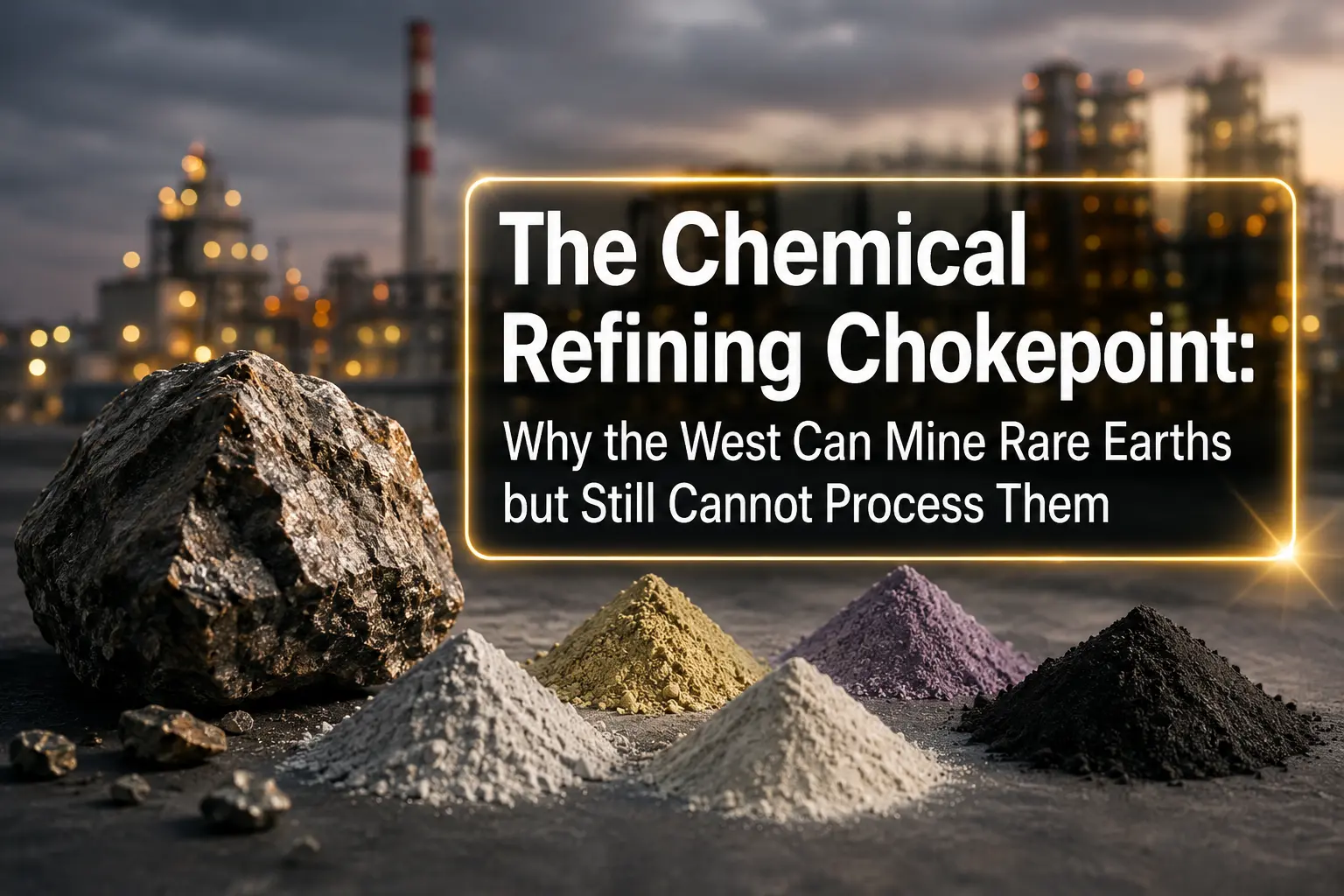
Picture a chemistry teacher's worst nightmare: seventeen elements that behave almost exactly alike, mixed together in the same rock, and your job is to pull them apart one by one using nothing but acid baths and patience measured in months. Now imagine doing that thousands of times a day, at industrial scale, without poisoning a river. That's not a hypothetical. That's Tuesday at a rare earth refinery in Inner Mongolia.
Meanwhile, in the US, Australia, and Europe, mining companies have spent the last few years proudly announcing new rare earth deposits like they've found the last dragon egg. And technically, they have found something valuable. But here's the awkward part nobody likes to say out loud at the press conference: pulling rock out of the ground was never the hard part. It's what happens next — in vats, acid tanks, and hundred-stage extraction lines — that decides who actually controls the world's supply of neodymium magnets, missile guidance systems, and EV motors.
This is the story of that "what happens next" — the chemical refining chokepoint that keeps China holding most of the cards even as Western mines multiply.
So: Why Can't the West Just Refine Its Own Rare Earths?
Because refining rare earths isn't a mining problem, it's a chemistry and industrial-scale problem. Every rare earth element sits so close to its neighbors on the periodic table that separating them requires solvent extraction cycles repeated dozens or even hundreds of times, using hazardous acids and generating radioactive-adjacent waste. China spent over three decades building this capability, absorbing environmental costs Western regulators wouldn't tolerate, and now produces refined rare earth compounds at roughly a fifth of the cost of anywhere else. Building a competing refinery isn't a construction project — it's rebuilding thirty years of applied chemistry, permitting, and workforce training almost from zero.
Mining vs. Refining: Two Completely Different Businesses Wearing the Same Trench Coat
People tend to lump "rare earths" into one category, as if digging the ore out of a hillside and turning it into a magnet-grade metal are the same skillset. They're not even close. Mining is geology and heavy equipment. Refining is applied chemistry that borders on industrial alchemy.
| Stage | What Actually Happens | Difficulty Level | Who Dominates It |
|---|---|---|---|
| Mining | Ore is blasted, crushed, and concentrated into a mixed rare earth mineral form | Moderate — capital-heavy but well understood | Spread across China, US, Australia, Myanmar |
| Cracking / Leaching | Acid or alkaline chemistry breaks the ore apart, releasing rare earths and toxic byproducts | High — generates radioactive-adjacent waste streams | Overwhelmingly China |
| Solvent Extraction / Separation | Nearly identical elements are pulled apart using dozens to hundreds of chemical extraction cycles | Extreme — the true bottleneck | China, ~90%+ |
| Metal & Alloy Production | Separated oxides are reduced into pure metal and alloyed for magnet use | High — requires qualified, consistent feedstock | China, with the US and Japan catching up |
| Magnet Manufacturing | Alloy is sintered and shaped into finished neodymium-iron-boron magnets | High — needs scale and precision tooling | China (~85–90%), Japan, emerging US/EU plants |
We covered the broader race to build alternatives to this chain in our earlier piece on Beyond China: The Race for Rare Earth Metals & Western Alternatives in 2026. That article maps who's doing what. This one is about why the middle of that chain — the chemistry — is so brutally hard to replicate.
The Chemistry Problem, Explained Without a PhD
Rare earth elements are lanthanides, meaning they occupy adjacent slots on the periodic table and share nearly identical chemical behavior. Neodymium and praseodymium, for example, differ by exactly one proton. Their ionic radii are so close that ordinary chemical reactions can't tell them apart.
The industry's answer, developed and refined mostly in China since the 1980s, is solvent extraction. Ore is dissolved into an acidic solution, then mixed with an organic solvent that has a very slight preference for one element over another. The two liquids separate, one phase carries a slightly enriched fraction, and the process repeats. And repeats. And repeats again.
- Separating light rare earths from each other can take dozens of extraction stages.
- Isolating heavy rare earths like dysprosium and terbium from their neighbors can require upward of 60 to hundreds of equilibrium stages to hit magnet-grade purity.
- Each stage needs precise control of acidity, temperature, and flow — a mistake early in the chain contaminates everything downstream.
- The waste generated includes thorium and other mildly radioactive byproducts, which have to be stored or disposed of somewhere, indefinitely.
This is why newer approachs — ionic liquids, membrane separation, bio-inspired molecules like lanthanide-binding proteins, and even chromatography-based systems — are getting serious investment in 2026. They promise fewer stages and less toxic waste, but none of them yet run at the industrial tonnage that solvent extraction delivers today. The lab result and the factory floor are still two different worlds.
Why "Just Build a Bigger Plant" Doesn't Work
A refinery isn't a single machine you can order and bolt together. It's a chain of interconnected chemical circuits tuned to a specific ore's mineralogy. Feedstock from Mountain Pass in California behaves differently than feedstock from Bayan Obo in China, which behaves differently again from ion-adsorption clays in Myanmar or Vietnam. Every plant essentially has to be custom-engineered and then debuged through trial and error, batch by batch, for years before it reaches reliable output.
The Real Moat: Thirty Years of Cost Advantage, Not Geology
Here's the part that surprises most people who assume this is a story about who has the most rock. China doesn't hold a majority of proven rare earth reserves — it holds the overwhelming majority of processing capacity, and that gap is the actual story.
Starting in the 1980s, Chinese state-backed refiners treated rare earths the way other nations treat steel or semiconductors: as a strategic industry worth subsidizing through decades of losses. Environmental cleanup costs that would sink a Western company's balance sheet were absorbed as the cost of building dominance. According to analysis referenced by S&P Global, Chinese refined rare earth output now costs roughly five to six times less to produce than equivalent Western output. That's not a subsidy Western goverments can casually match, because it's not a one-time grant — it's thirty years of accumulated engineering knowledge, workforce training, and infrastructure that a check can't instantly buy.
The International Energy Agency puts China's share of global rare earth processing at close to 90%, with an even higher concentration in heavy rare earth separation specifically — the dysprosium and terbium that keep magnets from losing strength at high temperatures in fighter jets and EV motors.
Environmental Reality: The Part Nobody Wants to Permit
This is arguably the least glamorous but most decisive piece of the puzzle. Cracking and leaching rare earth ore produces:
- Acidic wastewater loaded with heavy metals
- Solid tailings containing thorium, a radioactive element that occurs naturally alongside rare earths
- Volatile organic solvent residues from the extraction stages
- Large volumes of process water that need treatment before release
In China, this waste was historically managed with far looser environmental oversight than would ever pass a US or EU permitting review today. In the West, every one of those waste streams triggers a separate regulatory review, often at the state, national, and in Europe's case, EU level simultaneously. A single US environmental permit for a chemical processing facility handling radioactive-adjacent tailings can take several years on its own, before a shovel touches dirt.
This isn't red tape for its own sake — thorium tailings genuinely need to go somewhere safe for centuries, not years. But it does mean that "build a refinery" is realistically a decade-long undertaking once permitting, construction, and commissioning are stacked together, not the two or three years political announcements sometimes imply.
Who's Actually Closing the Gap in 2026
Progress is real, even if it's slower than headlines suggest. Here's where the West's most advanced refining projects actually stand right now.
| Company / Project | Country | Refining Milestone in 2026 | Status |
|---|---|---|---|
| MP Materials, Mountain Pass | United States | Heavy rare earth (dysprosium/terbium) separation circuit commissioning, targeting 200 metric tons/year of Dy/Tb output | Commissioning underway, first-of-its-kind in the US |
| MP Materials, Independence Facility | United States | Commercial NdFeB magnet production for GM and Apple offtake | Operating, scaling through 10X facility buildout |
| Lynas Rare Earths | Australia / Malaysia | Only non-Chinese company shipping separated dysprosium and terbium commercially; first samarium oxide production achieved | Operating, expanding |
| Neo Performance Materials | Estonia (EU) | Europe's first mass-production rare earth magnet facility | Operating |
| ReeMAP / Caremag | Sweden / France | EU Strategic Projects targeting REE processing start between 2026 and 2028 | Under construction / early ramp |
MP Materials' trajectory is probably the clearest data point available on how long this actually takes even with heavy government backing. The company went from essentially zero refining output in 2021 to record NdPr oxide production and an "imminent" heavy rare earth separation circuit backed by a $550 million Department of Defense investment in 2026 — roughly four and a half years of continuous, capital-intensive scaling to get from raw concentrate to a functioning heavy rare earth circuit. And that's considered a success story.
Pros and Cons of Building Refining Capacity Outside China
Pros
- Government-backed price floors and offtake agreements (like MP's 10-year, $110/kg price floor deal) are finally de-risking private investment
- New separation technologies — ionic liquids, membrane systems, bio-based extraction — could eventually cut both cost and toxic waste output
- Defense-linked demand guarantees a customer base that doesn't depend on volatile spot pricing
- Every new ton of non-Chinese separated output reduces single-point-of-failure risk across the whole supply chain
Cons
- Refining costs outside China remain several times higher, meaning Western output likely needs subsidy support indefinitely, not just during ramp-up
- Heavy rare earth separation capacity outside China is still measured in low hundreds of tons annually, versus tens of thousands from China
- Environmental permitting timelines for radioactive-adjacent waste remain a multi-year bottleneck in both the US and EU
- Technical workforce with actual solvent extraction experience is scarce outside China, Japan, and a handful of legacy Western plants
Verdict: Is the Refining Gap Closing or Just Getting Attention?
The honest answer: real progress, on a slow clock. Western refining capacity is growing faster than at any point in the last three decades, driven mostly by government money rather than market economics. But heavy rare earth separation — the step that matters most for defense and EV magnets — is still a rounding error next to Chinese output. Expect meaningful diversification of light rare earth processing by 2027–2028, and continued heavy dependency on China for heavy rare earth separation well into the 2030s unless investment accelerates sharply.
Alternatives to Waiting for New Refineries
Building new solvent extraction plants isn't the only lever being pulled. A few parallel approaches are gaining real traction in 2026:
Recycling
Pulling rare earth magnets out of old hard drives, EV motors, and wind turbines skips the mining and cracking stages entirely. It's not a full substitute — there isn't enough end-of-life material in circulation yet — but it's a genuine bridge while primary refining capacity ramps up. Notably, China has started restricting export of recycling-related technology, which many analysts read as a sign Beijing takes this threat seriously.
Substitution
Some manufacturers are engineering magnets and motors that use less dysprosium and terbium, or none at all, accepting a performance trade-off in exchange for supply security. This works for some consumer applications but is far harder to justify in defense and aerospace systems where performance margins are non-negotiable.
Alternative Feedstock Geography
Diversifying where ore comes from — including deposits in Brazil, Vietnam, and emerging African and Central Asian sources — spreads mining risk even if the refining still has to happen somewhere with real chemical infrastructure. It reduces single-country mining dependency without solving the processing bottleneck on its own.
How This Connects to the Wider Tech Supply Chain
Rare earth refining doesn't exist in a vacuum. It sits alongside a handful of other choke-point industries where one region's specialized know-how, not raw material scarcity, decides who has leverage. Our coverage of what a chip foundry actually is and why TSMC and Samsung matter so much looks at a strikingly similar dynamic in semiconductors — design is spread globally, but advanced fabrication is concentrated in a tiny number of facilities. The same logic applies here: mining is spread globally, but chemical refining is concentrated in a tiny number of facilities, mostly in China.
We also examined how geopolitical pressure points like this play out under stress in our piece on the Taiwan chip countdown and what a strait closure would mean for global semiconductors. Rare earths and advanced chips are increasingly discussed together for exactly this reason — both are stories about processing chokepoints, not raw material shortages.
Frequently Asked Questions
Why can't Western countries just build their own solvent extraction plants faster?
They can, and are — but each plant has to be custom-tuned to its specific ore chemistry, requires years of environmental permitting for radioactive-adjacent waste, and needs a technically trained workforce with experience most Western countries haven't maintained since the 1980s. It's an engineering and regulatory timeline problem, not a money problem alone.
Is refining rare earths actually dangerous or just expensive?
Both. The chemistry involves strong acids, large volumes of organic solvents, and waste streams containing thorium, a naturally occurring radioactive element. It's manageable with proper engineering, but the safety and disposal requirements add significant cost and time compared to most other industrial chemical processes.
Which country is closest to matching China's refining capability?
Australia's Lynas Rare Earths is furthest along on separation, including heavy rare earths, and the United States through MP Materials is closest on integrating mining through magnet production domestically, though full mine-to-magnet independence at scale isn't expected before around 2028 at the earliest.
Can new technology like ionic liquids solve this faster than building traditional plants?
Potentially, and it's one of the more promising developments in 2026. Ionic liquids and membrane-based separation could reduce the number of extraction stages and toxic waste generated. But none of these technologies currently run at the industrial tonnage solvent extraction achieves today, so they're a medium-term opportunity rather than an immediate fix.
Does this refining bottleneck affect regular consumer products?
Yes. Rare earth magnets show up in phone speakers, laptop drives, headphones, and countless small motors, not just EVs and fighter jets. Refining bottlenecks and export control volatility eventually ripple into consumer electronics pricing, in much the same way semiconductor supply constraints do.
Final Words
The rare earth story got sold to the public as a mining problem, because mining is the part you can put on a map and photograph with a hard hat. The real chokepoint is quieter, messier, and a lot less photogenic: acid tanks, mixer-settlers, and hundreds of chemical extraction cycles that took China three decades to perfect and subsidize into a five-to-six-times cost advantage. That gap is closing, but on an industrial timeline measured in years and billions of dollars, not on the timeline of a press release. Until Western heavy rare earth separation capacity moves from hundreds of tons a year into the thousands, mining new deposits will keep producing headlines without producing independence. The mine is the easy half of the story. The refinery is the half that actually decides who holds the leverage.
Comments 0
Be the first to comment!