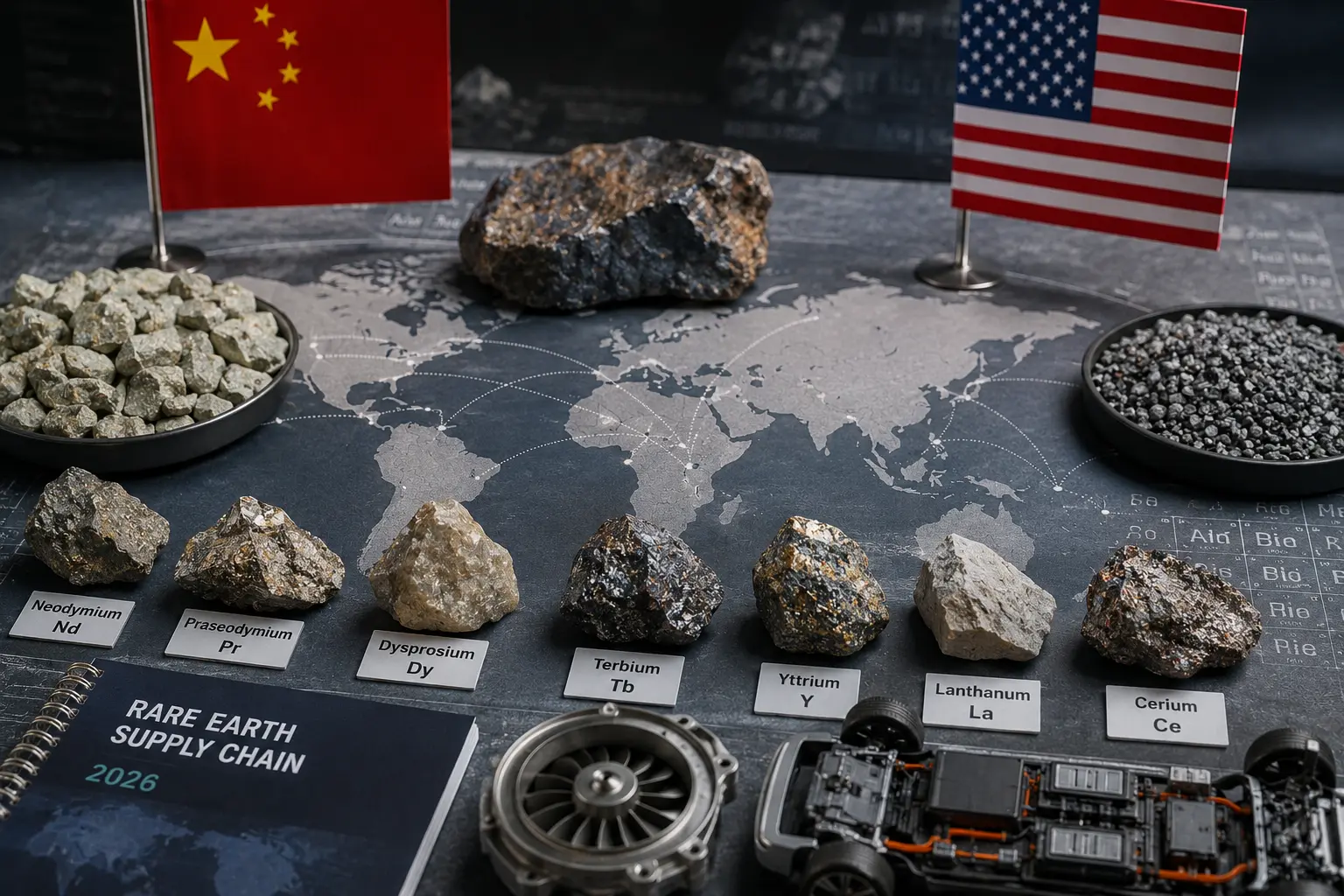
China doesn't just mine the most rare earths — it refines around 90% of the world's supply and controls nearly all heavy rare earth separation. The US, Australia, Canada, Europe, and Japan are all racing to build alternative supply chains in 2026, but most of them are still stuck at the mining stage. The hard part — turning ore into usable magnet-grade material — is years, not months, from being solved outside China.
So Why Rare Earths Became the Resource Everyone Suddenly Cares About
Rare earth elements aren't actually rare. What's rare is a country that can mine, refine, and process them at scale without it costing a fortune. That distinction is the entire story of 2026.
These 17 metals sit quietly inside almost everything that defines modern technology. Neodymium and praseodymium go into the permanent magnets that spin EV motors and wind turbine generators. Dysprosium and terbium keep those magnets from losing strength at high temperatures, which is why they're essential in fighter jets and precision-guided missiles. Gadolinium shows up in MRI machines. Yttrium and europium are used in advanced electronics and lasers.
Semiconductors depend on adjacent critical minerals too, which is part of why the rare earth story and the chip story keep colliding. Our earlier piece on the Taiwan chip countdown covers a related vulnerability — what happens when one region controls a chokepoint the entire industry depends on. Rare earths are the mineral version of that same problem, except the chokepoint isn't geography. It's processing capacity.
How China Built a Rare Earth Empire It Doesn't Fully Need Reserves To Keep
Here's the part that surprises most people: China doesn't hold the majority of the world's rare earth reserves. It holds the majority of the world's processing capacity, and that's a very different, much harder thing to replicate.
Starting in the 1980s, Beijing treated rare earths as a strategic industry the way other countries treat energy or steel. State-backed refiners absorbed decades of environmental cleanup costs that Western companies were never willing to eat. Chinese refined rare earth compounds now cost roughly five to six times less to produce than equivalent Western output, according to analysis cited by S&P Global. That cost gap, built up over 30-plus years, is the actual moat — not the ore in the ground.
The result is a supply chain where China controls close to 90% of global rare earth processing and an even higher share of heavy rare earth separation for elements like dysprosium and terbium, according to the International Energy Agency. Mining is the easy part. Refining is where China actually wins.
What Really Happens Between the Mine and the Magnet
This is the step most explainers skip, and it's exactly why "just open a new mine" isn't a real solution.
- Mining: Ore is extracted, but it contains a mix of light and heavy rare earths bound together with radioactive byproducts like thorium.
- Cracking and leaching: Chemical processing breaks the ore down into a rare earth concentrate, generating toxic and mildly radioactive waste that has to be handled somewhere.
- Separation: Each individual element has to be pulled apart from the others using solvent extraction — sometimes hundreds of extraction cycles for a single element. This step is where most non-Chinese producers still struggle.
- Refining into oxide, then metal: The seperated oxide is converted into metal form.
- Alloying and magnet production: Metal is alloyed and sintered into the finished neodymium-iron-boron magnets manufacturers actually buy.
| Supply Chain Stage | China's Approx. Global Share | Why It's Hard To Replicate |
|---|---|---|
| Mining | ~60% | Easiest stage; other countries have viable deposits |
| Refining/Separation | ~90% | Requires decades of process know-how and capital |
| Heavy rare earth separation | ~99% | Extremely few non-Chinese facilities exist at all |
| Magnet manufacturing | ~85–90% | Needs qualified metal supply plus manufacturing scale |
The 2026 Flashpoint: Export Controls, Suspensions, and a Ticking Clock
In October 2025, China's Ministry of Commerce escalated export controls to require licenses for products containing Chinese-sourced rare earth materials or made using Chinese rare earth technology — even components manufactured overseas. That single move exposed just how deep the dependency runs, since it wasn't just raw material exports being restricted anymore, it was anything downstream that touched Chinese rare earth inputs at any point.
The measures were suspended for a year following the Trump–Xi meeting, pushed out to November 2026, but the underlying licensing architecture stayed intact. Then in early 2026, Beijing tightened dual-use export rules specifically targeting Japan, a reminder that these tools get turned on and off based on diplomacy, not scarcity, as East Asia Forum has pointed out. Licensing approval rates for some European firms reportedly fell below 25% during the tightest periods.
This pattern — restrict, ease, restrict again — is the same dynamic we've tracked in our coverage of broader China+1 supply chain shifts. Rare earths are just the sharpest edge of it.
The Western Race: Who's Actually Building What in 2026
United States
MP Materials, backed by hundreds of millions in Pentagon investment, runs the Mountain Pass mine in California and produced a record 917 metric tons of separated neodymium-praseodymium in Q1 2026 alone. It's now commissioning a Fort Worth magnet facility and building toward heavy rare earth separation — real progress, but full magnet-to-market scale isn't expected until around 2028.
Australia
Lynas Rare Earths is the world's largest producer outside China, running its Mount Weld mine and a processing plant in Malaysia. It recently signed a $96 million Pentagon supply deal and is the only non-Chinese company shipping separated dysprosium and terbium commercially. Its Malaysian operating license, though, is up for renewal under nuclear licensing rules — a reminder that even the furthest-along player has fragile permitting risk.
Canada
Canada has fewer producing mines but a deep bench of junior developers and access to export credit financing alongside the US, Germany, and South Korea. Companies like Aclara and Neo Performance Materials are pushing forward, and Neo recently opened Europe's first mass-production rare earth magnet facility, in Estonia.
Europe
The EU's Critical Raw Materials Act set 2030 targets: 10% domestic extraction, 40% domestic processing, 25% recycling. Forty-seven Strategic Projects were designated in March 2025, including ReeMAP in Sweden and Caremag in France, both aimed at starting REE production between 2026 and 2028. Brussels projects that dependency on a single supplier for rare earth extraction could fall from 95% to 42% if these projects deliver, according to the European Council.
Japan
Japan is one of the only countries outside China that already makes rare-earth permanent magnets at meaningful scale, which is exactly why it's become a direct target of China's dual-use export controls in 2026. Tokyo has spent over a decade diversifying supply after a 2010 rare earth dispute with Beijing, but it still leans heavily on Chinese refined inputs for anything beyond its existing capacity.
| Country/Region | Strongest Stage | Realistic Timeline for Scale |
|---|---|---|
| United States | Mining + emerging separation | 2026–2028 |
| Australia | Mining + separation (incl. heavy REE) | Already operating, expanding |
| Canada | Exploration + magnet manufacturing (via EU site) | 2027–2030 |
| European Union | Processing + recycling projects | 2026–2030 |
| Japan | Magnet manufacturing | Already operating, capacity-limited |
Pros and Cons of the West's China+1 Rare Earth Strategy
Pros
- Government-backed financing (DoD, EU CRMA, export credit agencies) is now covering funding gaps private capital won't touch
- Multiple countries are hitting real production milestones, not just announcements
- Defense-linked deals (like Lynas's Pentagon contract) are creating guaranteed demand that de-risks new projects
- Recycling and magnet-manufacturing capacity outside China is finally starting to exist, not just get proposed
Cons
- Refining costs outside China remain five to six times higher, which limits how competitive Western output can be without subsidies
- Heavy rare earth separation capacity outside China is still almost nonexistent
- Environmental permitting for the toxic, radioactive-adjacent byproducts of processing is slow, especially in the US and EU
- Full mine-to-magnet independence realistically takes 10 to 20 years, not the 2-3 year windows political timelines assume
Is the West Actually Diversifying, or Just Rearranging Dependency?
The honest answer: both, at the same time. Mining diversification is real and happening faster than expected. Processing diversification — the part that actually matters — is happening much slower, and Western capacity for the hardest step (heavy rare earth separation) is still measured in the low hundreds of tons a year, not the tens of thousands China produces. Until that gap closes, "de-risking" mostly means fewer eggs in the same Chinese refining basket, not a genuinely independent supply chain.
Is Recycling the Shortcut Nobody's Talking About Enough?
Recycling magnets from old hard drives, EV motors, and wind turbines skips the mining and cracking stages entirely, which is a big deal given how slow permitting is for new mines. Europe's MagREEsource and INSPIREE projects are explicitly built around recycled feedstock, and China itself has started tightening export controls on recycling technology — arguably the clearest signal yet that Beijing sees recycling as a genuine long-term threat to its position, not a niche side project.
It's not a full solution on its own. There simply isn't enough end-of-life material in circulation yet to replace primary mining. But as a bridge while refining capacity ramps up elsewhere, it's one of the more underrated parts of this whole story.
Frequently Asked Questions
Why can't the West just build more rare earth mines?
Mining is the easiest step. The bottleneck is refining and separation — turning raw ore into the pure, magnet-grade materials manufacturers need. That part requires specialized chemical processes China has spent 30+ years perfecting at low cost.
Which country is closest to a real alternative to China?
Australia's Lynas is furthest along on separation, including heavy rare earths. The United States, through MP Materials, is closest on the mining-to-magnet integration timeline, targeting large-scale domestic magnet manufacturing by around 2028.
Are rare earth prices going to keep rising in 2026?
Analysts expect continued bottlenecks through 2026 and 2027 for heavy rare earths specifically, as alternative separation facilities are still being built and commissioned outside China.
Does this affect regular consumers, or just defense and EV companies?
It touches consumer electronics too — phones, laptops, hard drives, and headphones all use rare earth magnets. Price volatility upstream eventually shows up in device costs, similar to how chip manufacturing bottlenecks ripple into consumer tech pricing.
Is China likely to keep using export controls as leverage?
Based on the pattern through 2025 and 2026 — restrict, pause, restrict again around specific countries like Japan — most analysts expect China to keep using licensing as a flexible pressure tool rather than a permanent ban, since a permanent ban would accelerate the exact diversification it's trying to prevent.
Last Words
The West isn't losing this race, but it isn't winning it either — it's playing catch-up on the one part of the supply chain that was never really about geology. Mines are opening. Government money is flowing. Deals are getting signed. What's still missing is cheap, large-scale refining outside China, and that's not something you can announce your way into. It has to be built, tested, and scaled, one messy industrial process at a time.
For now, "beyond China" mostly means "less dependent on China," not independent from it. That's still progress. It's just not the finish line some 2026 headlines make it sound like.
Comments 0
Be the first to comment!