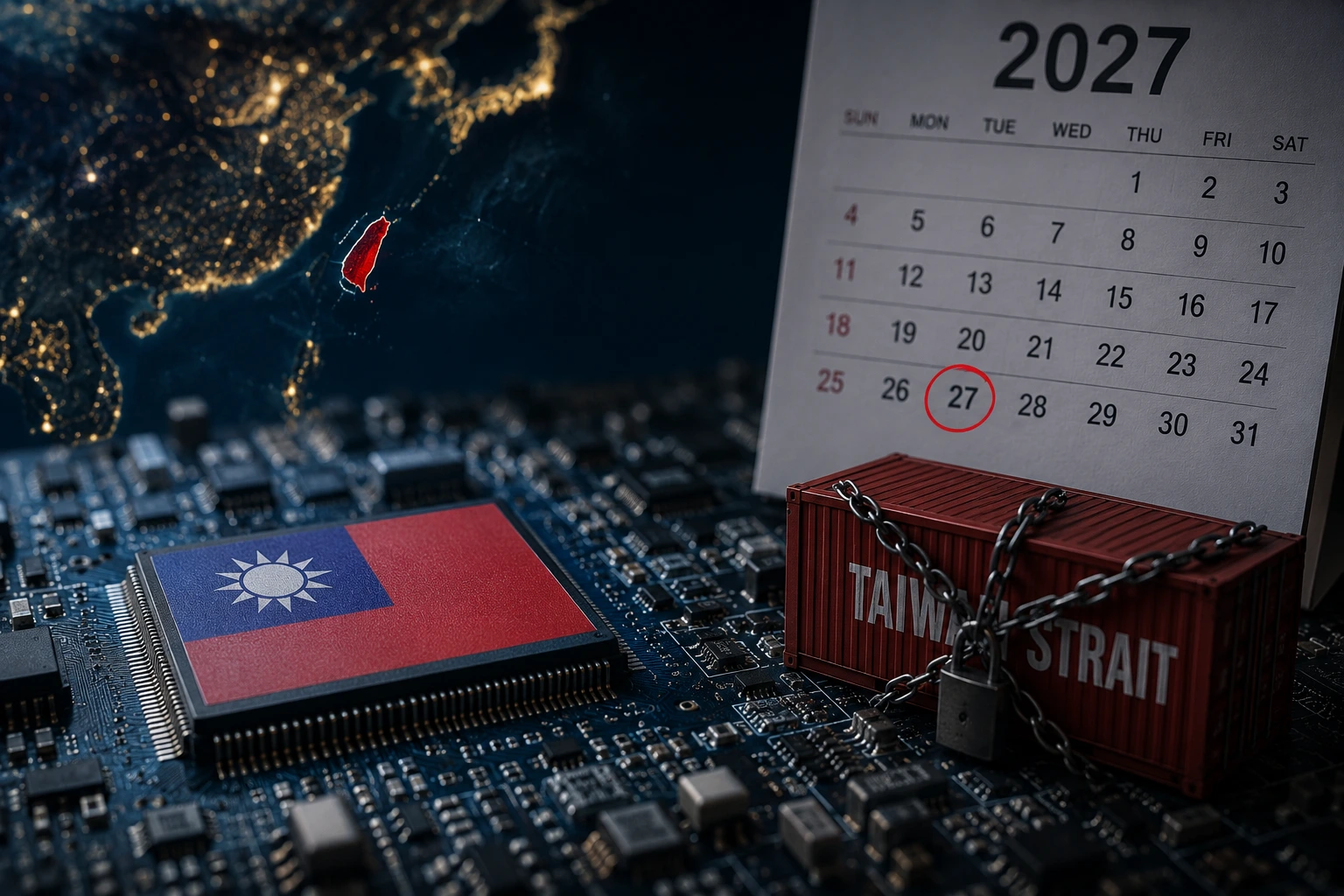
If commercial or naval traffic through the Taiwan Strait is halted in 2027, the global semiconductor supply chain would experience an immediate, catastrophic seizure. Taiwan produces over 60% of all global semiconductors and more than 90% of sub-5nm advanced microchips. Within 3 to 6 weeks, global assembly lines for AI servers, graphics cards, smartphones, and automotive electronics would stall. Despite billions spent on Western foundries through initiatives like the U.S. CHIPS Act, alternative fabs in Arizona, Japan, and Europe will still lack the capacity, advanced CoWoS packaging, and high-yield operational scale required to replace TSMC's western Taiwan corridor before 2030.
The 2027 Timeline: Why Defense Planners and Tech Executives Are Watching the Clock
In military and geopolitical circles, 2027 is frequently discussed as the "Davidson Window"—the timeline cited by former U.S. Indo-Pacific Commander Admiral Philip Davidson regarding China's military capability to enforce a blockade or amphibious operation against Taiwan. But in the executive suites of Silicon Valley, Tokyo, Seoul, and Frankfurt, 2027 represents something far more tangible: a razor-thin operational timeline where critical hardware migration cannot outrun geopolitical risk.
Over the past four decades, the global technology economy created the most concentrated industrial dependency in human history. The 100-mile-wide body of water separating mainland China from Taiwan is not just a shipping corridor carrying roughly half of the world's container fleet; it is the physical moat surrounding the beating heart of modern computation.
A full naval blockade, an enforced customs quarantine, or open kinetic conflict in the Strait would not merely cause a temporary chip shortage like the one experienced during the pandemic. It would trigger a fundamental supply blackout. Understanding why requires stripping away the geopolitical rhetoric and looking directly into the cleanrooms, packaging facilities, and chemical pipelines that keep the world running.
The Single Point of Failure: Behind the TSMC Silicon Shield
To grasp why the global electronics market cannot simply pivot overnight, one has to examine the extreme concentration of semiconductor fabrication located along Taiwan's western coastal plain, primarily centered around Hsinchu, Taichung, and Tainan Science Parks.
Taiwan Semiconductor Manufacturing Company (TSMC) is not just another contract manufacturer. It is a specialized industrial monopoly when it comes to cutting-edge silicon. While foundries across the globe fabricate legacy microcontrollers, power management integrated circuits (PMICs), and sensors, Taiwan manufactures virtually all of the world's most advanced computational silicon.
- Leading-Edge Concentration: Over 90% of sub-5nm and 3nm chips—powering Apple's A-series and M-series processors, Nvidia's Hopper and Blackwell AI accelerators, AMD's EPYC server CPUs, and Qualcomm's flagship SoCs—are etched on Taiwanese wafers.
- The Packaging Trap (CoWoS): Fabricating a raw silicon wafer is only half the battle. Cutting-edge AI silicon requires 2.5D and 3D advanced packaging, specifically TSMC's proprietary Chip-on-Wafer-on-Substrate (CoWoS). Over 85% of this specialized packaging capacity is physically situated inside Taiwan.
- Ecosystem Density: A single advanced fab requires hundreds of tier-1 suppliers within a two-hour driving radius—delivering ultra-pure chemicals, specialized gases, quartz components, and precision maintenance within minutes of an alert.
As explored in our analysis of the TSMC N2 vs Samsung SF2 2nm foundry war, maintaining high fabrication yields at sub-3nm requires decades of operational experience and proprietary library optimization that competitors cannot easily duplicate by simply purchasing equipment.
The Chain Reaction: What Happens to Global Hardware in the First 90 Days?
If access to the Taiwan Strait were suddenly cut off, the economic and industrial distruption would unfold in distinct, cascading phases rather than a single sudden crash.
Phase 1: Days 1 to 14 — The Cleanroom and Chemical Stoppage
Modern semiconductor fabrication plants (fabs) are continuous-flow chemical operations. They cannot simply hit "pause" on a production run. A single 12-inch wafer takes between 14 and 20 weeks to travel through thousands of photolithography, etching, and deposition steps.
Taiwan imports virtually all of its raw materials, including semiconductor-grade neon, specialty fluorinated chemicals, and silicon ingots. Simultaneously, Taiwanese fabs consume immense quantities of electricity and liquefied natural gas (LNG). If cargo ships cannot dock, Taiwan's domestic energy reserves and chemical stockpiles would deplete within weeks, forcing fabs to initiate emergency shutdown protocols. Once high-vacuum chambers and extreme ultraviolet (ASML) lithography tools lose clean power or calibration, restarting them takes months of recalibration.
Phase 2: Days 15 to 45 — Inventory Depletion & Component Starvation
The global tech industry operates on tight "just-in-time" supply chains. While major OEMs maintain safety buffers for certain passive components, expensive cutting-edge microchips are rarely stockpiled for more than 4 to 8 weeks due to rapid depreciation and carrying costs.
Smartphone makers would exhaust inventory for high-end application processors. As highlighted in our comparison of which smartphones get 2nm chips first, next-generation mobile devices rely entirely on uninterrupted wafer cycles. Without new deliveries, smartphone assembly lines in China, India, and Vietnam would grind to a halt.
Phase 3: Days 46 to 90 — The AI, Cloud, and Automotive Stall
By the third month, the crisis would spread deep into critical infrastructure:
- AI Datacenters: Cloud giants building next-generation hyperscale clusters would see server rack shipments freeze. The supply of high-bandwidth memory (HBM) paired with GPU computing dies would disappear.
- Automotive Lines: Modern vehicles rely on hundreds of specialized microcontrollers. While some are made on mature nodes, many infotainment, ADAS, and engine control chips trace back to Taiwanese fabs like TSMC and UMC.
- Consumer PC Hardware: Graphics cards, high-end desktop processors, and solid-state controller chips would vanish from retail shelves, driving secondary market prices up by 400% to 1,000%.
Can Alternative Foundries Save the World in 2027? A Reality Check
Governments across North America, Europe, and East Asia have committed hundreds of billions of dollars to diversify semiconductor manufacturing away from the Taiwan Strait. But how much usable capacity will actually be online by 2027?
| Region / Player | Projected 2027 Status | Process Nodes Available | Critical Bottleneck / Limitation |
|---|---|---|---|
| United States (TSMC Arizona, Intel IFS, Samsung Texas) | Early commercial output on 4nm/3nm; limited high-volume 2nm | 4nm, 3nm, Intel 18A | Wafer output represents <15% of TSMC's Taiwan volume; lacks domestic CoWoS scale; higher operating costs. |
| South Korea (Samsung Foundry) | Commercial GAA 3nm & 2nm production | 3nm (SF3), 2nm (SF2) | Lower historical yield curves compared to TSMC; dependent on the same East Asian maritime shipping lanes. |
| Japan (JASM Kumamoto & Rapidus) | JASM Fab 1/2 operational; Rapidus 2nm pilot testing | 12nm–28nm, 6nm; Rapidus 2nm (prototype) | JASM focused mostly on mature automotive/sensor nodes; Rapidus lacks mass-production validation. |
| China (SMIC & Domestic Foundries) | Massive legacy node expansion (28nm+); constrained 7nm/5nm DUV | 28nm+, limited 7nm multi-patterning | Cut off from ASML EUV tools; lower yields on advanced silicon; subjected to export controls. |
| Southeast Asia (Malaysia & Vietnam OSAT) | Major testing and assembly hubs | N/A (Back-end packaging & testing) | They do not fabricate raw wafers; rely on imported silicon from Taiwan and South Korea. |
As detailed in our study on how Mexico and Malaysia are reshaping the China+1 supply chain, back-end packaging hubs have grown rapidly across Southeast Asia. However, an assembly plant in Penang cannot function without bare silicon wafers arriving from Hsinchu.
Why Replicating Taiwan's Semiconductor Ecosystem Takes Years, Not Months
A common misconception among policymakers is that building fab shells solves the vulnerability. In reality, semiconductor manufacturing is constrained by hard physical and logistical bottlenecks:
1. Tooling Lead Times and Lithography Monopolies
A leading-edge fab requires hundreds of individual tools from specialized vendors: ASML for EUV lithography, Applied Materials and Lam Research for etching, KLA for optical metrology, and Tokyo Electron for track systems. These machines have lead times ranging from 12 to 24 months. ASML produces only a few dozen High-NA and Standard EUV machines each year, meaning global tool manufacturing cannot physically accelerate to replace dozens of lost Taiwanese cleanrooms simultaneously.
2. The Specialized Engineering Talent Deficit
Running a sub-3nm production line requires thousands of specialized process engineers working round-the-clock shifts. TSMC's operational culture in Taiwan relies on decades of accumulated institutional knowledge, high retention rates, and rapid root-cause analysis when yields dip. Exporting this exact ecosystem to overseas facilities in Arizona or Dresden has encountered cultural friction, union negotiations, and acute shortages of qualified cleanroom technicians.
3. The "Fail-Safe" Reality (The Remote Kill Switch)
In a severe crisis or military escalation, control over Taiwan's fabs would not fall neatly into an occupying force's hands. As reported by Reuters, ASML and TSMC maintain remote disablement capabilities that can render EUV machines completely inoperable in the event of an invasion. Furthermore, without regular software updates, proprietary laser gases, and spare mirror optics from Europe and Japan, an advanced fab becomes little more than a multi-billion-dollar museum within weeks.
The Macroeconomic Cost: How Much Would a Strait Disruption Cost?
Independent economic analyses indicate that a prolonged closure of the Taiwan Strait would generate an unprecidented economic shock. According to comprehensive estimates published by Bloomberg Economics, a full conflict and blockade over Taiwan would wipe an estimated $10 trillion from global gross domestic product (GDP)—equivalent to roughly 10% of the entire world economy.
To put this in perspective, the 2008 global financial crisis and the 2020 pandemic lockdowns caused far smaller relative declines in global industrial output. A Taiwan Strait stoppage would simultaneously hit:
- The United States: Heavily dependent on fabless design giants (Apple, Nvidia, Qualcomm, AMD, Broadcom) whose entire product roadmaps are tied to Taiwanese fabs.
- China: Despite heavy domestic subsidies, China remains the world's largest consumer and assembler of imported semiconductor silicon for export electronics and smartphones, as seen in our breakdown of 2nm vs 5nm chip designs.
- Europe and Japan: Core automotive and precision robotics industries would suffer catastrophic factory shutdowns within 60 days.
Studies by security think tanks like the Center for Strategic and International Studies (CSIS) emphasize that even a limited maritime quarantine—where commercial ships are subjected to inspections and delays without open missile exchanges—would drive maritime insurance premiums to prohibitive levels, effectively halting trade through the corridor.
Strategic Mitigation: What Tech Companies Are Doing Today
Knowing that 2027 sits on the strategic horizon, enterprise tech leaders and foundries are executing several defensive playbooks, though none offer complete immunity:
1. "Dual-Foundry" Sourcing Architecture
Fabless chip companies are actively rewriting design rules to enable dual-sourcing across both TSMC and Samsung Foundry. However, moving a complex chip architecture from one foundry's process design kit (PDK) to another takes 12 to 18 months of intensive re-engineering and tens of millions in non-recurring engineering (NRE) costs.
2. Strategic Inventory Buffering
Rather than relying purely on just-in-time shipping, major tech firms and defense contractors have quietly begun building 6-to-12-month strategic reserves of critical finished silicon and packaged microcontrollers, buffering against short-term maritime interruptions.
3. Accelerating Onshore Datacenter Capacity
Cloud and AI hyperscalers are racing to secure computational clusters ahead of 2027. Yet, as analyzed in our report on the AI electricity and power grid crisis, physical infrastructure and transformer backlogs are complicating these data center expansions in North America and Europe.
Frequently Asked Questions (FAQ)
Why is 2027 specifically mentioned as a critical year for Taiwan and semiconductors?
2027 marks the centenary of the People's Liberation Army (PLA) in China and has been highlighted in U.S. intelligence assessments as a target milestone for military readiness regarding Taiwan. From a technological standpoint, 2027 is also the target window when overseas fabs under the U.S. CHIPS Act and European Chips Act are scheduled to begin early volume manufacturing, creating a critical transitional window of vulnerability.
Can Intel, Samsung, or domestic U.S. fabs replace TSMC if Taiwan is cut off?
Not by 2027. While Intel's Foundry Services and Samsung are expanding capacity, TSMC still holds over 90% of sub-3nm volume and dominant share in CoWoS packaging. Even with new fabs in Arizona, Ohio, and Texas, U.S.-based output would satisfy only a small fraction of global demand, and much of the silicon would still need to travel overseas for final packaging and board assembly.
What would happen to consumer electronics prices during a Strait closure?
Prices for consumer electronics would surge immediately. Laptops, smartphones, gaming GPUs, and electric vehicles would face severe shortages. On secondary markets, hardware prices could spike by 300% to 1,000%, similar to the GPU shortages of 2020–2021 but on an unprecidented global scale.
Does China have the semiconductor capacity to remain unaffected?
No. China is the world's largest importer of semiconductors and relies heavily on Taiwanese fabs for advanced processors used in telecommunications, cloud servers, and consumer exports. While China dominates legacy nodes (28nm and above), its leading-edge fabrication remains constrained by Western export controls on EUV lithography tools.
Can semiconductor packaging be moved away from Taiwan quickly?
No. Advanced 2.5D/3D packaging requires specialized cleanroom facilities, high capital investment, and complex substrate supply chains. While countries like Malaysia, Vietnam, and Mexico handle standard wire-bond and flip-chip packaging, advanced packaging for AI silicon (like CoWoS) remains concentrated in Taiwan.
The Final Verdict: Why the World Cannot Afford a Strait Shock in 2027
The global technology ecosystem has spent the past half-decade attempting to hedge against geographic concentration, but the physical reality of chip manufacturing moves slower than geopolitics. Building fab buildings takes two years; installing and qualifying high-precision lithography tools takes another eighteen months; and mastering commercial yields at atomic scales takes decades.
If the Taiwan Strait closes in 2027, there is no backup switch, no hidden stockpile, and no alternative foundry capable of absorbing the shock. The world's dependancy on Taiwan is not just an economic fact—it is the ultimate structural reality of the digital age.



Comments 0
Be the first to comment!