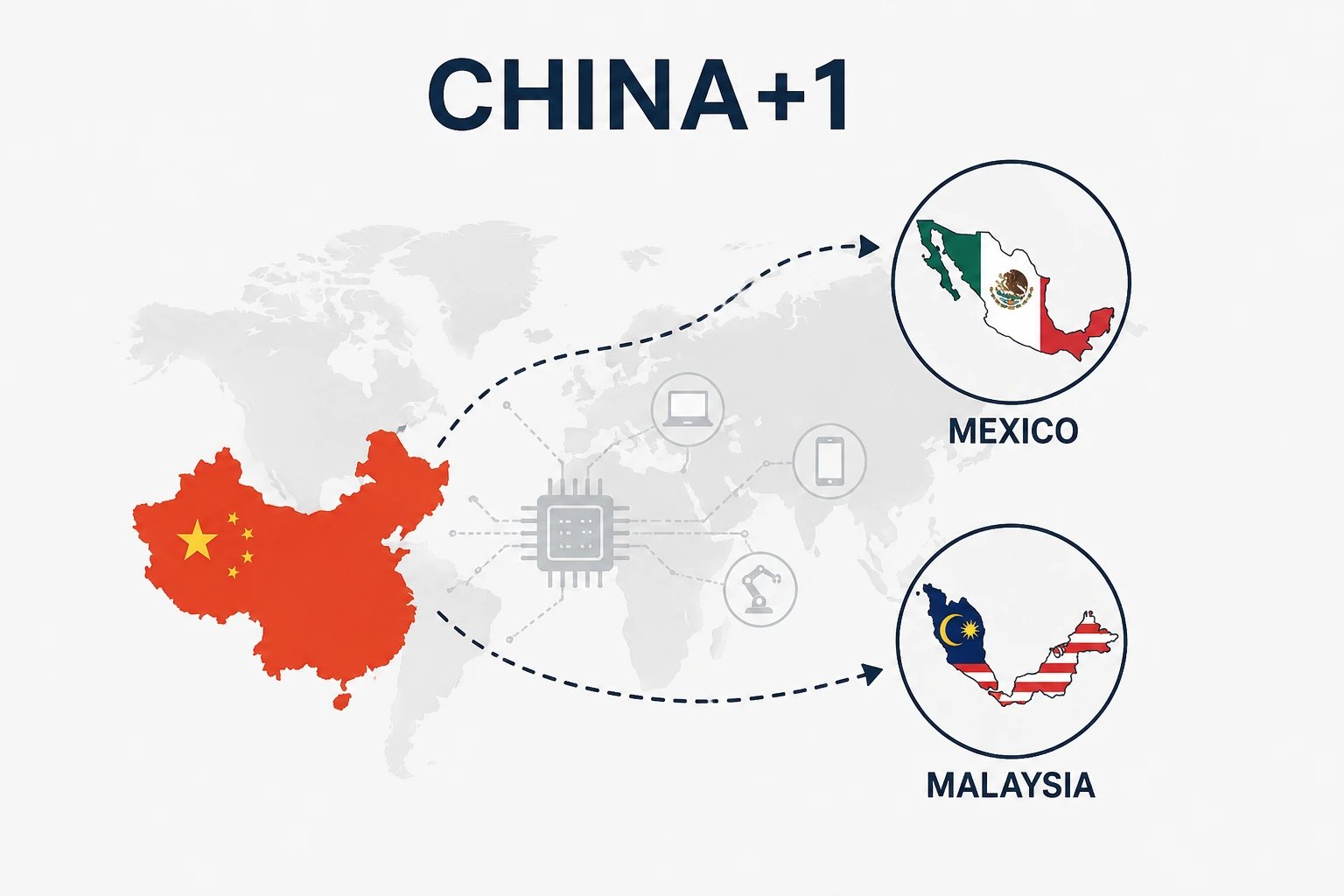
For the past three years, India and Vietnam have dominated the 'China+1' narrative, celebrated as the new hubs for iPhones and general manufacturing, respectively. Yet, behind the scenes, two other nations have secured billions in investments for semiconductors, data centers, and electric vehicles, largely flying under the media's radar.
Mexico and Malaysia aren't trying to out-compete India or Vietnam at their own game. They're winning a different game entirely — one built on geography, trade treaties, and decades-old industrial clusters that most headlines skip right past.
Let's Start: Mexico is becoming North America's nearshoring backbone for EVs, electronics assembly, and data centers thanks to USMCA and its 2–5 day truck route to the US market. Malaysia is becoming Asia's back-end semiconductor and hyperscale data center hub, leaning on 50+ years of chip packaging experience in Penang and a data center boom in Johor. Neither one replaces India or Vietnam — they fill gaps those two countries can't reach.
The China+1 Story You've Already Heard
India builds iPhones. Vietnam builds AirPods, Watches, and most of Apple's non-phone lineup. Both stories are true and both are already well covered — we broke down exactly how that split works in our India vs Vietnam China+1 breakdown. But Apple's supply chain is just one slice of a much bigger relocation that's been building since the first tariff rounds hit China, a trend we've tracked in detail in our piece on why global supply chains are shifting away from China.
That broader shift now touches semiconductors, EVs, and data center infrastructure — categories where India and Vietnam simply don't have the geography or the industrial history to compete. That's the gap Mexico and Malaysia are filling.
So Why Mexico Is the Overlooked Nearshoring Heavyweight
Mexico's pitch has nothing to do with cheap labor anymore, and everything to do with proximity. A container from Shenzhen to Long Beach takes 25 to 40 days by ocean. A truck from Monterrey to Texas takes 2 to 5 days. In a world where companies got burned twice by shipping shocks, that difference alone reshapes procurement decisions.
Semiconductors and Electronics
Mexico isn't building leading-edge fabs — that race still belongs to Taiwan, the US, and increasingly Malaysia's back-end cluster. What Mexico does have is a massive electronics assembly base in Tijuana, Ciudad Juárez, and Guadalajara, feeding contract manufacturers that already serve US tech brands. As Beijing keeps tightening its grip on refined inputs — the kind of chokepoint we covered in our piece on China's gallium and germanium export controls — Western brands have extra incentive to keep final assembly as far from that exposure as possible.
EVs and Automotive
Mexico is already the world's seventh-largest vehicle producer, churning out roughly three million vehicles a year, and the industry accounts for about a fifth of the country's manufacturing GDP. That base is now pivoting toward EVs. Chinese automaker BYD has spent over a year negotiating a Mexican plant, and Korea's Kia, plus European makers including BMW, Volkswagen, and Stellantis, have all announced EV-related investment on top of existing ICE production. The catch: to qualify for USMCA tariff breaks, batteries and final assembly both need to happen inside North America, which is exactly why this matters more than a simple factory announcement — a dynamic the Atlantic Council has examined in detail.
Data Centers
Mexico's data center build-out is smaller than Malaysia's but growing fast around Querétaro and the northern industrial corridor, largely to serve US cloud demand without crossing an ocean. Like everywhere else building AI infrastructure right now, power is the real constraint, not land or permits — something we go into more in our report on the AI electricity crisis stalling data centers.
Mexico at a Glance (2026)
| Metric | 2026 Snapshot |
|---|---|
| FDI Confidence Index rank | Climbed from 25th to 19th globally (Kearney) |
| 2025 total FDI | $40.87 billion, up 10.8% year over year |
| Manufacturing exports to US (2025) | $535 billion, up roughly $150 billion since 2021 |
| Chinese FDI trend | Fell 80% year-over-year in 2025 amid USMCA uncertainty |
| Core strength | EVs, electronics assembly, auto parts, nearshored manufacturing |
Mexico: Pros and Cons
- Pro: Truck access to the US in days, not weeks
- Pro: USMCA tariff preference over most Asian-origin goods
- Pro: Deep, decades-old automotive and electronics supplier base
- Con: The 2026 USMCA joint review has introduced real policy uncertainty
- Con: Energy grid and industrial land constrained in the busiest hubs
- Con: Skilled-labor shortages in advanced manufacturing roles
Why Malaysia Is Quietly Becoming Asia's Second Bench
Malaysia never left the chip industry — it's been doing packaging, assembly, and testing since the 1970s. What's changed in 2026 is scale. Multinationals that used to treat Malaysia as a cost-saving afterthought now treat it as a genuine hedge against concentration risk in Taiwan and China.
Semiconductors (Penang)
Penang is often called Malaysia's Silicon Valley, and the label is starting to hold up. Intel has poured investment into advanced 3D chip packaging there, Infineon is expanding power semiconductor production nearby in Kulim, and in February 2026 Taiwan's Chipbond opened a roughly $200 million advanced packaging facility in Batu Kawan, confirmed directly by the Malaysian Investment Development Authority. None of this is leading-edge fabrication — that's still a story about who wins the 2nm race, which we cover in our piece on China's 2nm ambitions against Western sanctions — but back-end packaging and testing is where a huge share of global chip capacity actually gets bottled up, and Malaysia already owns a meaningful slice of it.
Data Centers (Johor)
Johor has turned into an extension of Singapore's digital infrastructure, absorbing overflow demand that Singapore's own land and power limits can't accommodate. Singapore-based DayOne Data Centers alone committed to invest more than RM28 billion (roughly $6.96 billion) in Malaysia by the end of 2026, aiming to make Malaysia its single largest global market, according to a report picked up by Malay Mail. Malaysia's national news agency, BERNAMA, has described Johor as cementing its role as a rising hyperscale and AI cloud cluster heading into 2026.
EVs (Emerging, Not Dominant)
Malaysia's EV push is real but smaller than Mexico's. The first locally-assembled XPENG G6 rolled off the line in Melaka in mid-2026, BYD received conditional approval to assemble vehicles at Tanjong Malim with strict export quotas attached, and China's Changan is backing a new RM1 billion assembly plant in Malacca. It's a genuine industry in the making, just not yet the scale of Mexico's three-million-vehicle base.
Malaysia at a Glance (2026)
| Metric | 2026 Snapshot |
|---|---|
| Data center market size | Roughly $6 billion, projected to nearly double by 2031 |
| Single largest DC investment pledge | ~$6.96 billion (DayOne Data Centers, through 2026) |
| Key hubs | Penang (chips), Johor (data centers), Malacca (EVs) |
| Core strength | Chip packaging/testing, hyperscale data centers, EV assembly |
Malaysia: Pros and Cons
- Pro: Deep, established back-end semiconductor ecosystem
- Pro: Strong government incentives via MIDA and pioneer-status tax breaks
- Pro: Political and trade stability compared to some regional rivals
- Con: Exposed to US chip export restrictions that also touch its AI ambitions
- Con: No leading-edge fabrication capacity of its own
- Con: Power tariffs are rising fast for large data center operators
Mexico vs Malaysia: Different Roles, Not Direct Rivals
This is the part most coverage gets wrong. Mexico and Malaysia are rarely bidding for the exact same factory. One serves North America by truck; the other serves Asia-Pacific and global cloud demand by fiber and sea freight. Put side by side, the split becomes obvious.
| Category | Mexico | Malaysia |
|---|---|---|
| Primary market served | United States / North America | Asia-Pacific / global cloud |
| Trade advantage | USMCA tariff preference | ASEAN trade ties, long-standing tax incentives |
| Strongest sector | EVs, auto parts, electronics assembly | Semiconductor packaging & testing, data centers |
| Logistics edge | 2–5 day truck routes to the US | Established chip supply chain, submarine cable access |
| Biggest 2026 risk | USMCA joint review uncertainty | US chip export controls, rising power tariffs |
Where India and Vietnam Still Win
None of this means India and Vietnam are losing ground. India still dominates final iPhone assembly at massive scale, and Vietnam remains unmatched for consumer electronics volume and low-cost labor. Mexico can't replicate Vietnam's electronics workforce depth, and Malaysia can't replicate India's sheer assembly scale. Our full India vs Vietnam comparison covers why that race is far from settled either.
Other Dark Horses Worth Watching
- Indonesia — nickel and battery-material leverage for EV supply chains, though infrastructure still lags Malaysia's.
- Morocco — an emerging EV and auto-parts base for European automakers, playing a Mexico-style role for the EU market.
- Poland — increasingly used as a nearshoring base for European electronics and EV battery plants.
Final Words
Mexico wins if you're building for the North American market and need speed, USMCA tariff access, and an existing auto/electronics supplier base — but you have to accept 2026's trade-policy uncertainty as a real cost of doing bussiness there.
Malaysia wins if you're building for Asia-Pacific or global cloud demand and need chip packaging depth or hyperscale data center capacity — but you're exposed to whatever Washington decides about chip export rules next.
Neither one is a substitute for India or Vietnam. All four countries are becoming permanent, specialized pieces of a supply chain that no longer wants to depend on one country for everything.
FAQs
Is Mexico or Malaysia better for semiconductor manufacturing?
Malaysia has the stronger, longer-established position — but mainly in back-end packaging and testing, not leading-edge fabrication. Mexico's role is closer to electronics assembly than chipmaking itself.
Will Mexico replace Vietnam for electronics assembly?
Not directly. Vietnam still has a deeper, cheaper electronics workforce. Mexico's advantage is proximity to the US market, not labor cost, so the two tend to serve different buyers.
What exactly does "China+1" mean?
It's a strategy where companies keep some production in China but add a second country to reduce concentration risk, rather than exiting China entirely.
Are Mexico and Malaysia actually competing with each other?
Rarely for the same project. Mexico mostly captures investment aimed at the US market; Malaysia mostly captures investment aimed at Asia-Pacific and global cloud infrastructure.
What's the single biggest risk for each country in 2026?
For Mexico, it's uncertainty from the 2026 USMCA joint review, confirmed directly by the Office of the US Trade Representative. For Malaysia, it's exposure to US chip export controls and rising industrial power tariffs.
Which country is better for data centers right now?
Malaysia, by a clear margin. Johor's data center pipeline and hyperscale investment commitments currently dwarf what Mexico has announced so far.
The next phase of the China+1 shift won't be decided by a single winner-take-all country. It's being split by geography, trade treaties, and decades of industrial history that most headlines never bother to mention — and Mexico and Malaysia are proof that "dark horse" doesn't mean small, it just means underreported.


Comments 0
Be the first to comment!