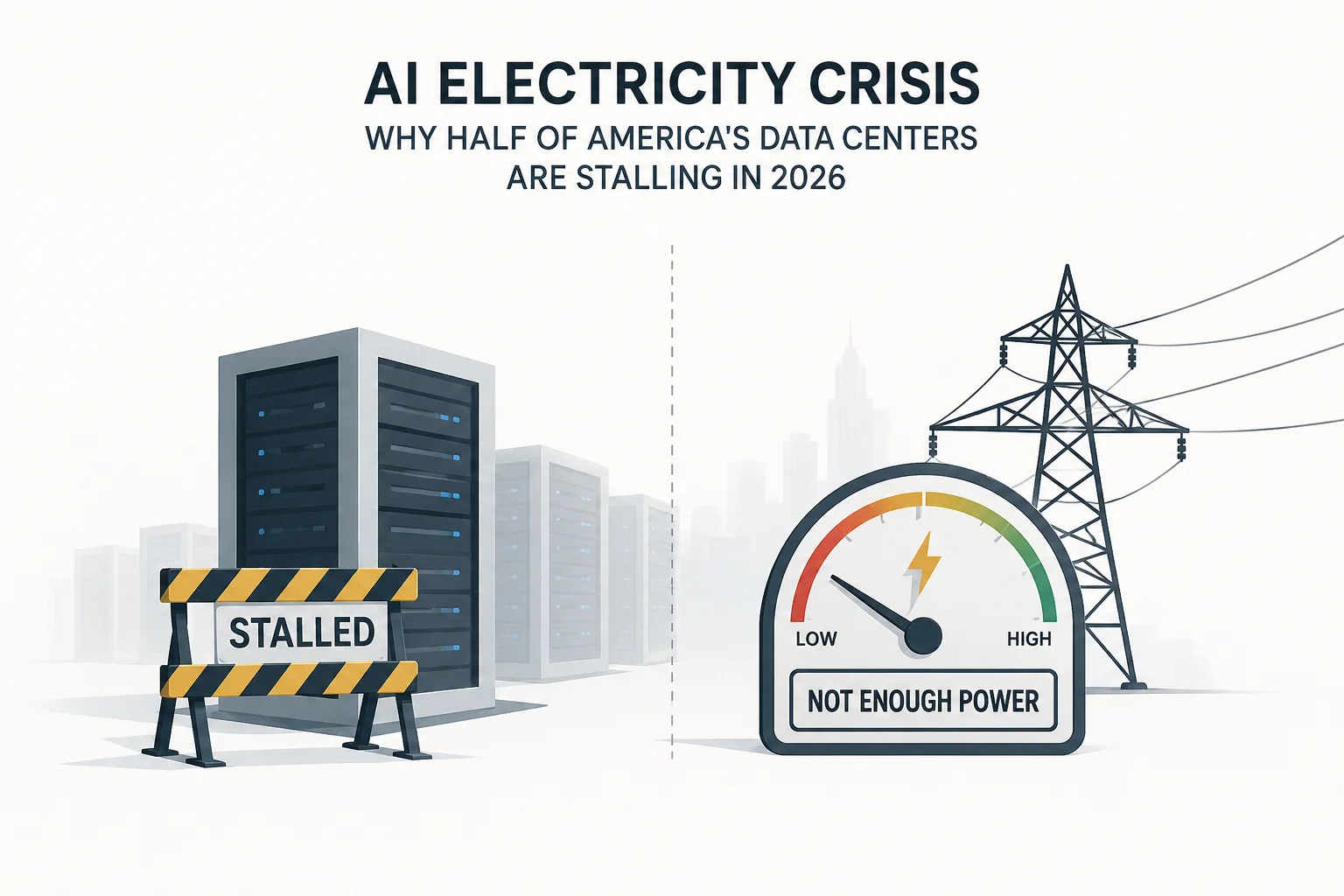
While everyone expected a chip shortage to derail the AI boom, it never happened. Nvidia is churning out GPUs faster than companies can rack them. In reality, the true bottleneck suffocating America’s AI infrastructure in 2026 is far more basic: there simply isn't enough power on the grid to plug them all in.
Roughly half of the AI data center capacity announced for construction this year in the United States is stuck. Not cancelled outright, just... waiting. Waiting for a transformer. Waiting for a grid study. Waiting for a utility to say yes. Behind the headlines about trillion-dollar AI investments is a much quieter story about substations, interconnection queues, and a power grid that was never built for what's being asked of it now.
Let's get into the details
Data center electricity demand has grown faster than the U.S. grid can physically accommodate it. High-voltage transformers that used to take two years to build now take up to five. Interconnection queues nationwide hold more capacity than the entire installed U.S. grid. As a result, industry trackers like Sightline Climate estimate that 30% to 50% of large AI data centers planned for 2026 will be delayed or cancelled, not because of GPU shortages or funding gaps, but because they cannot secure a reliable power connection in time.
So What's Really Happening Behind the Scenes
For most of the last decade, building a data center meant finding cheap land near fiber routes and calling it a day. That math broke somewhere around 2024. AI-optimized server racks now draw anywhere from 30 kW to over 100 kW each, compared to 5 to 15 kW for a traditional web-hosting rack. A single modern AI campus can request hundreds of megawatts, sometimes gigawatts, the kind of load that used to belong to a small city, not a building.
According to the International Energy Agency, global data center electricity use jumped 17% in 2025, with AI-focused facilities growing even faster than that. Hyperscaler capital spending crossed $400 billion in 2025 and is expected to climb another 75% in 2026. The money is there. The chips are there. What isn't there, in enough places, is megawatts.
The Grid Wasn't Built for This
Most of America's transmission infrastructure dates back 40 to 60 years. It was engineered for gradual, predictable load growth, not for a single customer showing up and asking for 500 MW in eighteen months. Utilities have to run interconnection studies, upgrade substations, and sometimes build entirely new transmission lines before they can safely say yes.
This is really no different from the chip export story your readers already know from our coverage of the quiet tech cold war — a critical resource becomes the real bottleneck once demand outruns supply, and everyone downstream feels it.
The Interconnection Queue Backlog
Data from Lawrence Berkeley National Laboratory shows there is now more generation and storage capacity sitting in U.S. interconnection queues than the country's entire installed grid capacity. The median wait time to reach commercial operation has stretched toward five years, and in some regions, closer to a decade.
Why Electricity Now Matters as Much as GPUs
Two years ago, the AI race was purely a compute race — who has the most H100s, who can train the biggest model. That's shifted. Site selection for new AI campuses is now driven first by "can we get power here," and only second by latency or fiber access. It's a strange inversion for an industry obsessed with chips, and it echoes something we already flagged when covering the global 2nm chip race: the bottleneck rarely sits where the headlines point.
Even efficiency gains in silicon, like the ones we looked at in our Tensor G6 vs Snapdragon efficiency breakdown, help at the chip level but barely dent the problem at data center scale, because the number of racks being deployed is growing faster than per-chip efficiency is improving.
Where the Bottleneck Actually Sits
| Stage | Typical Timeline | 2026 Reality |
|---|---|---|
| GPU procurement | 3–9 months | Largely on schedule |
| Land & permitting | 6–18 months | Facing local opposition in several states |
| Grid interconnection study | 1–3 years | Often 3–7 years in major markets |
| High-voltage transformers | Pre-2020: 24–30 months | Now up to 5 years |
| Switchgear | 12–18 months | Reportedly sold out through 2028 in some categories |
The Transformer Shortage Nobody Saw Coming
Electrical equipment is a small slice of a data center's total budget, under 10%, but it has become close to 100% of the delay. High-voltage transformers require specialized steel, limited global manufacturing capacity, and long factory queues. Utilities in Wisconsin alone have projects on the books needing a combined 3.9 GW of new capacity, and connecting that kind of load isn't something you fast-track with money alone.
What Happens When a Data Center Can't Get Power
When the grid can't deliver in time, developers have started skipping it entirely. This is often called "bring your own power," or BYOP.
- On-site gas turbines — fastest to deploy, but raises emissions and local permitting fights.
- Behind-the-meter solar and storage — clean, but rarely enough for a full AI campus load on its own.
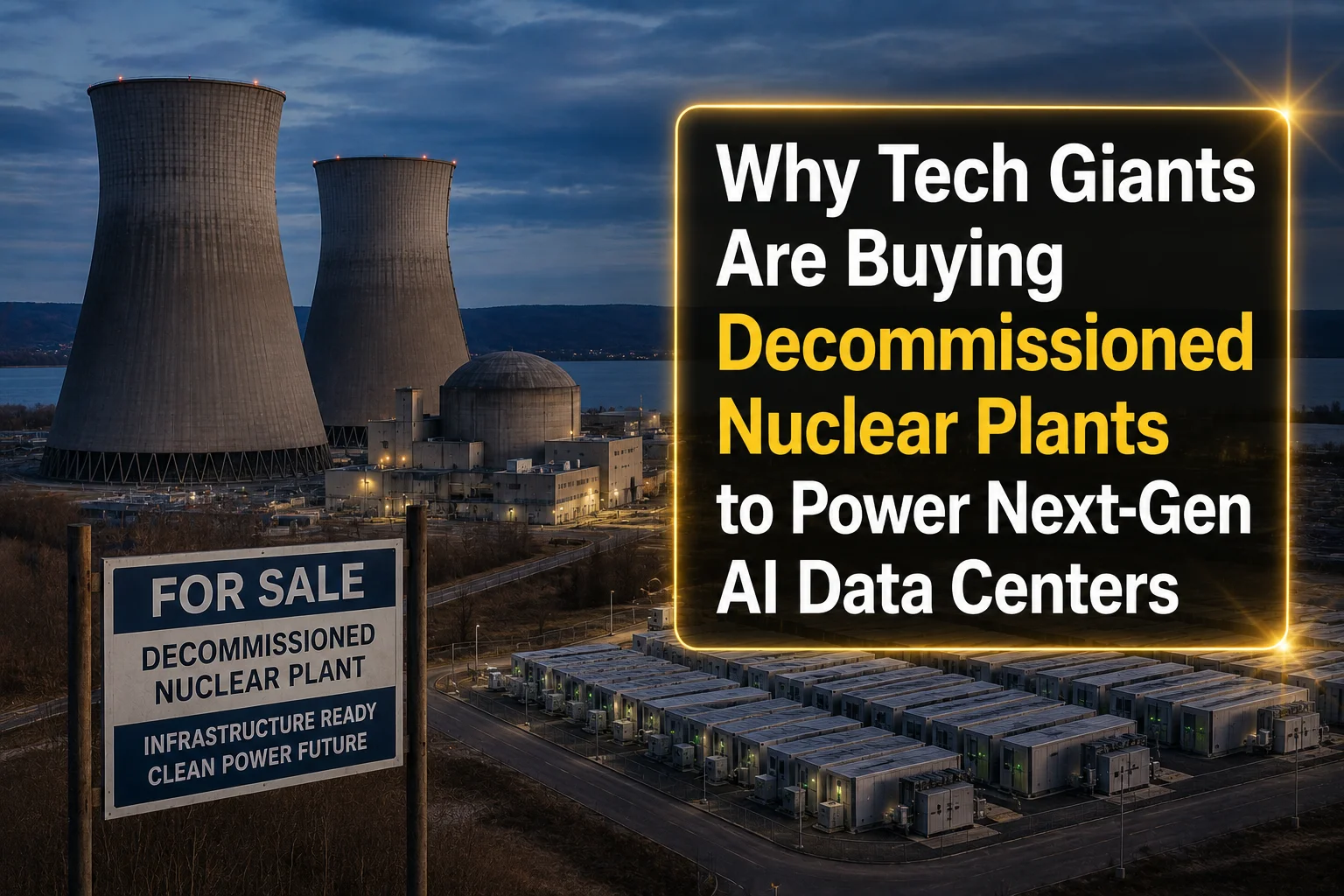
- Direct nuclear partnerships — companies are now funding advanced reactor projects just to lock in future capacity.
- Power purchase agreements (PPAs) — long-term contracts for dedicated wind, solar, or gas generation, often hundreds of megawatts at a time.
The U.S. Department of Energy has leaned into this shift too, closing a $26.5 billion loan package in early 2026 to add over 16 GW of dispatchable power in Georgia and Alabama, and backing advanced nuclear projects specifically framed around AI-driven demand.
The Three-Way Tug of War
Tech Companies
Amazon, Google, Meta, Microsoft, OpenAI, Oracle and xAI signed a "Ratepayer Protection Pledge" in March 2026, agreeing to fund the grid upgrades their own facilities require rather then push those costs onto residential customers. It's as much a PR move as a policy one, since public anger over rising bills has become impossible to ignore.
Utilities and Grid Operators
PJM Interconnection, which covers much of the eastern U.S., has seen capacity market prices spike sharply between the 2024–25 and 2025–26 delivery years. Utilities are now studying which markets even have room left, and several, including parts of Virginia, have quietly become saturated.
Governments and Regulators
In June 2026, FERC issued orders directed at every regional grid operator to speed up large-load interconnection, following pressure from the Department of Energy. At the state level, at least 18 states have introduced legislation creating special rate classes so data centers pay their own way instead of shifting costs to households, per data collected by the U.S. Energy Information Administration.
Pros and Cons of the Current Power Race
Pros
- Forcing long-overdue investment in transmission and generation infrastructure
- Accelerating advanced nuclear and grid-storage technology deployment
- Pushing utilities to modernize planning processes that hadn't changed in decades
Cons
- Residential electricity rates rising faster in regions near major data center clusters
- Multi-year project delays undermining AI capacity forecasts
- Community pushback and local moratoriums cancelling several projects outright
- Heavier reliance on natural gas in the near term, complicating climate targets
Alternatives Companies Are Exploring
- Relocating to power-rich regions — the Gulf Coast, parts of the Midwest, and even overseas markets with surplus generation.
- Modular and small-scale designs — smaller footprints that fit within what a local substation can actually deliver today.
- Flexible, demand-responsive operation — shifting non-urgent AI training workloads to off-peak hours.
- Retired coal-site reuse — repurposing existing grid connections at decommissioned power plants instead of building new ones from scratch.
The reality
Bottom line: The AI industry isn't slowing down because of demand, funding, or even chips. It's slowing down because the physical grid can't scale on the same timeline as software and silicon. Expect 2026 and 2027 to be defined by on-site generation deals, nuclear partnerships, and a genuine geographic reshuffling of where AI infrastructure actually gets built, favoring states with spare power over states with fast fiber.
Frequently Asked Questions
Why are data centers being delayed if companies have enough money to build them?
Money can't shorten a transformer factory's production queue or force a utility to finish a multi-year grid study faster. The constraint is physical capacity, not capital.
Is this only a U.S. problem?
No, but the U.S. is experiencing it most acutely because of how concentrated data center demand has become in a handful of regions like Virginia, Texas, and Georgia, combined with an aging domestic grid.
Will this raise my electricity bill?
In areas near large data center clusters, yes, rate increases have already been documented. Several states are now passing legislation to shift those upgrade costs back onto data center operators instead of households.
Could nuclear power actually fix this?
It could help in the long run, but new reactors take years to license and build. Nuclear is a solution for the 2030s, not for a data center that needs power this year.
Are any data center projects being cancelled outright, not just delayed?
Yes. A number of proposed projects have been cancelled in 2025 and 2026 alone due to a mix of local community opposition, state moratoriums, and confirmed inability to secure a power connection.

Comments 0
Be the first to comment!