Last updated: August 15, 2026
China+1 Latest Updates — August 2026
-
August 12, 2026 — Foxconn Opens $500M Bengaluru Campus: Foxconn officially inaugurated its newest component manufacturing and smartphone assembly hub in Karnataka, India, scaling up capacity to handle U.S.-bound device production previously concentrated in Zhengzhou.
-
August 8, 2026 — U.S. Finalizes 50% Tariff on Legacy Chinese Semiconductors: The U.S. Trade Representative enacted expanded Section 301 duties targeting Chinese-origin legacy chips and power electronics, triggering an immediate wave of dual-sourcing contracts to testing and packaging facilities in Malaysia and Vietnam.
-
August 4, 2026 — Tier-1 Auto Suppliers Break Ground in Nuevo León: A consortium of automotive electronics and wiring suppliers broke ground on a 150-hectare manufacturing cluster in Monterrey, Mexico, aiming to secure tariff-free North American supply chains under the USMCA.
-
July 29, 2026 — Pegatron Shifts 30% of Laptop Assembly to Hai Phong: Major electronics manufacturer Pegatron completed Phase 2 of its northern Vietnam expansion, formally transitioning nearly a third of its U.S.-destined notebook assembly lines out of eastern China.
Somewhere in a logistics office in Shenzhen, a supply chain manager is quietly signing off on a second production line — not in China, but in an industrial park outside Hanoi. There's no press conference. No "decoupling" headline. Just one line item in a quarterly planning document, repeated thousands of times across thousands of companies. That's how the biggest reshuffling of global manufacturing in decades is actually happening: quietly, spreadsheet by spreadsheet, container by container.
You've probably seen the headlines about the US and China "decoupling." What actually happens behind those headlines is a lot messier, slower, and more interesting than a clean divorce. This is what's really going on.
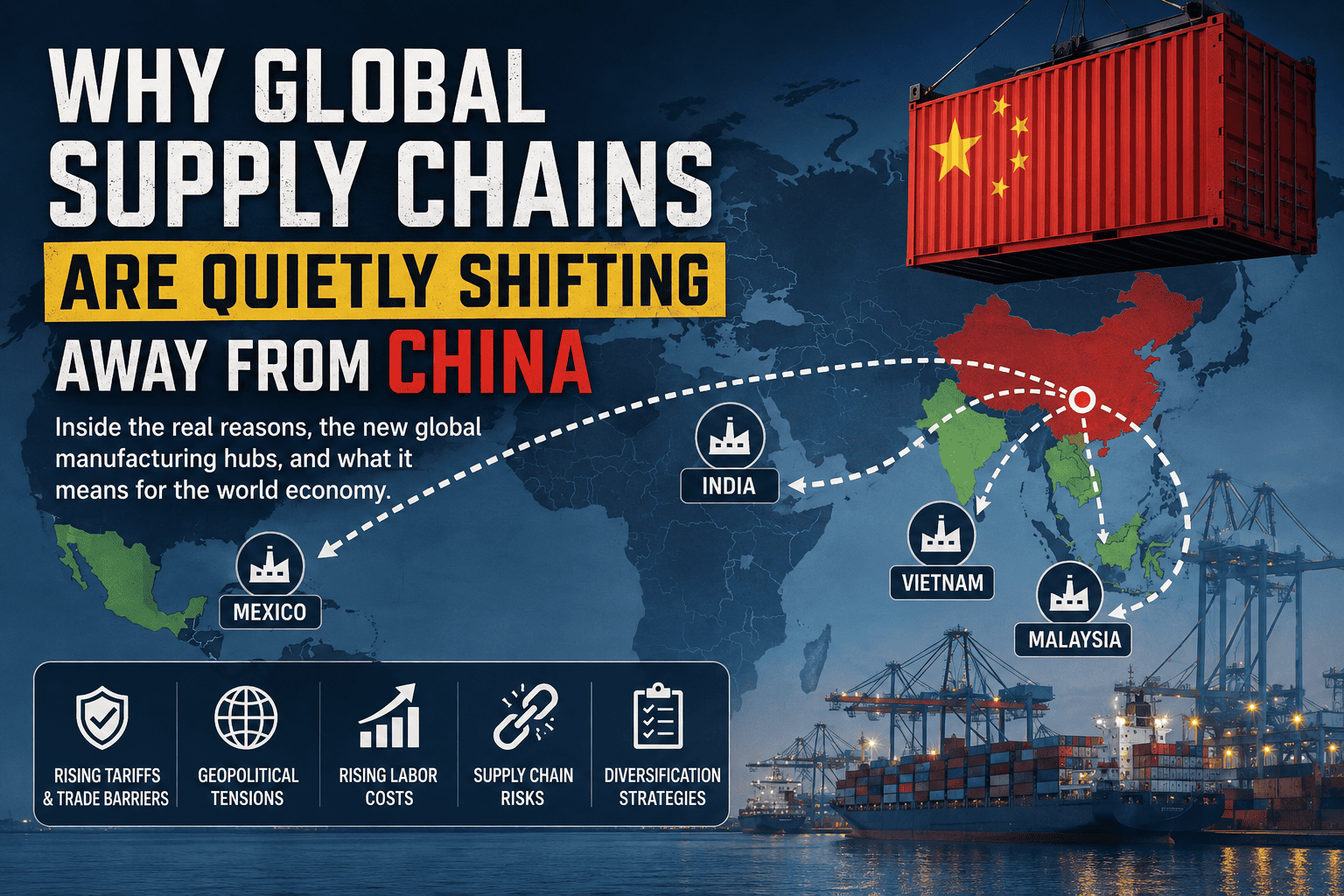
okay so the global supply chains really are shifting — but it's a hedge, not an exit. Tariffs, rising Chinese wages, and geopolitical risk are pushing manufacturers toward a "China Plus One" strategy: keep a footprint in China, but add Vietnam, India, Mexico, and other hubs for new capacity and backup production. China still produces roughly 28% of everything manufactured on the planet, more than the United States, Japan, and Germany combined. Nobody is walking away from that. They're just refusing to depend on it entirely.
So What's Actually Happening Behind the "Decoupling" Headlines
"Decoupling" makes it sound like a switch someone flips overnight. In reality, moving a supply chain is closer to moving a small city — factories, suppliers, ports, customs relationships, skilled labor, and years of accumulated know-how don't relocate in a single fiscal quarter. What's actually happening is a gradual redistribution, product line by product line, driven by cold arithmetic rather than politics alone.
A company doesn't wake up and decide to "leave China." It looks at a specific product — say, a mid-range laptop or a car alternator — and asks where that specific item can be made most cheaply once tariffs, freight costs, and political risk are all priced in. Sometimes the answer is still China. Increasingly, for products headed to the US market, it isn't.
The Real Reasons Companies Are Quietly Diversifying
1. Tariffs That Never Really Went Away
Section 301 tariffs, first imposed in 2018, never fully disappeared — they got layered, adjusted, and in several sectors, raised further. Semiconductors, electric vehicles, batteries, and critical minerals from China can now face duties ranging from 25% up to 100%, depending on the category, according to the Office of the U.S. Trade Representative. When a tariff adds tens of percentage points to your landed cost, sourcing from a country with a lower or zero tariff isn't ideological — it's basic cost accounting.
2. China Isn't the Cheap Labor Story Anymore
Factory wages in China's coastal manufacturing hubs have climbed for over a decade. The country that once competed almost entirely on cheap labor now competes on scale, infrastructure, and component ecosystems nobody else has matched — but for labor-intensive, lower-margin goods like garments, shoes, and basic assembly, that cost advantage has largely evaporated. Vietnam, Bangladesh, and parts of India now simply pay workers less for the same task.
3. Geopolitical Risk and the "One Point of Failure" Problem
Export controls, entity-list blacklists, and sudden regulatory shifts have taught procurement teams a hard lesson: a supply chain concentrated in one country is a single point of failure. This dynamic is easiest to see in semiconductors, where export licensing decisions can quietly reroute a supply chain worth billions overnight. The same logic now applies well beyond chips — to rare earth materials, batteries, and industrial components.
4. COVID-19 Was the Wake-Up Call, Not the Cause
The pandemic didn't start this trend, but it made the risk impossible to ignore. When a single lockdown in a single Chinese port city could stall car production lines on three continents, boards of directors started asking a question that hadn't come up much in the previous twenty years: what happens if this one country simply can't ship for a month?
Behind the Scenes: How a Company Actually Redesigns Its Supply Chain
Most coverage treats "moving out of China" like a single decision. In practice, it's a slow, multi-year process with a fairly predictable sequence:
- Audit exposure. Procurement teams map exactly which products, components, and suppliers are concentrated in China, and how much tariff or geopolitical risk each one carries.
- Qualify a second supplier. A factory in Vietnam, India, or Mexico gets sampled, audited, and tested — often producing a small trial batch alongside the existing Chinese line, not instead of it.
- Split volume gradually. New orders shift a percentage at a time — 10%, then 25%, then more — while the original supplier keeps producing the rest, partly to preserve leverage in price negotiations.
- Rebuild the component ecosystem. This is the slow part. A factory needs local suppliers for screws, packaging, plastics, and sub-assemblies. In many new hubs, those still have to be imported from China, which quietly keeps China embedded in the chain even after final assembly moves out.
- Renegotiate logistics. New shipping lanes, customs relationships, and warehousing get built around the new production geography, which can take longer than building the factory itself.
That fourth step is the part most headlines skip entirely. Vietnam's electronics sector, for example, still imports roughly 80% of its components — it's an assembly powerhouse, not yet a self-contained ecosystem. Moving final assembly out of China doesn't automatically mean China disappears from the chain; it often just moves one or two steps upstream.
Where Production Is Actually Going
| Destination | What It's Winning | Main Advantage | Main Limitation |
|---|---|---|---|
| Vietnam | Electronics assembly, phones, apparel | Competitive labor costs, strong free trade agreements, fast-growing FDI | Still heavily reliant on Chinese components and raw materials |
| India | Smartphones, electronics, pharmaceuticals | Huge workforce, government production-linked incentives | Costs run 5–10% higher than China for now; supply base still maturing |
| Mexico | Automotive parts, appliances, mid-volume electronics | Zero/low tariffs under USMCA, short shipping times to the US | Higher wages than Southeast Asia, capacity limits for complex electronics |
| Indonesia | Textiles, footwear, some electronics | Large population, low costs, growing industrial policy push | Infrastructure and logistics still catching up |
Vietnam: The Default "Plus One"
Vietnam has become the most common landing spot for production leaving China. In 2025, the country's exports of computers, electronics, and components crossed US$100 billion for the first time, and shipments to the US kept climbing into 2026, according to Voice of Vietnam. It's now the second-largest smartphone exporter to the US after China itself.
India: The Long Game
Apple is the clearest example here. The company assembled about 55 million iPhones in India in 2025 — a 53% jump from the year before — pushing India's share of global iPhone output to roughly a quarter, according to Bloomberg. It's still more expensive to build a phone in India than in China, but Apple is absorbing that gap in exchange for not having its entire supply chain sitting behind one border.
Mexico: Built for Speed
Mexico's pitch isn't the cheapest labor — it's proximity. A part made in Nuevo León can be on a US assembly line in days, not weeks, largely tariff-free under USMCA. Investor confidence has followed: Mexico jumped six spots in Kearney's 2026 Foreign Direct Investment Confidence Index, one of the largest gains of any country that year, according to Mexico News Daily.
Real-World Impact: Who Actually Feels This
| Sector | What's Changing | Effect You Might Notice |
|---|---|---|
| Consumer electronics | Phones, laptops, and accessories split production across India, Vietnam, and China | Regional price differences, occasional launch delays, and the same product quietly using different chips in different markets |
| Automotive parts | Alternators, wiring harnesses, and electronics increasingly sourced from Mexico | Faster restocking for US automakers, fewer port-related production halts |
| Apparel and footwear | Steady, longer-running migration to Vietnam, Bangladesh, and Cambodia | Marginal price stability, though most brands never advertise the switch |
| Semiconductors | Design and cutting-edge fabrication remain concentrated, largely outside China | GPU and laptop pricing swings tied to export rules, not just demand |
If you've noticed graphics card and PC prices swinging around for reasons that have nothing to do with the hardware itself, this is part of why — it's the same dynamic covered in our breakdown of how chip export bans are reshaping global power, and it bleeds directly into whether the next gaming PC or console you buy gets more or less expensive next year.
Pros and Cons of Diversifying Away From China
| Pros | Cons |
|---|---|
| Reduces exposure to a single country's tariffs, policy shifts, or shutdowns | New hubs often still depend on Chinese components, so risk isn't fully removed |
| Gives companies negotiating leverage with existing Chinese suppliers | Building a new supplier base takes years and real upfront investment |
| Shortens shipping times for regionally-focused hubs like Mexico | Costs are often higher in the short term than staying in China |
| Creates manufacturing jobs and investment in emerging economies | Quality control and infrastructure gaps can slow scale-up |
Verdict Box: Is the World Really Leaving China?
Short answer: no, but it's stopped putting all its eggs in one basket. China still dominates global manufacturing value added at close to 28%, according to World Bank figures compiled by Statista — more than the US, Japan, and Germany combined. What's actually shrinking is China's share of specific categories headed to specific markets, mainly the US, in electronics, apparel, and select automotive parts. This is diversification, not abandonment, and it's likely to stay that way for the forseeable future unless something dramatically accelerates it.
Alternatives to Full Diversification
1. China Plus One
The dominant strategy right now. Keep the existing Chinese production base for scale and speed, but qualify a second country for new capacity, overflow orders, or products headed to tariff-sensitive markets.
2. Friend-Shoring
Instead of chasing the lowest cost anywhere, some companies deliberately source from politically aligned countries — even at a premium — to reduce the odds of a sudden export restriction or sanctions regime disrupting supply.
3. Reshoring
Bringing production fully back to the US or Europe. It's politically popular and heavily subsidized in some sectors, but independent trackers like Kearney's Reshoring Index have shown it hasn't actually overtaken offshoring in most categories — the cost gap is still too wide for most products.
4. Dual Sourcing Within China Itself
An underrated option: some companies simply diversify within China, moving production from coastal hubs facing labor shortages to lower-cost inland provinces, without leaving the country at all.
What This Actually Means for Prices, Jobs, and Technology
- Prices: Expect gradual, uneven increases on tariff-exposed categories, and occasional short-term price stability where diversification succeeds in dodging duties entirely.
- Jobs: Manufacturing employment is growing in Vietnam, India, and Mexico, but reshoring hasn't produced the scale of factory jobs some politicians promised — automation fills much of the gap instead.
- Technology: The most advanced manufacturing — leading-edge chips, precision components — remains far harder to relocate than assembly work, which is why geopolitical tension over technology access keeps escalating even as everyday consumer goods diversify relatively smoothly.
Frequently Asked Questions
Is China losing its position as the "world's factory"?
Not in absolute terms — it's still the largest manufacturer on Earth by a wide margin. It's losing share in specific, mostly labor-intensive categories headed to the US market, while holding or growing its position in advanced manufacturing and exports to other regions.
Why is Vietnam the most common alternative to China?
Proximity, existing trade agreements, an already-established electronics assembly base, and years of prior investment from companies diversifying after earlier trade disputes gave Vietnam a head start most other countries didn't have.
Does moving production out of China actually lower prices for consumers?
Sometimes, but not reliably. New hubs often carry higher per-unit costs in the short term, and much of the savings from avoiding tariffs gets absorbed by companies rather than passed on immediately to shoppers.
Will manufacturing ever fully return to the US?
Unlikely at the scale some proposals suggest. Labor costs, automation economics, and the decades it took China to build its supplier ecosystem make a full reversal a multi-decade project at best, not a policy switch.
What products are hardest to move out of China?
Anything requiring a deep, mature supplier ecosystem — mid-range electronics with dozens of specialized components, precision machinery, and products where China's existing cluster of factories has no real substitute yet.
Final Words
The story here isn't a dramatic exit — it's a slow hedge, built order by order, factory audit by factory audit. Companies aren't abandoning China; they're refusing to be entirely dependent on any single country ever again, a lesson that tariffs, export bans, and a global pandemic all taught in different ways over the same decade. For everyday readers, the takeaway isn't which country "wins" this shift. It's that the phone in your pocket, the car in your driveway, and the price tag on both are quietly downstream of sourcing decisions made in procurement offices most people will never think about.
Sources: Office of the U.S. Trade Representative, Bloomberg, Statista / World Bank, Mexico News Daily, and Voice of Vietnam.



Comments 0
Be the first to comment!