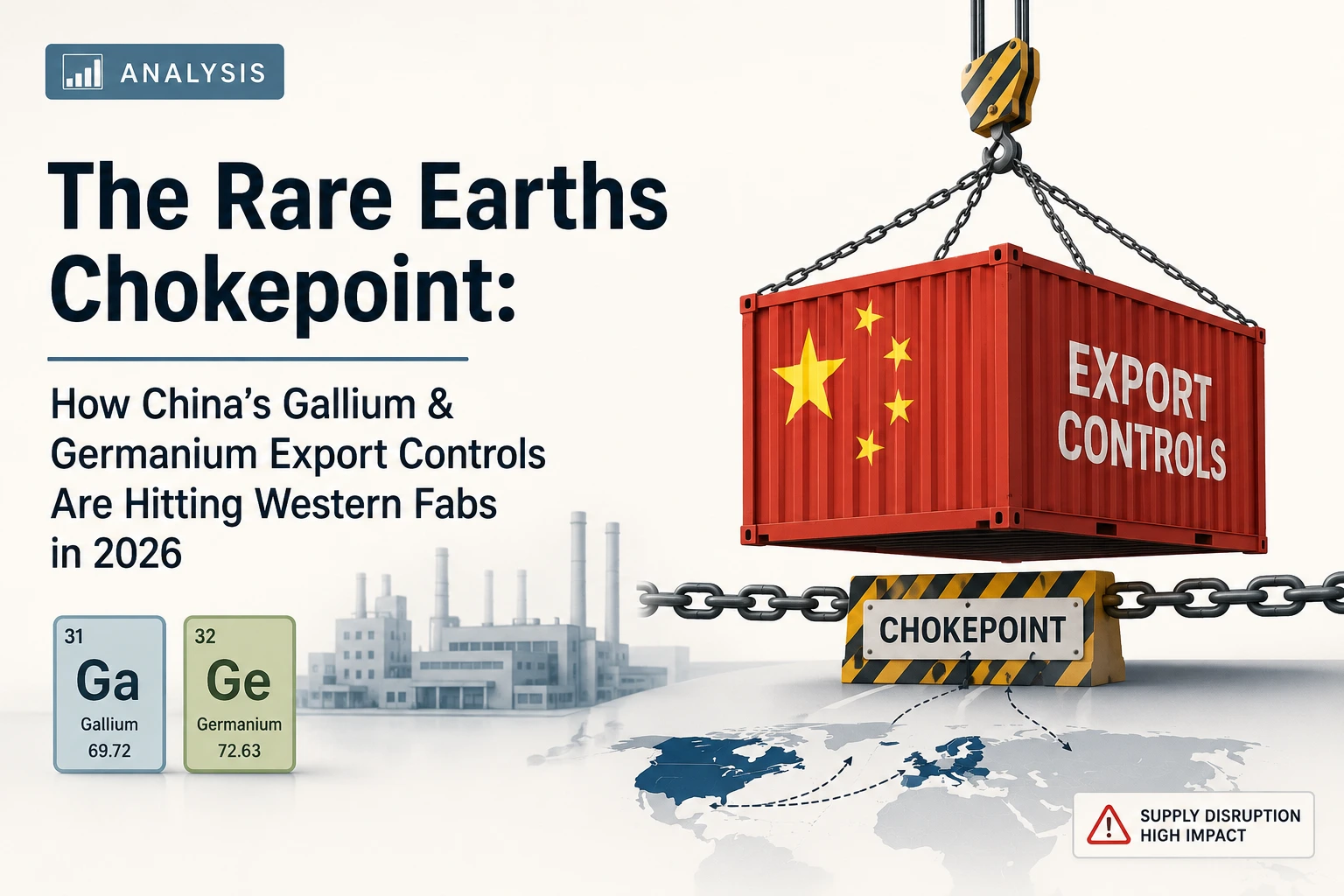
Gallium and germanium aren't in the transistor channel of your CPU, but they sit inside the RF chips, power electronics, fiber-optic gear, and wafer-polishing chemistry that keep a fab running. China controls roughly 98% of refined global supply of both. After a one-year truce, Beijing widened its export controls again in June and July 2026, and the July 2026 International Energy Agency outlook now puts $6.5 trillion of downstream production at risk worldwide if the rules are enforced in full, with the US and Europe carrying nearly half of that exposure. Retail chip prices haven't moved yet. Input costs already have.
So What China Actually Restricted, and When
This isn't a single ban, it's a slow ratchet that's been tightening for three years. Licensing requirements on gallium and germanium exports first went into effect on August 1, 2023. By December 2024, China had moved to what amounted to a near-total ban on shipments of both metals to the United States. Then came a pause: on November 9, 2025, Beijing suspended that ban as part of a broader trade de-escalation, with the suspension running through November 27, 2026. Licensing controls, and a standing ban on shipments to any US military end-user, stayed in place the whole time.
What changed the picture again this summer is that the truce didn't hold as a full ceasefire. On June 22, 2026, China's Ministry of Commerce tightened export restrictions on ten US companies, including two firms central to Washington's own rare earth build-out effort. A month later, on July 24, it extended similar restrictions to fourteen companies inside the European Union. In between, on July 16, the IEA published the $6.5 trillion figure that's since become the headline number everyone in the industry quotes.
| Date | Action | Who's Affected |
|---|---|---|
| Aug 1, 2023 | Licensing requirements begin on gallium and germanium exports | Global |
| Dec 2024 | China moves to a near-total export ban on both metals to the US | United States |
| Nov 9, 2025 | Ban suspended as part of a broader trade truce, running to Nov 27, 2026 | United States |
| Jun 22, 2026 | Ten US firms placed under tightened restrictions | United States |
| Jul 24, 2026 | Fourteen EU firms added to the restricted list | European Union |
| Nov 10, 2026 | Second wave of controls scheduled (holmium, erbium, thulium, europium, ytterbium) | Global |
| Nov 27, 2026 | Gallium/germanium suspension to the US is due to expire | United States |
We've been tracking this same escalating pattern from the semiconductor side since it first flared up, in our earlier piece on how chip export bans are reshaping global power. The materials fight is really the mirror image of the equipment fight: Washington restricts what chipmaking tools reach China, Beijing restricts what raw materials leave it.
Why Two Obscure Metals Can Bottleneck a Massive Industry
Here's the part that trips people up: gallium and germanium aren't what your CPU or GPU die is made of. That's still silicon. The two metals matter because of what they enable around the core chip, not inside it.
- Gallium arsenide (GaAs) goes into high-frequency RF chips, laser diodes, LEDs, photodetectors, and solar cells.
- Gallium nitride (GaN) handles power electronics and RF components that need to push higher voltage and frequency than plain silicon can manage.
- Silicon-germanium (SiGe) shows up in high-frequency transistors, plus fiber-optic and infrared optics.
- Germanium also plays a smaller role in specialty infrared lenses and detectors used in defense and industrial sensing equipment.
None of that is the mainstream logic die. But almost none of it is optional either. A modern fab, a 5G base station, and a data center's optical interconnects all depend on some slice of this supply chain, which is exactly why Huawei's own workaround strategy has leaned so heavily on securing non-restricted domestic material — a story we dug into in how Huawei built a 5nm chip despite US sanctions.
| Material | Hardware Role | Where It Shows Up |
|---|---|---|
| Gallium (GaAs / GaN) | Compound semiconductors for RF and power electronics | RF chips, laser diodes, LEDs, photodetectors, power modules |
| Germanium (SiGe) | High-frequency transistors and optics | Fiber optics, infrared optics, high-speed transceivers |
| Cerium | Wafer polishing (CMP) and wire bonds | Fabrication process, not the finished die itself |
| Neodymium / Dysprosium | Permanent magnets | HDD actuators, cooling fan motors, speakers |
Fabless vs. Owning the Fab: It Matters Less Than You'd Think
You'd assume fabless companies like Nvidia and AMD, which contract their manufacturing out to TSMC, are more insulated than an integrated manufacturer like Intel. In practice the exposure runs through a different layer entirely: RF component suppliers, optical transceiver makers, and the CMP slurry and equipment vendors that sell into every fab regardless of whose logo ends up on the finished chip. Whether it's TSMC in Taiwan, Intel in Arizona, or Samsung in Texas, they're all buying from a similarly concentrated upstream materials pool. That's a genuinely different kind of vulnerability than the one we wrote about in our look at whether China can compete in the 2nm chip race, which was mostly about who controls leading-edge manufacturing capacity. This is about who controls the inputs everyone's fab needs, no matter how advanced the process node is.
The Numbers: How Bad Is It, Really, for Western Fabs in 2026?
The honest answer sits between "nothing to see here" and "the sky is falling."
Pricing tells the clearest story. Chinese primary low-purity gallium climbed from roughly $325 per kilogram in January 2024 to around $420 by October of that year as the first licensing controls bit down. By early 2026, Rotterdam spot prices for gallium had reached somewhere around $2,100 per kilogram, reflecting just how scarce non-Chinese supply has become. According to the IEA's Global Critical Minerals Outlook 2026, gallium and heavy rare earths like dysprosium and terbium now trade in Europe at roughly five times Chinese domestic prices, with germanium running close to three times higher. One industry estimate, attributed to the trade group SEMI, put the 2023-2024 restrictions at cutting global semiconductor supply capacity by somewhere between 18 and 22 percent. Treat that figure as directional rather than exact, but it lines up with how tight the compound semiconductor segment specifically has become.
What hasn't happened yet, as of this writing, is a confirmed pass-through to retail GPU, CPU, or motherboard pricing. That gap between rising input costs and stable shelf prices is a pattern we've already watched play out once this year in a completely different part of the supply chain — see why RAM prices spiked in 2026 for how long that lag can run before it finally shows up at checkout.
The Western Countermove: Reshoring, Recycling, and Stockpiles
Governments on both sides of the Atlantic have stopped treating this as a background risk and started writing checks, and the amount of goverment money moving into gallium and germanium projects this year is a good measure of how seriously it's being taken.
In the US, the White House issued a Section 232 proclamation in January 2026 formally finding that import dependence on processed critical minerals threatens national security, opening the door to tariffs and minimum import prices if ongoing trade negotiations stall. The Department of Energy has also taken direct equity stakes in domestic producers, including a $150 million position tied to a roughly $450 million gallium production facility being built by Pinnacle Asset Management and Atlantic Alumina. Korea Zinc has separately announced plans for a critical-minerals smelter in Oklahoma aimed at gallium and germanium output.
The European Union adopted its own RESourceEU action plan in December 2025, modeled on the earlier REPowerEU energy strategy, with an initial €3 billion allocation to fast-track alternative supply projects. Gallium and germanium were explicitly flagged as priority materials for defense applications.
Recycling is the quieter half of the response. Redwood Materials in the US and the UK's Tyseley Energy Park are both scaling up recovery of critical minerals from existing products rather than mined ore, and a project shipping waste tailings from the Democratic Republic of Congo to Belgium is being used to extract germanium that would otherwise go unrecovered. None of this replaces Chinese refining capacity overnight. Building a smelter, unlike flipping a licensing switch in Beijing, takes years, not months. We covered the broader version of this reshoring push, well beyond just these two metals, in why global supply chains are quietly shifting away from China.
Pros and Cons of the Western Decoupling Push
| Pros | Cons |
|---|---|
| Reduces long-term exposure to a single-country chokepoint | New mines and refineries take years to reach commercial output |
| Government equity stakes de-risk early-stage projects for private investors | Non-Chinese material still costs 3–5x more right now, which someone has to absorb |
| Recycling adds supply without new extraction | Recycled volumes can't keep pace with demand growth on their own |
| Diversification across allied countries limits single-point failure | Coordination between the US, EU, Japan and others is still uneven |
Alternatives Fabs Are Actually Leaning On Right Now
- Non-Chinese primary production — expanded output from Australian, Canadian and US-based smelters, including established operations like Teck's Trail facility in British Columbia.
- Recycling and secondary recovery — pulling gallium and germanium back out of e-waste, industrial scrap, and process tailings instead of relying purely on fresh ore.
- Strategic stockpiling — the IEA has floated coordinated multilateral stockpiles of eleven high-risk materials as a comparatively cheap insurance policy against future shocks.
- Design-level substitution — some RF and power applications can shift toward silicon carbide or other compound semiconductors where GaN isn't strictly required, though this only works for a subset of use cases.
Verdict and conclusion
Is this a five-alarm crisis for the chip industry today? No, not yet. Is it a structural risk that's getting harder to ignore? Also yes. The materials involved are narrow and specific enough that most consumers will never notice a direct price tag on them, but they sit close enough to fab operations, RF components, and optical hardware that a sustained disruption would eventually ripple outward. The single date worth marking on a calendar is November 10, 2026, when a second, broader wave of rare earth controls is scheduled to take effect. Whether that date arrives on schedule, gets pushed back again, or triggers another round of escalation will say a lot about whether 2026 turns out to be a temporary standoff or the new normal for anyone building hardware in the West.
Frequently Asked Questions
Are gallium and germanium used to make the actual chip inside my GPU or CPU?
No. Leading-edge logic chips are built on silicon. Gallium and germanium matter for compound semiconductors like GaAs and GaN, wafer-processing chemistry, RF components, and fiber-optic hardware, rather than the core transistor material itself.
Has this pushed up the price of GPUs or laptops yet?
Not in a confirmed, direct way as of mid-2026. Input costs for gallium and related materials have risen sharply, but that hasn't clearly shown up in finished hardware pricing, similar to the lag seen before this year's RAM and NAND shortages hit shelves.
Why does China control so much of the supply?
China refines an estimated 98% of the world's gallium and germanium, largely because it built out that midstream refining capacity over decades while other countries didn't. Mining the raw ore is one thing; the specialized refining step is where the real chokepoint sits.
What happens on November 27, 2026?
That's when the current suspension of the gallium and germanium export ban to the United States is due to expire. Whether it's extended, allowed to lapse, or folded into a wider deal will shape materials pricing heading into 2027.
Can Western fabs just switch to non-Chinese suppliers?
Partially, and slowly. Projects in the US, Canada, Australia and the EU are ramping up, backed by direct government funding and equity stakes, but new refining capacity takes years to certify and scale. In the near term, Western buyers are paying a real premium for non-Chinese material rather than replacing Chinese supply outright.
Where can I check reliable, updated figures myself?
The International Energy Agency and the U.S. Geological Survey both publish regularly updated data on critical mineral supply and pricing, and the Semiconductor Industry Association tracks the industry's own exposure in detail.
Further reading on this standoff: the Center for Strategic and International Studies has a detailed one-year retrospective on the export restrictions, and the Stimson Center has modeled the broader economic consequences for the US in seperate detail.


Comments 0
Be the first to comment!