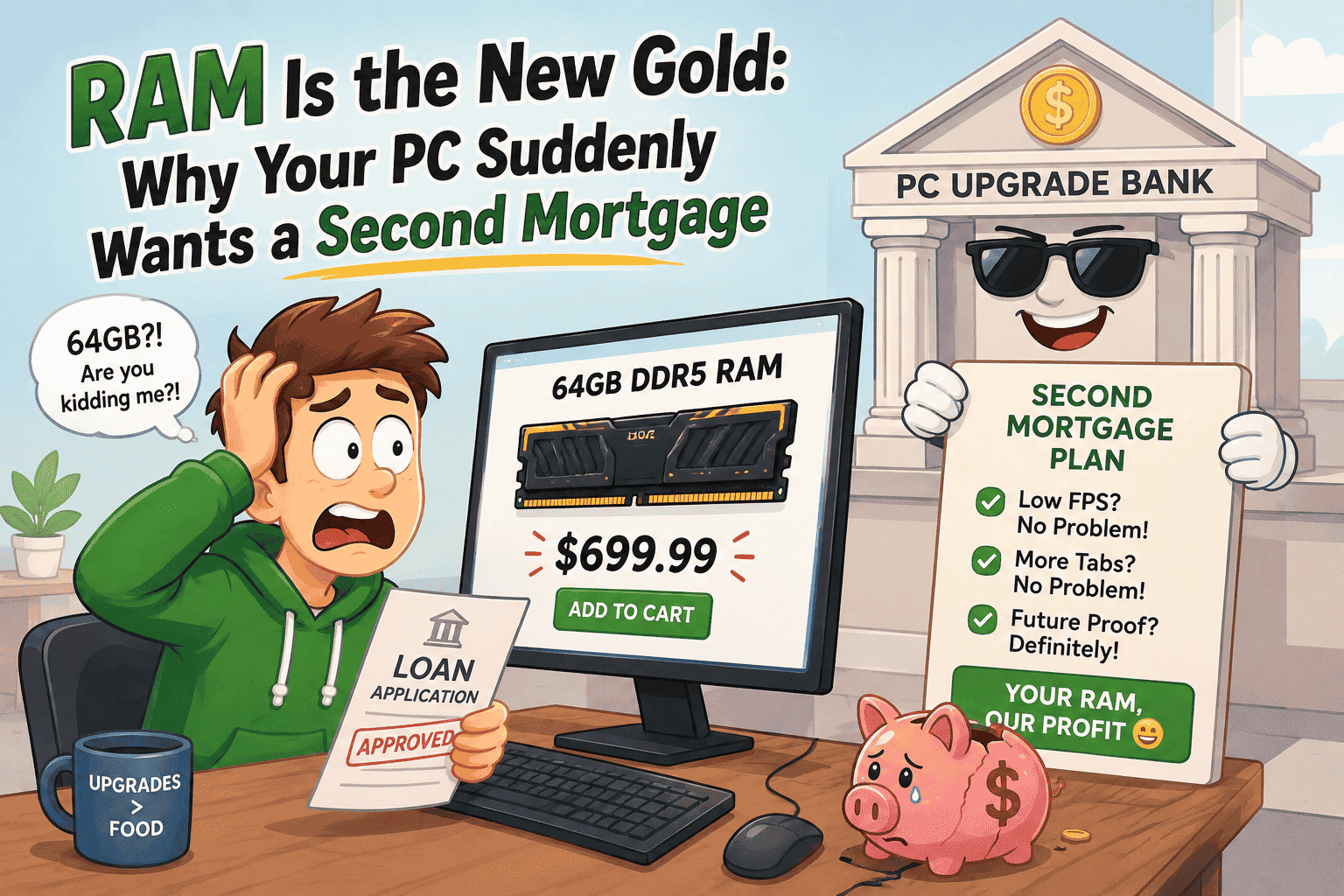
Somewhere between checking out a graphics card and adding a "simple" 32GB memory kit to your cart, you probably felt it: the small heart-attack moment where a part that used to cost less than a dinner for two now costs more than the CPU sitting next to it. You didn't imagine it. RAM genuinely has become one of the most expensive components in a PC build, and the reason has almost nothing to do with gamers at all.
Simply RAM prices are rising because AI data centers need enormous amounts of high-bandwidth memory (HBM), and the same three companies that make your desktop RAM — Samsung, SK Hynix, and Micron — are the same ones building AI memory. They've shifted factory capacity away from consumer DDR4/DDR5 toward HBM because it's far more profitable, which has cut consumer supply and pushed 32GB DDR5 kits from around $75–$100 in late 2025 to $375–$589 by August 2026. Analysts, including SK Hynix, expect the crunch to peak around 2027 and only gradually ease toward the end of the decade.
So What Actually Happens Behind the Scenes When You Buy RAM
Here's the part most price-tracking headlines skip. A memory chip doesn't start life as "gaming RAM" or "server RAM." It starts as a raw silicon wafer, and a factory decides what to stamp onto it based on whatever earns the most money that quarter. For most of the last decade, that meant consumer DDR4 and DDR5 modules for laptops, desktops, and phones, because that's where the volume was.
That math flipped almost overnight once generative AI infrastructure took off. A single AI server rack can burn through more high-grade memory than dozens of ordinary laptops combined, and the companies building that infrastructure — Microsoft, Google, Meta, Amazon, and the rest — are not price-sensitive the way a PC gamer is. When a hyperscaler is willing to pay whatever it takes to secure supply, a factory that used to split output between consumer and enterprise customers quietly stops splitting it at all.
Mmm And now Why Are RAM Prices Rising in 2026? The Real Supply and Demand Story
Just three companies control roughly 95% of the world's DRAM output: Samsung, SK Hynix, and Micron. That's already a tight oligopoly, and now all three are chasing the same customer base — AI accelerator makers like Nvidia — instead of competing hard for your wallet.
HBM: The AI Chip That's Eating Your RAM Budget
High-bandwidth memory, or HBM, is a stack of DRAM dies bonded on top of each other and wired directly next to an AI chip so data can move faster. It's what lets an Nvidia data-center GPU actually feed its processing cores at the speed AI training demands. The catch is that HBM is brutally inefficient to produce: industry estimates put its wafer cost at roughly three to four times that of standard DDR5 for the same capacity, because of the stacking, bonding, and lower yields involved. Every wafer a factory devotes to HBM is a wafer it isn't using to make the RAM sitting in your PC.
The Big Three Would Rather Sell You Nothing
This is the uncomfortable part. HBM and server-grade memory earn manufacturers three to five times the margin of consumer RAM, according to multiple industry analysts tracking the shift. So it isn't that Samsung, SK Hynix, and Micron can't make consumer memory anymore — it's that they'd genuinely rather not, when the same production line could be making something Nvidia will pay a premium for. That's a very different kind of shortage than a factory fire or an earthquake. It's a business decision, and business decisions don't reverse themselves just because gamers are upset.
Micron Basically Told Consumers "It's Not You, It's Us"
The clearest sign of where priorities sit came when Micron wound down Crucial, its consumer memory and SSD brand, to focus entirely on AI and data-center customers. According to Micron's own investor announcement, the move was framed as improving supply for "larger, strategic customers in faster-growing segments" — which is corporate language for "AI companies pay more." Micron has also indicated its HBM output is effectively sold out for the year, leaving essentially nothing left over for casual upgraders. It's the same kind of consolidation we've covered before in how global supply chains are quietly reshaping themselves around whoever can pay the most, fastest.
How Much Have RAM Prices Actually Gone Up?
Numbers make this easier to feel in your wallet than percentages do. Here's roughly where things stood in late 2025 versus where they sit as of August 2026, based on retail tracking from Tom's Hardware's RAM price index.
| Kit | Late 2025 | August 2026 | Approx. Increase |
|---|---|---|---|
| 16GB DDR5 | ~$70–$100 | ~$200–$240 | ~150–200% |
| 32GB DDR5 | ~$75–$125 | ~$375–$589 | ~300–400% |
| 64GB DDR5 | ~$150–$220 | ~$650–$680+ | ~250–300% |
| 32GB DDR4 | ~$60–$90 | ~$150–$220 | ~100–150% |
Notice that DDR4 wasn't spared either, even though it's the older, "boring" standard. Because DDR4 and DDR5 production shares some of the same fab capacity and wafer supply chain, a shortage in one bleeds into the other. There genuinely isn't a safe corner of the RAM market to hide in right now.
Is This Just Like the 2017–2018 RAM Shortage? Not Really
PC builders who've been around a while remember the 2017–2018 memory squeeze, which roughly doubled prices and eventually drew antitrust scrutiny toward the same three manufacturers. That crunch resolved itself in a year or two once new fab capacity came online and demand normalized.
This one is structurally different. It isn't a temporary bottleneck waiting for a new factory to open, it's a permanent reallocation of priorities. Even as Samsung, SK Hynix, and Micron pour tens of billions into new capacity, most of that new capacity is being earmarked for HBM and AI-grade memory before it's even built. That's why SK Hynix's own CEO, Kwak Noh-jung, told Bloomberg that customer demand is likely to keep outrunning supply capacity even beyond 2030. When the head of one of the three companies that controls the entire market says that out loud, on the day of his own company's stock listing, it's worth taking seriously.
Where Is This Heading? The RAM Market From Now Through 2031
Nobody has a perfect crystal ball here, but the pattern that industry executives and analysts keep pointing to looks something like this.
2026–2027: The Worst of It
SK Hynix's own leadership has publicly called 2027 the likely "worst year" in the memory industry's history for supply. New HBM4 chips are expected to roughly double in price per gigabit compared to current-generation HBM3E, and roughly half of global DRAM output may already be locked into long-term contracts with AI customers, leaving smaller PC and device makers fighting over what's left.
2028–2029: New Fabs Start Coming Online, Slowly
SK Hynix's massive Cheongju M15X facility and Micron's new Singapore and planned Taiwan fabs are expected to begin meaningfully adding supply in this window. Relief won't be instant or dramatic, but this is roughly when analysts expect the sharpest edge of the shortage to start dulling, assuming AI demand growth doesn't accelerate even further in the meantime.
2030–2031: A New, More Expensive Normal
Even the more optimistic forecasts don't expect RAM to fall back to 2024 pricing. What's more likely is a market where consumer memory stabilizes at a permanently higher price floor than PC builders were used to, because AI demand is expected to keep absorbing a large, guaranteed slice of global output indefinitely. Some analysts think the worst pricing pressure may already be behind us by then; others, including SK Hynix's own chairman, have said the shortage could still be running through 2030 and beyond. Reasonable people in the industry genuinely disagree on the exact timeline.
When Will DDR5 RAM Prices Drop? (RAM Prices & Market Forecast)
If you are checking price trackers daily hoping for a sudden DDR5 RAM price drop, the hard truth is that a return to sub-$100 32GB kits is nowhere on the near-term horizon. Because current fab capacity remains locked into enterprise AI contracts, overall RAM prices are operating under high baseline pressure that will prevent any rapid crash throughout 2026 and most of 2027.
However, understanding what actually triggers a DDR5 RAM price drop helps separate temporary retail discounts from genuine structural market relief.
What Needs to Happen for a Real DDR5 RAM Price Drop?
For consumer memory costs to experience a sustainable downward correction, three specific market conditions must align:
- HBM Production Yield Improvements: As packaging yields for high-bandwidth memory (HBM3E and HBM4) mature, memory foundries will require fewer total silicon wafers per gigabyte of AI output, freeing up residual wafer capacity for standard consumer DDR5 dies.
Fusion Worldwide
-
New Fab Capacity Hitting Volume Output (2028+): True supply relief depends on major manufacturing expansions—such as SK Hynix’s M15X fab and Micron’s expanded facilities—actually reaching mass production.
-
Hyperscaler CapEx Normalization: A meaningful drop in retail RAM prices will only happen once cloud giants ease their emergency inventory hoarding and transition into scheduled replacement cycles.
How to Spot Temporary Dips in RAM Prices Right Now
While a permanent market-wide price drop is years away, you can still catch localized dips in DDR5 RAM prices if you track buying windows strategically:
-
Watch Retail Component Bundles: Retailers frequently discount DDR5 kits when bundled with motherboards or CPUs to move slower-selling inventory without lowering standalone memory list prices.
-
Monitor Mid-Tier Speed Bins: High-frequency kits (like DDR5-6400+ CL32) carry steep enthusiast markups. Standard DDR5-5200 to DDR5-5600 modules frequently see minor price corrections first as supply stabilizes.
-
Use Automated Price-Tracking Tools: Volatility means memory kits can swing 10–15% within a single week. Setting automated price alerts on trackers like PCPartPicker or CamelCamelCamel lets you buy during brief promotional dips before stock sells out.
Should You Buy RAM Now or Wait?
This is the question everyone actually cares about, so let's be direct about it.
Verdict: Buy What You Need Now. Don't Buy What You're Hoping To Need Later.
Waiting for a meaningful price drop before late 2027 at the earliest looks like a bad bet based on everything manufacturers themselves are saying. If your current PC is genuinely short on memory and it's affecting how you work or play, buying now at today's inflated price beats buying in six months at an even more inflated one. What you shouldn't do is overbuy "just in case," since capacity you don't need yet is expensive insurance in a market this distorted.
How Much RAM Do You Actually Need in 2026?
Prices being high doesn't automatically mean you need more RAM than you think — in fact, this is the year to be honest with yourself about your real workload instead of chasing a bigger number.
| What You Do | Realistic RAM | Notes |
|---|---|---|
| Browsing, office work, streaming video | 8–16GB | 8GB is the bare floor now, not a comfortable target |
| Gaming at 1080p/1440p | 16–32GB | 16GB still runs most titles fine; 32GB adds headroom for the next few years |
| Streaming while gaming, light content creation | 32GB | Background encoding and multitasking start to matter here |
| Video editing, 3D rendering, local AI models | 64GB+ | Genuinely memory-bound workloads where more capacity pays for itself |
If you're gaming and wondering whether your GPU or your RAM deserves the bigger budget this year, it's worth reading how the same memory crunch is also reshaping GPU pricing in our breakdown of the best budget GPUs for 1440p gaming right now — VRAM shortages are hitting graphics cards through almost the exact same supply chain squeeze.
How to Upgrade Without Overspending
- Buy only the capacity your workload actually needs. 32GB is the sensible ceiling for most gamers and creators right now, not 64GB "to be safe."
- Check whether DDR4 is still viable for your platform. If your motherboard supports it, DDR4 remains meaningfully cheaper per gigabyte than DDR5, even after its own price hikes.
- Watch combo deals. Motherboard-plus-RAM or CPU-plus-RAM bundles have quietly become one of the few ways to beat standalone RAM pricing.
- Consider certified refurbished or pulled server memory from reputable sellers. It carries some risk, but it can meaningfully undercut new retail pricing if you buy from a seller with a real return policy.
- Don't chase peak speed ratings. A DDR5-6000 kit at CL30 costs a real premium over DDR5-5200; unless you're squeezing out competitive frame rates, the performance difference rarely justifies it this year.
- Time big purchases around sales events rather than buying the moment you decide you need an upgrade — memory pricing swings by the week right now, and a little patience within a purchase window can save real money.
DDR4 vs DDR5 in 2026: Pros and Cons
| DDR4 | DDR5 | |
|---|---|---|
| Pros | Cheaper per gigabyte, wide compatibility with older and budget platforms, mature and stable | Higher bandwidth, required for newer CPUs, better long-term upgrade path |
| Cons | Being phased out by newer platforms, its own prices have roughly doubled too | Costs roughly 2–2.5x more per gigabyte than DDR4 right now, hit hardest by the shortage |
Alternatives Worth Considering
If straight-up buying more RAM doesn't make sense for your budget this year, you've got a few side paths. Some prebuilt PC brands now offer "bring-your-own-RAM" programs that let you skip their marked-up memory pricing entirely. If you're building a new rig from scratch, it's also worth weighing whether you even need a full desktop tower — our comparison of handheld gaming PCs like the Legion Go 2 and Steam Deck covers how those devices sidestep a lot of this pricing mess with fixed, soldered memory configurations. And if you're torn between building your own machine or buying something pre-configured, our look at Valve's Steam Machine versus a traditional gaming PC digs into a similar cost-versus-flexibility tradeoff.
It's also worth understanding the bigger picture driving all of this. The same AI chip race that's draining RAM supply is tangled up with export controls and geopolitics — we broke down how that's playing out in our piece on chip export bans and global tech power, and how manufacturers like Huawei have responded to sanctions in our look at how Huawei built a 5nm chip despite U.S. restrictions. RAM pricing doesn't exist in a vacuum; it's one visible symptom of a much larger fight over who controls advanced chip manufacturing.
Our Advice and last words
RAM isn't overpriced because of greed alone — it's a symptom of an industry-wide bet on AI that consumer PCs happen to be losing.
If you need to upgrade or build now, do it with a clear, honest target for how much memory you'll actually use, not a "future-proof" number that just hands more money to a market already stacked against you. Buy 16GB if that genuinely covers your use case, 32GB if you're gaming or multitasking seriously, and save 64GB+ for workloads that actually demand it. The shortage looks likely to stay uncomfortable through at least 2027, with only gradual relief after that, so treat every RAM purchase this year like the premium item it currently is — becuase, for now, that's exactly what it is.
Frequently Asked Questions
Why is RAM suddenly so expensive in 2026?
AI data centers need massive amounts of high-bandwidth memory (HBM), and the same three companies — Samsung, SK Hynix, and Micron — that make consumer RAM have shifted factory capacity toward HBM because it's far more profitable. That's left less supply for everyday DDR4 and DDR5 memory, pushing consumer prices up sharply through 2026.
Will RAM prices ever go back to normal?
Probably not to pre-2025 levels. New factory capacity is coming online over the next few years, but most manufacturers plan to dedicate it to AI memory first. Most industry forecasts point to gradual easing after 2027, with a permanently higher price floor rather than a full return to old pricing.
Should I buy RAM now or wait for prices to drop?
If you have a genuine need, buy now. Every credible forecast points to prices staying high or climbing further through 2027, so waiting on a "recovery" that keeps getting pushed back rarely pays off.
How much RAM do I actually need for gaming in 2026?
16GB still runs most current games comfortably. 32GB is the realistic sweet spot if you multitask, stream, or want a few years of headroom. Anything beyond that is overkill for gaming alone at today's prices.
Is DDR4 a smarter buy than DDR5 right now?
If your platform supports it, DDR4 remains noticeably cheaper per gigabyte, even after its own price increases. It's a reasonable way to sidestep some of the worst DDR5 pricing, as long as your CPU doesn't require DDR5.
Does the RAM shortage affect other PC parts too?
Yes. GPUs use their own high-speed memory (GDDR), which is squeezed by the same wafer capacity fight, and it's a big part of why new budget graphics cards have been so scarce this year. You can see this play out directly in our Technology & PC Games section, where we track hardware pricing as it shifts.
Comments 0
Be the first to comment!