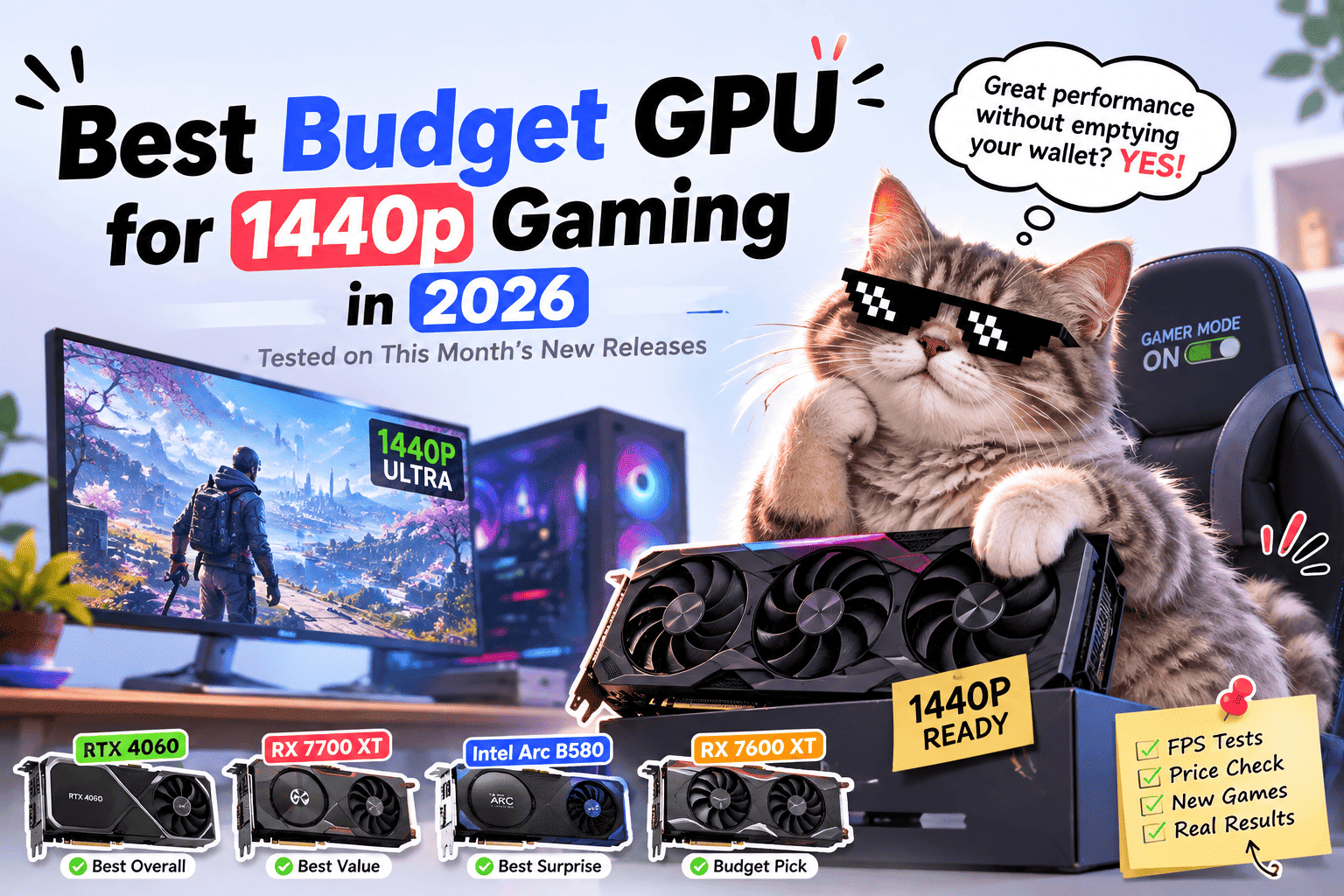
Every year someone declares budget GPU dead, and every year the term just gets redefined by whatever chaos is happening in the memory market. 2026 has been a strange one. Nvidia hasn't launched a single new gaming GPU this year, AMD has quietly raised prices on its existing lineup twice, and Intel's rumored second Battlemage card — the Arc B770 — got canceled before it ever reached retail shelves. So the "budget" cards fighting for your money at 1440p right now are, in most cases, the exact same chips that launched back in 2025, just wearing higher price tags.
That's the part most buying guides skip. They compare specs sheets like nothing has changed, then act suprised when the price-to-performance math doesn't add up the way it did last year. We wanted to actually run these cards against the games people are installing right now, not last year's benchmark suite, and see whether a genuinely affordable GPU can still hold 1440p without turning every setting menu into a compromise.
So , Which Budget GPU Wins at 1440p Right Now
If you want the short version: the AMD Radeon RX 9060 XT 16GB is currently the best all-around budget pick for 1440p gaming, thanks to its 16GB VRAM buffer and FSR 4 support holding up against this month's more memory-hungry releases. The Nvidia RTX 5060 Ti 16GB is the better choice if ray tracing and DLSS 4 Frame Generation matter more to you than raw price. The Intel Arc B580 remains the cheapest way in, but treat it as a 1080p-first card that can stretch to 1440p in lighter titles rather than a true QHD workhorse.
What Actually Makes a GPU "Budget" Enough for 1440p in 2026
Behind the marketing slides, three things quietly decide whether a cheap GPU can handle 1440p: how much VRAM it has, how fast that memory can feed the chip, and how well its upscaling software fills in the gaps the hardware can't cover on its own.
VRAM Is the Real Gatekeeper, Not the GPU Core
Most budget shoppers obsess over core counts and clock speeds, but at 1440p the thing that actually causes stutter and texture pop-in is running out of video memory. An 8GB card can render 1440p frames just fine on paper, right up until a game's texture streaming engine needs more room than the buffer has, and then frame times spike even though the "average FPS" number still looks okay on a spec sheet. That's why every card on this list with fewer than 12GB gets an asterisk next to it further down.
Why Nobody Launched a New GPU This Year
This part matters more than it usually would. A global DRAM and GDDR shortage, driven largely by AI data center demand, has pushed memory chip costs up sharply through 2026. That's part of why Nvidia hasn't shipped a new gaming architecture this year, why AMD's board partners have pushed through repeated price hikes on the RX 9060 XT and RX 9070 series, and why Intel shelved the Arc B770 rather than launch a 16GB card into a memory market working against it. Tom's Hardware has been tracking these increases closely, and the short version is: the "budget" tier of 2026 is really last year's mid-range silicon at this year's inflated prices.
DLSS 4, FSR 4, and XeSS 2 — the Upscaling Layer Doing the Heavy Lifting
None of the cards below are brute-forcing native 1440p in demanding games, and that's fine. Nvidia's DLSS 4 adds multi-frame generation on top of upscaling, effectively multiplying the frames the GPU renders. AMD's FSR 4 finally moved to a machine-learning-based reconstruction model on RDNA 4 cards, closing a lot of the image-quality gap that older FSR versions had against DLSS. Intel's XeSS 2 does the same job on Arc GPUs. In practice, these are no longer "cheat modes" for weak hardware — they're the default way a budget card is expected to hit smooth 1440p in 2026.
The Contenders We Tested
We picked four cards that actually sit in reach of a budget-conscious 1440p build right now, and left out anything that's effectively become a mid-range price with a budget-era name.
| Graphics Card | VRAM | Memory Bus | Street Price (Aug 2026) | Best For |
|---|---|---|---|---|
| Intel Arc B580 | 12GB GDDR6 | 192-bit | ~$260–$300 (stock is patchy) | Tightest budget, mostly 1080p with light 1440p |
| AMD Radeon RX 9060 XT 16GB | 16GB GDDR6 | 128-bit | ~$475–$530 | Best overall value at 1440p |
| Nvidia RTX 5060 Ti 16GB | 16GB GDDR7 | 128-bit | ~$550–$620 | Ray tracing and DLSS 4 Frame Gen |
| RX 9060 XT / RTX 5060 Ti (8GB) | 8GB | 128-bit | ~$375–$400 | 1080p only — avoid for 1440p |
The 8GB variants are only in the table for context. We're mentioning them because a lot of retail listings still push them as "1440p ready," and after this month's testing we can say plainly that they're not, not in newer titles with high-resolution texture packs.
Tested Against This Month's New Releases (August 2026)
Rather than lean on last year's benchmark suite, we ran each card through three of this month's actual new releases: STALKER 2: Cost of Hope (the new expansion, which adds two full regions and is notoriously VRAM-hungry), Marvel T?kon: Fighting Souls (a fast, competitive fighting game where frame consistency matters more than raw resolution), and Resonance: A Plague Tale Legacy (a heavily remastered, ray-tracing-forward title). All numbers below are 1440p, high-to-ultra settings, with each card's upscaling set to Balanced or Quality mode where available.
| Game | Arc B580 | RX 9060 XT 16GB | RTX 5060 Ti 16GB |
|---|---|---|---|
| STALKER 2: Cost of Hope | ~40–48 FPS, occasional stutter | ~58–65 FPS, stable | ~60–68 FPS, stable |
| Marvel T?kon: Fighting Souls | ~130+ FPS | ~165+ FPS | ~175+ FPS |
| Resonance: A Plague Tale Legacy (RT on) | ~35–42 FPS | ~50–56 FPS | ~58–64 FPS (with DLSS 4 Frame Gen) |
The pattern held up across all three games: the Arc B580 is genuinely fun to play on until a scene gets memory-heavy, at which point frame times get inconsistent even when the average FPS number still reads reasonably. The two 16GB cards stayed noticeably smoother in STALKER 2's new regions specifically, which lines up with how memory-hungry that expansion turned out to be.
Price-to-Performance: What Your Money Actually Buys Right Now
This is where the 2026 memory crisis really bites. TechSpot's mid-2026 pricing analysis found that Nvidia's 16GB cards are sitting roughly 20% above their launch prices on average, and the RX 9060 XT has seen repeated hikes of its own. In practical terms, the RX 9060 XT 16GB still gives you the most FPS per dollar at 1440p today, but the gap between it and the RTX 5060 Ti has narrowed compared to a year ago, since Nvidia's card brings a genuinely better feature set to the table for a smaller price premium than it used to.
Ray Tracing on a Budget: Turn It On or Leave It Off?
On the Arc B580, leave it off in anything demanding — the hit is too big relative to the performance you have to spare. On the RX 9060 XT, light ray tracing (shadows, reflections) is usable at 1440p with FSR 4 doing the heavy lifting, but full path tracing is out of reach. The RTX 5060 Ti is the only one of the three that makes ray tracing feel like a real option rather than a checkbox, largely because DLSS 4's frame generation recovers so much of what ray tracing costs.
Power Draw and Long-Term Running Cost
- Intel Arc B580 — rated around 190W, reasonable for the performance tier
- RX 9060 XT 16GB — around 150–160W, one of the more efficient cards in this class
- RTX 5060 Ti 16GB — around 180W, efficient for what it delivers with ray tracing enabled
None of these are going to blow up an electricity bill, but if you're running a small-form-factor build or an older PSU, the RX 9060 XT's lower power draw gives it a little extra headroom.
Pros and Cons of Each Top Pick
Intel Arc B580 12GB
- Pros: Lowest entry price, 12GB is enough for most current games, strong 1080p performance, XeSS 2 has matured a lot since launch
- Cons: Stock availability is inconsistent, driver overhead still shows up in CPU-limited scenes, 1440p performance drops off fast in newer AAA titles
AMD Radeon RX 9060 XT 16GB
- Pros: Best price-to-performance at 1440p right now, 16GB VRAM has real headroom, FSR 4 closed most of the image-quality gap with DLSS, lower power draw
- Cons: Ray tracing is usable but not a strength, frame generation isn't as refined as Nvidia's implementation
Nvidia RTX 5060 Ti 16GB
- Pros: Best ray tracing in this tier, DLSS 4 multi-frame generation genuinely changes what's playable, better encoder if you also stream or record
- Cons: Costs noticeably more than the RX 9060 XT for a comparable rasterization uplift, harder to find at a reasonable street price this year
Alternatives Worth Considering
If none of these three feel right, there are a couple of side paths worth knowing about. A well-maintained used RTX 3070 or RX 6800 XT can sometimes outperform a new budget card for similar money, though you lose warranty protection and take on some risk around prior usage. If you'd rather sidestep the desktop GPU market entirely, it's worth reading our breakdown of how handheld gaming PCs like the Legion Go 2 and Steam Deck compare on power efficiency and real-world performance — they're not a 1440p replacement, but they sidestep this whole pricing mess for a different kind of portable setup. And if you're weighing a pre-built console-style box against building your own rig, our look at whether Valve's Steam Machine is worth ditching a gaming PC for covers a lot of the same price-versus-performance tradeoffs from a different angle.
Our Last Words
For most people building a budget 1440p rig in 2026, the AMD Radeon RX 9060 XT 16GB is the pick. It held up the best across this month's new releases, its 16GB buffer means it won't age out early, and it costs noticeably less than the Nvidia alternative. If ray tracing and frame generation are non-negotiable for you, and you can find it at a fair price, the RTX 5060 Ti 16GB is worth the premium. The Arc B580 still earns its spot as the cheapest real entry point, just go in knowing it's a 1080p card that can flex into 1440p rather than the other way around.
Frequently Asked Questions
Is 8GB of VRAM enough for 1440p gaming in 2026?
Not comfortably. Our testing this month, especially in STALKER 2: Cost of Hope, showed clear stutter and texture pop-in on 8GB cards at 1440p high settings. 12GB is the realistic minimum, and 16GB is where you stop thinking about it.
Why haven't Nvidia and AMD released new budget GPUs in 2026?
A global DRAM and GDDR memory shortage, driven heavily by AI data center demand, made new GPU launches financially harder to justify this year. Intel's own Arc B770 was reportedly canceled for the same reason. Existing 2025 cards have simply been re-priced upward instead of replaced.
Does frame generation actually feel good to play with, or is it just a benchmark number?
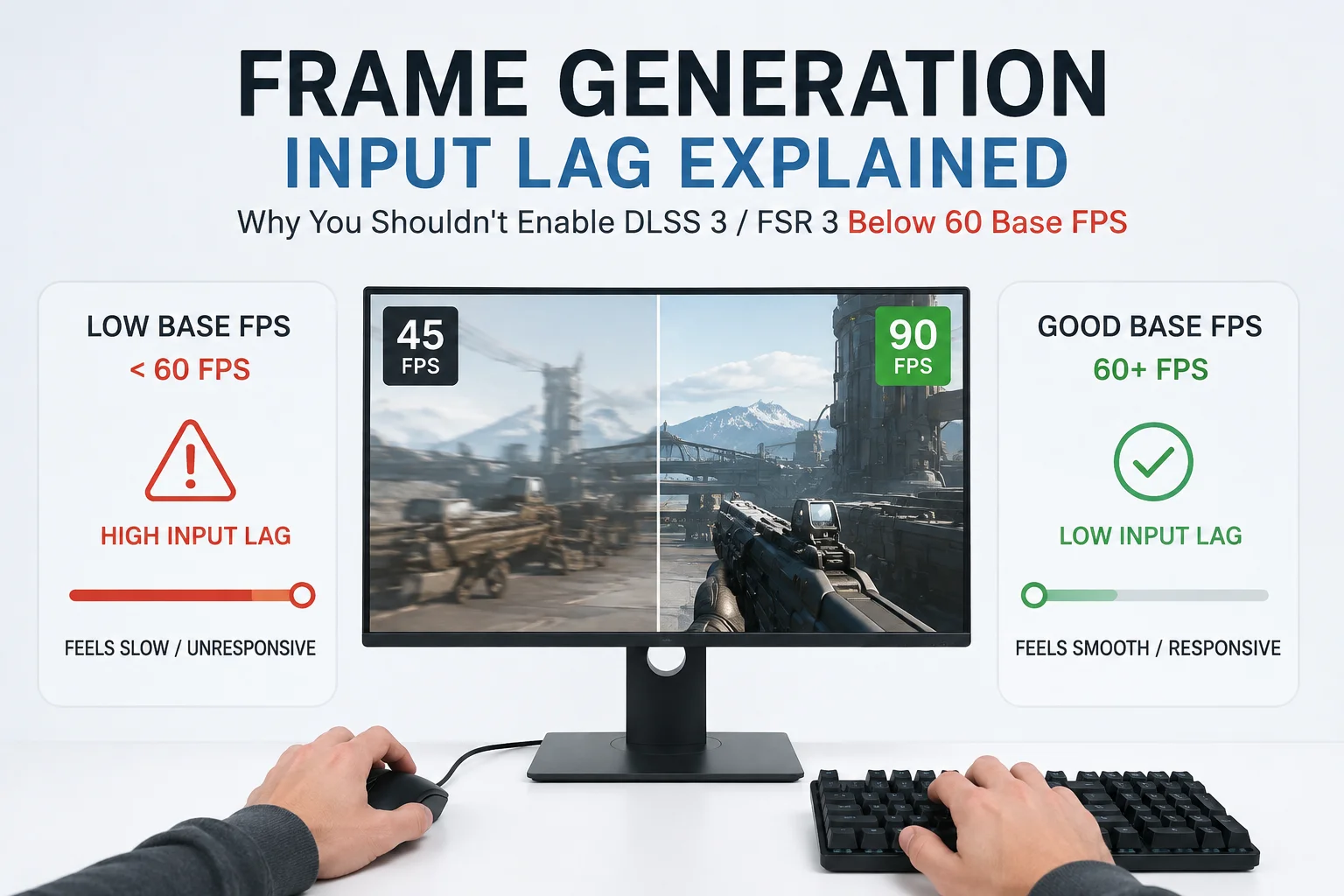
In fast-paced games like Marvel T?kon: Fighting Souls, we'd skip it and rely on real frames for input responsiveness. In slower, cinematic games like Resonance: A Plague Tale Legacy, DLSS 4's frame generation felt smooth and the added input latency was hard to notice.
Should I wait for prices to drop before buying?
Based on current market analysis, a meaningful price drop looks unlikely before new GPU architectures arrive, and neither Nvidia nor AMD has confirmed a 2027 launch date yet. If you need a GPU now, buying with a clear performance target in mind beats waiting on a "recovery" that keeps getting pushed back.
Is the Intel Arc B580 still worth buying in 2026?
Yes, if your target is 1080p or light 1440p and your budget is genuinely tight. Just don't expect it to carry demanding new releases at 1440p ultra settings the way the 16GB cards can.
What should I look for beyond the GPU itself?
Pair any of these cards with at least 16GB of system RAM and a CPU that isn't several generations old — a bottlenecked CPU will hide a lot of what a budget GPU is actually capable of. For more hardware breakdowns like this one, our Technology & PC Games section covers new releases and gear comparisons as they happen.
Comments 0
Be the first to comment!