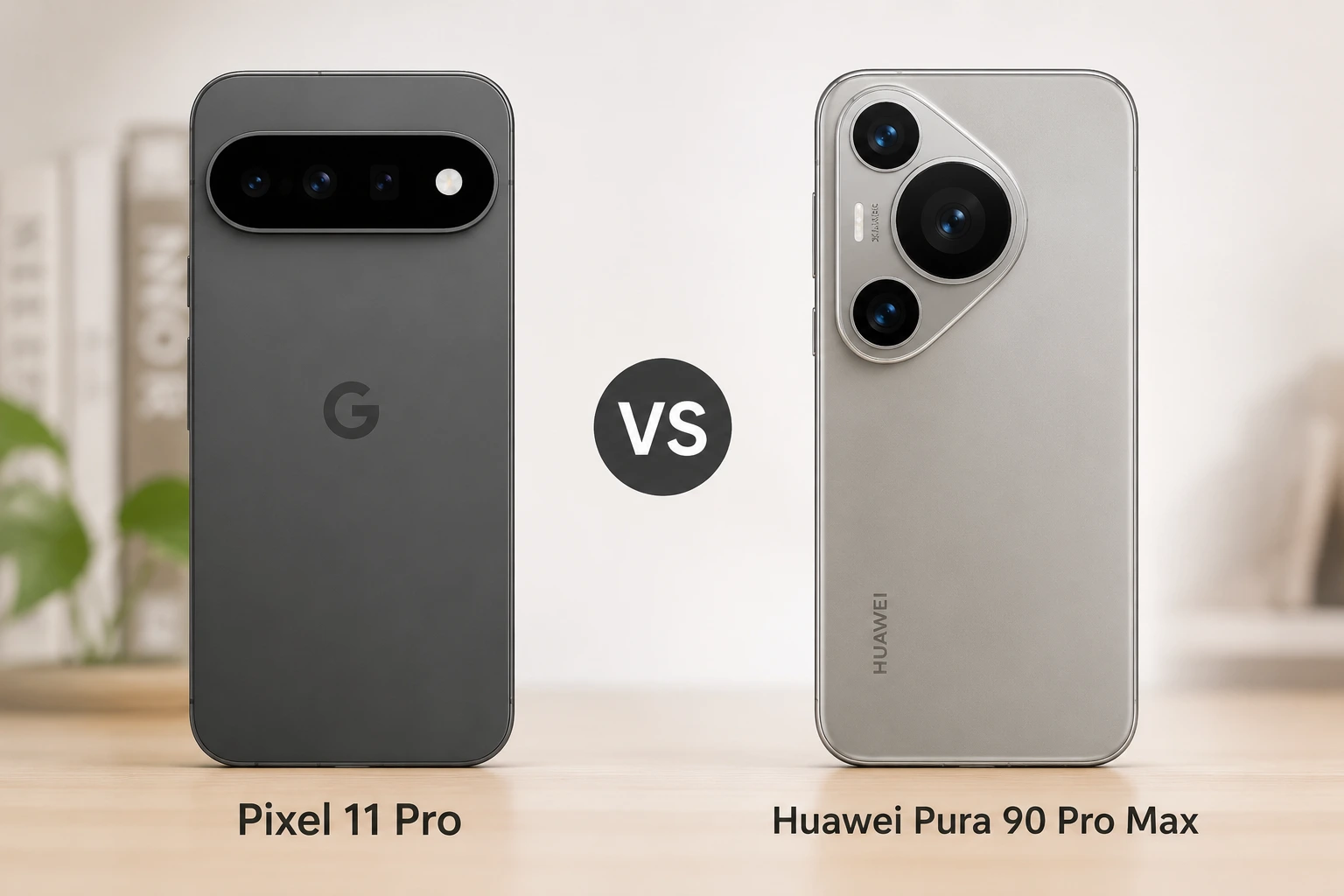
The Pixel 11 Pro and Huawei Pura 90 Pro Max are often portrayed as a simple chip battle: 2nm versus 5nm, newer versus older, winner versus loser. But that comparison gets a fundamental detail wrong from the outset. Google's Tensor G6 is not a 2nm chip; it is reportedly manufactured on a refined 3nm process. Huawei's Kirin 9030S, on the other hand, is built on a 5nm-class node. So the widely repeated “2nm vs. 5nm” narrative is misleading before the performance comparison even begins—and that's exactly what makes this matchup worth examining more closely.
This isn't a spec sheet rehash. It's a look at what each company actually built underneath the marketing, why a smaller node number didn't automatically hand Google a win, and where Huawei's hardware-first camera philosophy still holds up against Google's software-heavy one.
- The Tensor G6 inside the Pixel 11 Pro is built on TSMC's refined 3nm (N3P) process, not 2nm — Google confirmed this at launch, which we broke down in our 2026 2nm chip race coverage.
- The Kirin 9030S is a genuine 5nm-class chip, fabricated by SMIC using deep ultraviolet multi-patterning instead of EUV — the full story is in our Huawei sanctions workaround explainer.
- Despite the "older" node label, Tensor G6 still beats the Kirin 9030S on raw CPU and GPU benchmarks, roughly 1.9 million AnTuTu points versus around 1.6 million.
- Huawei wins decisively on camera hardware, with a 200MP periscope telephoto sensor against the Pixel's single 48MP unit.
- Google wins on ecosystem and AI assistant depth for most global buyers; Huawei's Pura 90 Pro Max ships without Google services outside China.
Spec-by-Spec: What's Actually Inside Each Phone
| Spec | Pixel 11 Pro | Huawei Pura 90 Pro Max |
|---|---|---|
| Chip | Tensor G6 (TSMC N3P, 3nm) | Kirin 9030S (SMIC N+3, 5nm-class) |
| CPU | 7-core: 1x C1-Ultra @4.11GHz, 4x C1-Pro @3.38GHz, 2x C1-Pro @2.65GHz | 8-core Taishan v124: 1x Big ~3.0GHz, 3x Mid ~2.27GHz, 4x Little ~1.72GHz |
| GPU | PowerVR CXT-series (via Vulkan translation layer) | Maleoon 935F (~933MHz) |
| RAM | 12GB LPDDR5X (down from 16GB last gen) | 12–16GB LPDDR5X |
| Main camera | 50MP, 1/1.3", f/1.68 | 50MP, variable f/1.4–f/4.0, OIS |
| Telephoto | 48MP, 5x optical, up to 120x digital | 200MP periscope, 4x optical (96mm), ~10x hybrid (240mm) |
| Ultrawide | 48MP, f/1.7 | 40MP, f/2.2 |
| Battery | 4,850mAh | ~6,000mAh / ~5,850mAh typical (global) |
| Charging | Standard wired ( 30W ) + wireless | 100W wired, 80W wireless |
| OS | Android 17 with Gemini built in | HarmonyOS 6.1 Built on Android 16, agentic AI assistant, no Google services outside China |
| Starting price | $1,099 | ~$1,150 / €1,150 |
The Node Myth: Why "2nm vs 5nm" Was Never the Real Story
Google let 2nm rumors run for months before quietly confirming the Tensor G6 stayed on a refined 3nm process. That's not a failure on Google's part, it's a deliberate trade-off — TSMC's 2026 wafer allocation for 2nm is reportedly booked solid, and a single 2nm wafer costs roughly 50% more than a 3nm one, according to TSMC's own technology documentation. We covered this exact dynamic across the whole industry in our 2nm race breakdown, where Apple's A20 Pro and Qualcomm's Snapdragon 8 Elite Gen 6 Pro are actually shipping on 2nm this cycle — Tensor G6 isn't.
Meanwhile, Huawei's "5nm" label carries its own asterisk. The Kirin 9030S is fabricated on SMIC's N+3 process using deep ultraviolet lithography run through multiple patterning passes, since ASML has been barred from selling EUV equipment to China since 2019. It reaches 5nm-class transistor density without ever touching an EUV machine, a genuinely impressive engineering workaround we detailed in our Pura 90 Pro Max chip deep dive. It's real, but it's also costlier per wafer and more yield-constrained than a TSMC 5nm chip from a few years back.
Two Manufacturing Philosophies, Two Different Bets
TSMC's N3P still uses FinFET transistors refined to their practical limit. SMIC's N+3 pushes DUV as far as it physically goes through a technique called Self-Aligned Quadruple Patterning. Neither company is chasing the same finish line this generation — Google optimized for AI efficiency and modem stability, while Huawei optimized for supply chain independence and camera silicon. Our 2nm vs 3nm processor explainer covers why the node number alone rarely predicts which chip actually feels faster in hand.
CPU and GPU: Who Actually Wins the Silicon Fight
This is where the node-number myth falls apart completely. Despite running an "older" 3nm process against Huawei's 5nm-class chip, the Tensor G6 posts noticeably higher benchmark numbers across the board.
| Benchmark | Pixel 11 Pro (Tensor G6) | Pura 90 Pro Max (Kirin 9030S) |
|---|---|---|
| Geekbench 6 single-core | ~2,688 | ~1,410 |
| Geekbench 6 multi-core | ~6,871 | ~4,100 |
| AnTuTu 11 | ~1.93 million | ~1.6 million |
| GPU compute (Geekbench) | ~6,195, an 80% jump over Tensor G5 | Maleoon 935F, no published compute comparison yet |
Two caveats matter here. First, Tensor G6's CPU actually dropped a core versus last year's chip — Google trimmed one of the middle cores to free up die space, likely for the TPU, which is why multi-core gains look smaller than the single-core jump. Second, Huawei's Maleoon 935F GPU is a known weak point; independent testers have flagged the "S" variant of the Kirin 9030 family as a step down from the standard Kirin 9030's graphics silicon, prioritizing camera and AI blocks over gaming muscle.
Try This Yourself
If you're shopping in person, don't trust the spec sheet alone. Open a demanding game on both phones in-store, play for five straight minutes, then check how warm each device runs near the camera bump. That five-minute test tells you more about sustained performance than any single benchmark number, since thermal throttling is where node and cooling design actually show up in daily use.
Power Efficiency: Where the Real Node Advantage Should Show
On paper, a more advanced node should mean better efficiency, and this is genuinely where Tensor G6 pulls ahead — just not purely because of the manufacturing process. Google also swapped its long-troubled Samsung modem for a MediaTek M90 5G modem this generation, which independently addresses a heat and battery drain issue that's dogged Pixel phones for years. That modem change, not the node shrink, is doing a lot of the efficiency work here.
Huawei's approach leans the other direction: a genuinely massive 6,000mAh battery (rated closer to 5,850mAh on global units due to EU labeling rules) simply outlasts a smaller battery through brute capacity rather than chip-level efficiency. Combined with 100W wired charging, the Pura 90 Pro Max rarely leaves you anxious about battery life, even if its chip runs less efficiently per task.
Camera Hardware: Reconstruction vs Raw Optics
This is the category where "newer node" matters least and camera philosophy matters most. Google's Pixel 11 Pro leans almost entirely on computational photography — burst capture, HDR+ frame merging, and TPU-driven noise reduction doing the heavy lifting behind a comparatively modest 48MP telephoto sensor, a strategy we examined closely in our Pixel 11 Pro camera pipeline breakdown.
Huawei goes the opposite direction. The Pura 90 Pro Max's headline feature is a 200-megapixel periscope telephoto sensor, the largest telephoto sensor on any phone this generation, paired with a variable f/1.4–f/4.0 main aperture that physically adjusts to lighting conditions instead of relying purely on software correction. Huawei's predecessor, the Pura 80 Ultra, actually topped DXOMARK's camera rankings with a 175-point score, ahead of every iPhone and Galaxy flagship at the time, so this isn't a company bluffing about camera credentials.
The trade-off is texture handling. Reviewers testing the Pura 90 series have noted the AI upscaling pipeline occasionally over-sharpens fine detail at extreme zoom, producing an inconsistant, slightly artificial texture in some shots — a software reliability issue, not a hardware one, and one Google's more conservative computational approach mostly avoids.
On-Device AI: Gemini Nano vs HarmonyOS's Agentic Assistant
Both companies are now building AI directly into silicon rather than treating it as an app layer. Tensor G6's TPU got a real generational bump, and Google claims Gemini Nano tasks run meaningfully faster while drawing less power per task — the specifics are in our Tensor G6 efficiency deep dive. That efficiency directly benefits features like Magic Editor and Instant Night Sight without draining the battery over a full day.
Huawei's Da Vinci NPU inside the Kirin 9030S delivers a claimed 200% jump in NPU image-processing capability over the previous Kirin 9020, plus a 110% improvement in AI-driven telephoto video clarity, according to Huawei's official specifications. HarmonyOS 6.1 also ships with a genuinely agentic AI assistant capable of multi-step tasks, not just single commands. The catch for most buyers outside China: no Gmail, Maps, or Play Store natively, which remains the single biggest reason global buyers hesitate on any Huawei flagship.
Pros and Cons
Pixel 11 Pro
- Pros: Stronger raw CPU/GPU benchmarks despite the "older" node, more efficient AI processing per task, full Google ecosystem, lower starting price.
- Cons: RAM cut to 12GB from last year's 16GB, GPU still trails dedicated gaming-focused chips, single telephoto lens versus Huawei's dual-reach setup.
Huawei Pura 90 Pro Max
- Pros: Best-in-class telephoto hardware, physically variable aperture, massive battery with 100W charging, proven camera pedigree from the DXOMARK-topping Pura 80 Ultra.
- Cons: No Google Mobile Services outside China, weaker CPU/GPU benchmarks, occasional AI over-sharpening at extreme zoom, higher manufacturing cost per chip due to lower SMIC yields.
Alternatives Worth Considering
If neither phone's ecosystem trade-off sits right with you, Samsung's Galaxy S26 Ultra splits the difference with a 200MP main sensor and full Google services — we compared it directly against the Pixel 11 Pro in our Pixel 11 Pro vs Galaxy S26 Ultra camera and AI comparison. If you'd rather wait for an actual 2nm phone chip, Apple's A20 Pro and Qualcomm's Snapdragon 8 Elite Gen 6 Pro are both landing within weeks of each other, detailed in our TSMC vs Samsung 2nm foundry breakdown.
Verdict Box
For most buyers: the Pixel 11 Pro is the safer overall pick. It benchmarks faster despite the node disadvantage, its AI processing is more power-efficient, and you keep the full Google ecosystem.
For photography-first buyers who don't need Google services: the Pura 90 Pro Max's telephoto hardware and variable aperture are genuinely unmatched at this price, especially if you already live inside Huawei's ecosystem or don't mind sideloading apps.
Bottom line: a smaller node number didn't win this fight. Execution did — and this generation, Google's "outdated" 3nm chip out-benchmarks Huawei's "newer" 5nm one on almost everything except the camera.
Frequently Asked Questions
Is the Pixel 11 Pro actually a 2nm phone?
No. Despite pre-launch rumors, Google confirmed the Tensor G6 uses a refined 3nm process (TSMC N3P), not 2nm. The earliest realistic 2nm Tensor chip is expected in 2027.
Is the Huawei Pura 90 Pro Max's chip really 5nm?
It's a 5nm-class node. SMIC's N+3 process reaches comparable transistor density to early 5nm chips from TSMC or Samsung, but it's built using older deep ultraviolet lithography with multiple patterning passes rather than EUV, so cost and yield aren't identical to a true EUV-based 5nm chip.
Which phone has better raw performance?
The Pixel 11 Pro, despite running on the technically less advanced node. Its Geekbench and AnTuTu scores are noticeably higher than the Kirin 9030S across CPU and GPU tests.
Which phone has the better camera?
It depends what you shoot. The Pura 90 Pro Max's 200MP periscope telephoto and variable aperture give it a real hardware edge for zoom and low-light main-camera shots. The Pixel 11 Pro's computational pipeline produces more consistent, natural-looking results overall.
Can I use Google apps on the Huawei Pura 90 Pro Max?
Global units run HarmonyOS 6.1 without Google Mobile Services but it's Built on Android 16 so it's can run apk files, relying on Huawei's AppGallery instead, though workarounds exist for some apps.
Should I wait for a true 2nm phone instead of buying either one?
Only if you want the newest node specifically. Apple's A20 Pro and Qualcomm's Snapdragon 8 Elite Gen 6 Pro will be the first genuine 2nm phone chips in late 2026 — both the Pixel 11 Pro and Pura 90 Pro Max sit a generation behind that specific race, though neither one is worse off for it in daily use.


Comments 0
Be the first to comment!