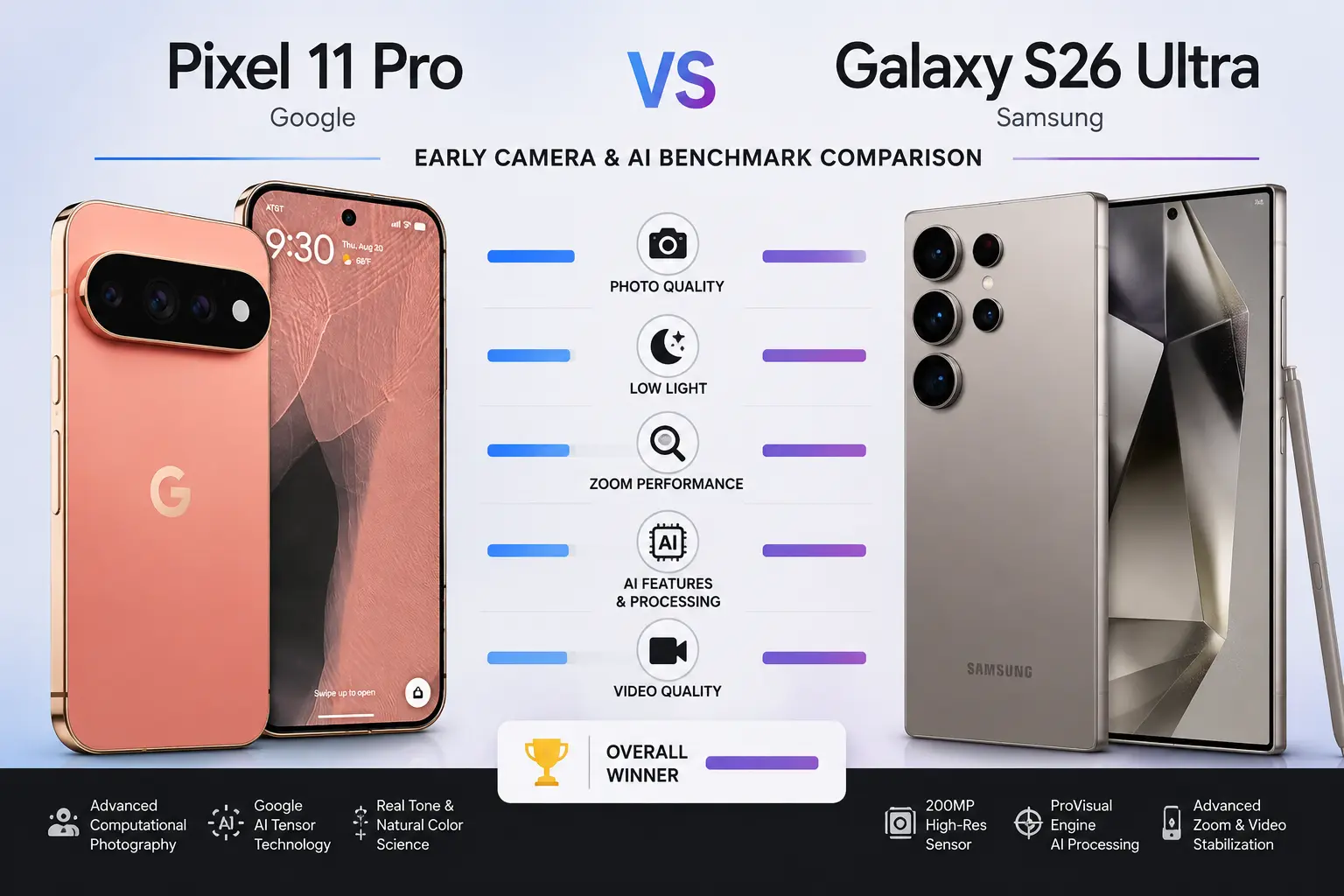
Google's Pixel 11 Pro landed on shelves before Samsung's Galaxy S26 Ultra had even cooled off from its own launch cycle, and buyers keep asking the same question they ask every year: which camera actually deserves your money, the one with the AI reputation or the one with the bigger sensor. The honest answer needs more than a spec sheet, because both companies now lean so heavily on software that the raw hardware numbers only tell half the story.
This isn't a marketing recap. It's a look at what happens between the tap of the shutter and the photo landing in your gallery on each phone, where the real differences in image processing, zoom, and on-device AI actually live, and why early benchmark numbers deserve a healthy amount of caution this soon into both phones' life cycles.
Let's delve into the details for a quick answer
- Samsung's Galaxy S26 Ultra has already been benchmarked by DXOMARK, scoring 157 points and landing 18th globally, a real step up from the S25 Ultra's 151 but still outside the top tier.
- The Pixel 11 Pro hasn't gone through independent camera benchmarking yet at the time of writing, so any confident "winner" claim floating around right now is partly educated guesswork based on the Pixel 10 Pro XL's strong 163-point result.
- Samsung wins on raw hardware: a 200MP main sensor, a brighter f/1.4 aperture, and four rear cameras versus the Pixel's three.
- Google wins on computational consistency: HDR+, Real Tone, and Tensor G6's TPU are built to make a smaller sensor punch above its resolution, especially in tricky light.
- For on-device AI specifically, Tensor G6's TPU currently has an efficiency-per-task edge over Snapdragon's more general-purpose Hexagon NPU, though Snapdragon still leads on raw sustained performance.
The Hardware Both Companies Are Betting On
Before getting into processing pipelines, it helps to see what light is actually hitting each sensor. Samsung kept the same core 200MP ISOCELL HP2 sensor it has used since the Galaxy S23 Ultra but widened the aperture and swapped the periscope module, a change confirmed by GSMArena's teardown and review. Google redesigned its main sensor for the Pixel 11 Pro and pushed its telephoto reach further than any Pixel before it.
| Spec | Pixel 11 Pro | Galaxy S26 Ultra |
|---|---|---|
| Main camera | 50MP, 1/1.3", f/1.68 | 200MP, 1/1.3", f/1.4 |
| Ultrawide | 48MP, f/1.7 | 50MP, f/1.9 |
| Telephoto | 48MP, 5x optical, up to 120x Pro Zoom | 50MP 5x (f/2.9) + 10MP 3x (f/2.4), up to 100x Space Zoom |
| Front camera | 42MP | 12MP |
| Video | 8K/30fps with Video Boost | 8K/30fps, 4K/120fps, APV codec support |
| Chip | Tensor G6 (TSMC 3nm) | Snapdragon 8 Elite Gen 5 for Galaxy (TSMC 3nm) |
| Starting price | $1,099 | $1,300 (12GB/256GB) |
On paper, Samsung's 200MP sensor with an f/1.4 aperture looks like the clear winner. It gathers roughly 47% more light than the S25 Ultra's main camera, according to Samsung's own figures. But megapixels and aperture size only describe how much raw information a sensor captures, not what happens to that information afterward, which is exactly where these two phones start to diverge.
Two Philosophies: Reconstruction vs Raw Resolution
Google has never really tried to win on sensor size. The Pixel 11 Pro's approach, which we broke down in detail in our look at the Pixel 11 Pro's camera pipeline, is to shoot a burst of frames at different exposures, align them with the ISP, and merge them into one composite through HDR+. Semantic segmentation then treats skies, skin, and foliage differently before Real Tone adjusts color and tone mapping finishes the job. None of this is a single photo in the traditional sense, its a reconstruction built from several captures and refined by models trained on millions of real images. Google detailed some of the underlying Tensor G6 improvements powering this on its official Pixel blog.
Samsung's ProVisual Engine starts from a different assumption. With four times the resolution on the main sensor, Samsung can lean on pixel binning and cropping to keep more raw detail before AI processing ever touches the image, rather than depending entirely on computational merging. That tends to produce punchier, more saturated results straight out of the camera app, which some reviewers still find a touch oversaturated next to the Pixel's more neutral rendering.
Real Tone vs Samsung's Color Science
Google's Real Tone system was built specifically to correct historic inaccuracies in how phone cameras render darker skin tones, and it remains one of the genuinely useful AI features in the Pixel lineup rather than a headline gimmick. Samsung has closed most of its own color-accuracy gap in recent generations too, and DXOMARK's testing specifically credited the S26 Ultra with better white balance and more consistent skin tones than its predecessor.
Zoom Performance: 120x Pro Zoom vs 100x Space Zoom
Both companies now sell zoom numbers that go well past what optics alone can deliver. The Pixel 11 Pro's telephoto uses a 5x optical lens, then leans on AI super-resolution to stretch digital reach all the way to 120x. The Galaxy S26 Ultra pairs a 5x periscope lens with a separate dedicated 3x telephoto, then uses its own AI-enhanced digital zoom to reach 100x Space Zoom.
In practice, neither headline number means much past roughly 30x. What actually matters is the native optical range, 3x to 5x on both phones, where real glass is doing the work instead of software guessing at texture that was never resolved. Samsung's dual-telephoto setup gives it more flexibility across the mid-range zoom band (3x-10x), a gap Google tries to close with software rather than a second dedicated lens.
Low-Light Imaging: Where the Real Gap Shows
This is arguably the category buyers care about most, and it's where both companies made their biggest claims this generation. Google's Instant Night Sight on the Pixel 11 Pro captures shots up to 4.5 times faster than before, largely by throwing more TPU power at noise reduction instead of forcing a long static exposure. Samsung's wider f/1.4 aperture lets in 47% more light before any processing even starts, and DXOMARK specifically flagged low-light detail and noise reduction as the Galaxy S26 Ultra's single biggest year-over-year improvement.
The difference in approach is worth sitting with. Samsung is solving low light partly at the hardware level, with a physically wider aperture doing real work. Google is solving it almost entirely in software, with a smaller aperture backed by a far more aggressive computational pipeline. Both strategies can produce excellent results, but Samsung's own testers still noted occassional autofocus struggles and exposure instability in dim, high-contrast scenes, a software reliability issue rather than a hardware one.
Video: 8K Boost vs Nightography and APV
Both phones shoot 8K at 30fps, but each solves a different problem around it. The Pixel 11 Pro's Video Boost offloads HDR processing to Google's cloud for a richer final result, at the cost of needing an upload after you finish recording. The Galaxy S26 Ultra keeps everything on-device with Nightography's improved noise handling and a new Super Steady horizontal lock, plus support for Samsung's APV codec, a professional format aimed at creators who edit footage afterward rather than share it straight from the phone.
On-Device AI: Tensor G6's TPU vs Snapdragon's Hexagon NPU
Camera processing and on-device AI are really the same conversation now, since so much of what a modern flagship camera does happens through the neural processing unit rather than the ISP alone. We went deep on this in our Tensor G6 vs Snapdragon efficiency breakdown, but the short version matters here too. Tensor G6's TPU got a 50% compute increase this generation, and Google claims Gemini Nano tasks now run up to 3.5x faster while using up to 3.5x less energy per task compared to the previous chip.
Snapdragon 8 Elite Gen 5's Hexagon NPU is built for a broader job, since it has to serve dozens of OEMs across gaming, productivity, and camera workloads instead of one company's AI stack alone. That generality is a real strength for raw throughput and sustained performance under load, but Google's tighter co-design between Tensor silicon and its own Gemini models gives the Pixel an edge specifically in efficiency per AI task, which is the number that actually decides whether Night Sight or Magic Editor quietly drains your battery over a day of shooting.
What Early Benchmarks Actually Say
Here's the part that matters most for a comparison labeled "early": the Pixel 11 Pro simply hasn't gone through independent camera benchmarking yet. DXOMARK has already published its Galaxy S26 Ultra results, but the Pixel 11 Pro only reached retail shelves in the back half of August 2026, and rigorous third-party lab testing takes real time to run properly.
| Phone | DXOMARK score | Global rank |
|---|---|---|
| Galaxy S26 Ultra | 157 | 18th |
| Galaxy S25 Ultra (previous gen) | 151 | 29th |
| Pixel 10 Pro XL (previous gen) | 163 | 4th |
| Pixel 11 Pro | Not yet tested | — |
Early hands-on impressions offer a hint of where things might land. Android Authority's early comparison noted a personal preference for the Pixel's more restrained color science over Samsung's punchier output, while stressing that full side-by-side lab testing is still pending. If Tensor G6's camera pipeline improves on the Pixel 10 Pro XL by a margin anywhere close to what Google claims for AI efficiency, the Pixel 11 Pro has a genuine shot at outscoring the Galaxy S26 Ultra once independent testing lands. That's an educated projection, not a confirmed result, so treat any confident "winner" claims you see online right now with the same caution.
Pros and Cons
Pixel 11 Pro
- Pros: Best-in-class computational photography, genuinely useful Real Tone color science, more efficient on-device AI per task, lower starting price.
- Cons: Smaller main sensor on paper, single telephoto lens versus Samsung's two, extreme zoom leans harder on AI guesswork past 30x.
Galaxy S26 Ultra
- Pros: Larger 200MP sensor with a brighter aperture, dual telephoto lenses for more flexible zoom, stronger raw CPU and GPU performance, built-in S Pen.
- Cons: Still lands outside DXOMARK's top 15, autofocus and exposure instability noted in low light, higher starting price.
Alternatives Worth Considering
If neither flagship's trade-offs feel right, the market has more genuine options than usual this year. Apple's iPhone 17 Pro currently outscores both phones on DXOMARK, worth a look if benchmark performance alone is your deciding factor. On the hardware-first end of the spectrum, the Huawei Pura 90 Pro Max takes a completely different approach to chip constraints and photography, and it's worth comparing if you want to see how a manufacturer under different pressures handles the same problems Google and Samsung are solving here.
Real Verdict
For most buyers: the Pixel 11 Pro is the safer camera pick today. Its computational pipeline is more consistent, its AI processing is more efficient, and it costs $200 less to start.
For zoom flexibility and raw resolution: the Galaxy S26 Ultra's dual telephoto setup and larger sensor give it more to work with, especially for travel and wildlife shooters who actually live in the 3x-10x range.
For AI-heavy workflows: Tensor G6's TPU currently holds the efficiency edge, but Snapdragon 8 Elite Gen 5 keeps the advantage in general-purpose performance, which matters if your phone does a lot more than take photos.
Frequently Asked Questions
Does the Pixel 11 Pro's camera beat the Galaxy S26 Ultra?
It's too early to say for certain. The Galaxy S26 Ultra already has a published DXOMARK score of 157, while the Pixel 11 Pro hasn't been independently benchmarked yet. Based on the Pixel 10 Pro XL's strong 163-point result last generation, the Pixel 11 Pro has a realistic shot at outscoring Samsung once testing wraps up.
Why does the Galaxy S26 Ultra have a 200MP camera and the Pixel 11 Pro only 50MP?
Samsung and Google use different strategies. Samsung leans on higher resolution and pixel binning to capture more raw detail up front, while Google uses a smaller sensor paired with heavier computational processing across several merged frames.
Which phone has better low-light photos?
Samsung's wider f/1.4 aperture physically captures more light before processing starts, and DXOMARK noted a real low-light improvement over the S25 Ultra. Google's Instant Night Sight compensates for a smaller aperture with faster, TPU-driven noise reduction. Both are strong performers; independent side-by-side testing of the Pixel 11 Pro is still needed for a definitive answer.
Is 120x Pro Zoom or 100x Space Zoom actually usable?
Treat both as novelty features past roughly 30x. Below that mark, real optical glass is doing the work; above it, you're mostly looking at AI-generated texture filling in detail the lens never actually captured.
Which chip is better for on-device AI, Tensor G6 or Snapdragon 8 Elite Gen 5?
Tensor G6's TPU is more efficient per AI task, largely because Google co-designs it directly alongside its own Gemini Nano models. Snapdragon 8 Elite Gen 5 wins on general-purpose CPU and GPU performance, which matters more for gaming and multitasking than for camera-specific AI features.
Should I wait for full reviews before buying either phone?
If camera performance is your main deciding factor, yes. Independent testing on the Pixel 11 Pro will tell you far more than early specs or marketing claims, and the same caution applies to Samsung's own zoom and low-light figures until third parties confirm them under controlled conditions.


Comments 0
Be the first to comment!