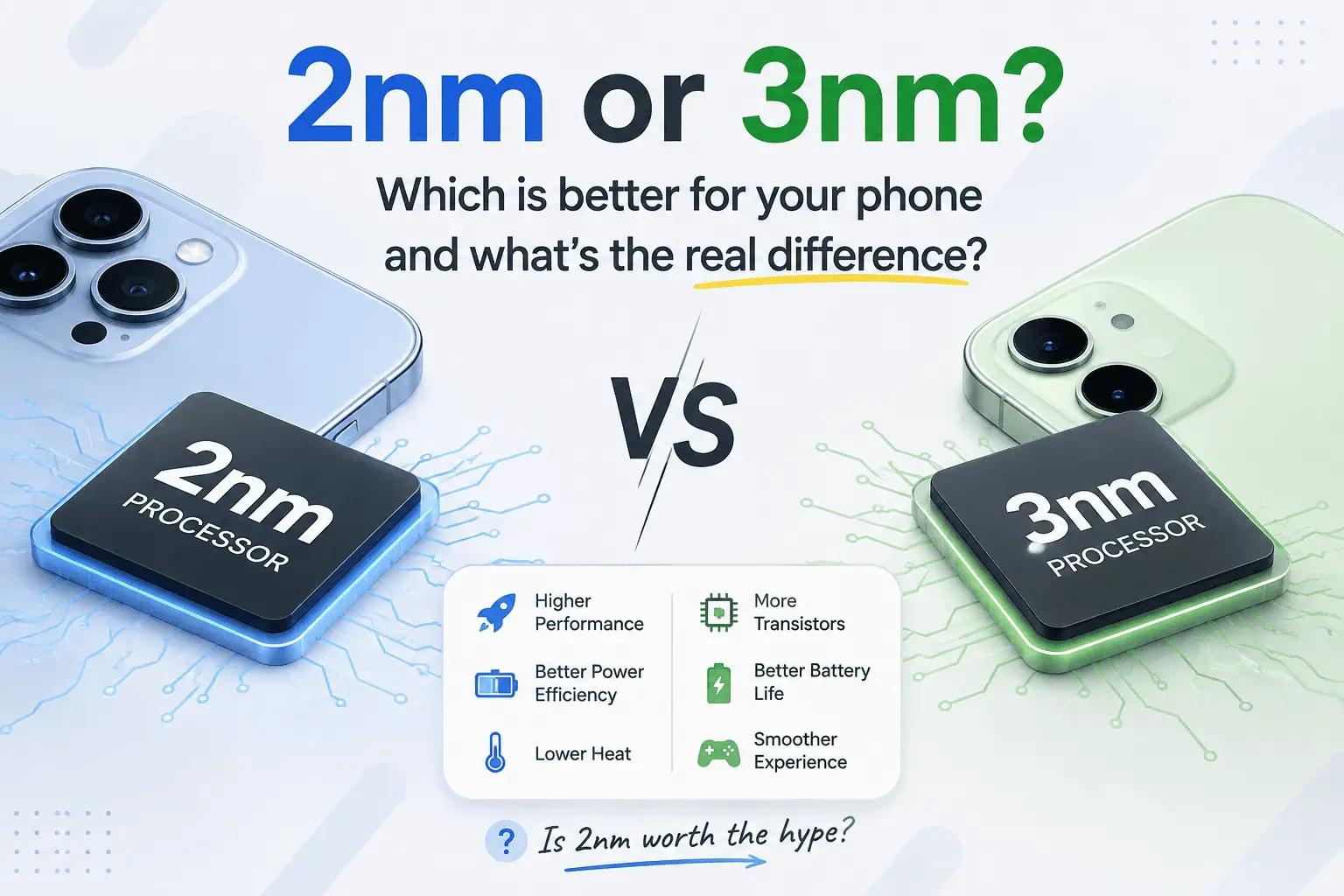
Every new smartphone in 2026 will feature a chip fabricated on a more advanced node, such as 2 nm or 3 nm, along with its increased speed. This sounds simple and is somewhat similar to the jump from 1080p to 4K. However, a manufacturing node cannot be felt as easily as improved video resolution. This year offered a great example when Samsung's first 2 nm smartphone chip failed to win several benchmark tests against a 3 nm competitor. So what is behind this number and whether should we care about it as consumers?
Short answer:
2 nm chips are made using the new GAA technology and are supposed to offer greater transistor density and reduced power consumption (by 25-30%) compared to 3 nm chips at equal performance levels or additional 10-15% of speed at the same power. The actual benefits become apparent during battery life testing, long games and AI processing intensive tasks but not regular browsing or phone calls. As the comparison between the Exynos 2600 and Snapdragon 8 Elite Gen 5 showed, a more advanced node is not automatically superior to an advanced 3 nm chip architecture.
It’s not what you’d expect to see on the spec sheet.
The term "nanometer" referred to the actual physical size of an object, such as the gate width of a transistor. This is no longer the case. Nowadays, "2 nm" and "3 nm" are primarily brand names that refer to a generation of fabrication process, but don't represent any actual physical size measured on a ruler. This is stated on the 2nm (N2) technology webpage from TSMC.
This is important because two “2nm” chips manufactured by different foundries such as TSMC and Samsung could be extremely different despite having the same name. The digit indicates the generation but not who manufactured it better.
What Changes in a 2nm Chip?
From FinFET to Gate-All-Around
The revolution at 2nm isn't about size; it's about shape. While the chip of 3nm generation, such as the TSMC N3E (Snapdragon 8 Elite Gen 5), has FinFET transistors, those of 2nm have GAA (Gate-All-Around) nanosheets, where the gate covers the entire surface of the stacked silicon sheets. The wraparound design, according to IEEE Spectrum, provides the designers with much greater control over the current leakage – the main obstacle on the road to high performance and energy efficiency.
Transistor Density
According to TSMC figures reported by Tom's Hardware, N2 can fit roughly 15% more transistors per square millimeter compared to N3E in a combination of logic and SRAM, or 20% more in only logic cells. Increased transistor density gives an opportunity to integrate more cores or AI modules, or to increase cache size without increasing silicon area.
Power and heat: the figure that truly matters
Here comes the point which directly gets to your hand. Under the same clock speed, a 2nm processor is 25-30% more power efficient than a 3nm processor. In case if you remain with the same power efficiency level, then the 2nm processor could give around 10-15% more speed. Smartphone companies tend to take a balanced approach here with some improvements in speed, performance, and power consumption but not much on the single-app opening speed.
2nm and 3nm Phone Chips You Can Actually Buy in 2026
It’s no longer theoretical. Some actual processors due out in phones this year come from either side of the 2nm/3nm divide:
| Chip | Node | Foundry | Found In | Notable Trait |
|---|---|---|---|---|
| Snapdragon 8 Elite Gen 5 | 3nm (N3) | TSMC | Galaxy S26 Ultra, S26/S26+ (US) | Highest sustained clocks, strongest benchmarks |
| Exynos 2600 | 2nm (SF2) | Samsung Foundry | Galaxy S26 / S26+ (global) | First 2nm phone chip, but lower clocks and yield limits |
| Google Tensor G6 | 2nm | TSMC | Pixel 11 series | First TSMC 2nm chip to actually ship in a phone |
| Dimensity 9500 | 3nm | TSMC | Various 2026 flagships | Higher clocks than the 2nm Exynos despite a similar core design |
| Apple A20 / A20 Pro | 2nm (N2) | TSMC | iPhone 18 series (late 2026) | Apple reserved over 50% of TSMC's early 2nm capacity |
The Exynos 2600 Problem: Why 2nm Didn't Automatically Win
The Exynos 2600 by Samsung was the world's first 2nm mobile chip to debut in a smartphone, and, on paper, should outdo the 3nm Snapdragon 8 Elite Gen 5. It hasn't, not entirely. In their review, Android Authority has shown that the Snapdragon chip remains faster than Samsung's in pure processing, GPU workload, and overall experience. Also, reports have shown that Samsung's 2nm manufacturing technology remains under development – an issue the company has faced before in the case of the Exynos 990 chip.
Clock speed appears to be part of the reason for the gap. The top frequency of the big core in Samsung's chip is approximately 3.8GHz, while that of the Oryon core in the Snapdragon 8 Gen 5 exceeds 4.6GHz. The 3nm MediaTek Dimensity 9500 uses an Arm-based core similar to that used in the Exynos 2600, but its frequency is higher. This means that node number is not everything in chip performance; clock timing, cache architecture, and other elements such as the modem play a role. According to reports, Samsung's decision to use an external modem rather than an integrated one reduces the effectiveness of the 2nm node in terms of power efficiency.
This is reminiscent of Huawei's struggle with sanctions; a 5nm chip can still deliver
Where You'll Actually Feel the Difference
Battery Life
This is the most consistent, measurable gain. Lower leakage at idle and under light load means your phone sips less power during the hours it spends doing very little — checking notifications, sitting in your pocket, playing music in the background. Expect meaningfully longer screen-on time on a well-optimised 2nm phone, even if the battery capacity is identical.
Gaming and Sustained Performance
Short bursts (opening apps, unlocking the phone) rarely show a difference you'd notice without a stopwatch. Long sessions are where node improvements earn their keep — a cooler-running chip throttles later, so frame rates stay higher for longer during a 45-minute gaming session instead of dropping after 15.
On-Device AI
Local AI features — live translation, photo processing, voice assistants that don't need the cloud — are power-hungry by nature. The extra efficiency headroom from a smaller node gives phone makers more room to run these features without visibly draining the battery, which is a big part of why Apple, Google, and Qualcomm are all racing for 2nm allocation this year.
Everyday Use
Honestly? For calls, texting, social media, and browsing, most people won't notice the jump at all. Both 2nm and 3nm flagship chips are massively overpowered for that kind of usage. This is the gap between what a spec sheet promises and what a typical day actually demands.
2nm vs 3nm: Pros and Cons
2nm Chips
- Pros: Better power efficiency, cooler under sustained load, higher transistor density for more on-chip features, longer runway for future AI workloads
- Cons: More expensive to manufacture, limited early supply, gains depend heavily on how well the foundry executes the process (see: Exynos 2600)
3nm Chips
- Pros: Mature, high-yield process with predictable performance, cheaper to produce, often clocked higher because the process is well understood
- Cons: Slightly worse power efficiency ceiling, will eventually be phased out as 2nm capacity ramps up through 2026 and beyond
Why 2nm Phones Cost More
A single 2nm wafer reportedly costs around $30,000 to produce, roughly 50% more than a 3nm wafer. That cost gets passed down the chain, and it's a big reason Apple locked up more than half of TSMC's early 2nm capacity for its A20 chips rather than leaving room for smaller players. We've covered a similar dynamic in how export bans and licensing fights are reshaping who even gets access to advanced nodes — capacity at the leading edge is scarce, and the biggest checkbooks get served first. It also echoes what's happening with memory right now: RAM prices have spiked for reasons that have nothing to do with RAM getting better, and 2nm pricing follows a similar "scarcity plus demand" pattern rather than a pure cost-of-manufacturing story.
Verdict box: If you are shopping for a smartphone right now, don’t obsess about the node number alone. The properly executed 3nm (Snapdragon 8 Elite Gen 5, Dimensity 9500) will beat the 2nm, if done in haste or with a poor yield. It is not until 2nm’s ecosystem is developed and execution gap closed that the latter wins, which happens sometime in 2026-2027.
Alternatives: What Matters More Than the Node Number
If you want a phone that actually feels fast and lasts through a long day, the manufacturing node is one input among several. Cooling design (vapor chambers vs bare metal), RAM speed and capacity, software optimisation, and even battery chemistry all pull real weight. It's the same lesson we found when picking a budget GPU for 1440p gaming — the newest silicon on paper isn't always the smartest buy once price, thermals, and real benchmarks are factored in.
- Check independent benchmark reviews, not just the node name on the box
- Look at sustained performance tests (30+ minute gaming loops), not just peak scores
- Consider battery capacity and screen resolution alongside the chip — a big, bright screen can erase efficiency gains
FAQs
Is a 2nm phone chip always faster than a 3nm one?
No, as Exynos 2600 (2nm) was slower than Snapdragon 8 Elite Gen 5 (3nm) in some 2026 benchmarking tests due to low clock speeds and problems with initial yields.
Will 2nm phones have better battery life?
Yes, especially in intense use scenarios (games, navigation, AI features). For lighter usage, they won't be much better as both nodes are capable of handling that just fine.
Why do 2nm phones cost more?
As the cost of wafers is 50% higher compared to 3nm, initial capacity is limited and big players such as Apple snap up most of it first.
Can I hold off on buying a new device and wait for 2nm phones?
If you are looking for ultimate efficiency and are ready to pay extra, sure. Otherwise, get a mature and well-researched 3nm flagship in 2026.
Which manufacturers produce 2nm chips for phones first?
First 2nm devices were Samsung Exynos 2600 and Google Tensor G6. Others are Apple A20 in late 2026 and Qualcomm future Snapdragon series. For further information on chipset adoption, visit PhoneArena's article on 2nm launch by TSMC.
Final Word from Me
The fact that 2nm technology is an actual engineering advancement and not simply a marketing trick cannot be overlooked; after all, the adoption of GAA transistors means more efficient power consumption and therefore better heat dissipation and durability of the device after 2026. However, 2026 was also the year that demonstrated that the smaller the nm value on the sheet does not always mean the better chip. The ability to execute a good strategy and software makes the difference between an advanced chip and a great chip.



Comments 0
Be the first to comment!