Apple didn't build the chip inside your iPhone. Nvidia didn't build the chip inside your graphics card either. Weird, right? These are two of the richest tech companies on Earth, and neither one owns a factory that actually makes their most important product.
Thats not a scandal. Its just how the entire chip industry works, and once you understand it, half the confusing headlines about TSMC, Samsung, and "2nm chips" suddenly make a lot more sense. So grab a coffee, because this one's actually kind of fun once you get past the jargon.
Fast Answer: A chip foundry is a company that manufactures semiconductor chips designed by other businesses. Foundries like TSMC, Samsung Foundry, and Intel Foundry own the actual factories (called fabs), while companies like Apple, Nvidia, AMD, and Qualcomm only design the chips and pay a foundry to physically build them.
The Big Misunderstanding: Designing a Chip Isn't the Same as Making One
Think of it like a restaurant. Apple writes the recipe, decides how the dish should taste, and puts its name on the menu. But somebody else has to actually own the kitchen, the ovens, and the staff who can cook that exact recipe at massive scale, every single day, without burning a single plate.
That "somebody else" is a foundry. The semiconductor industry actually splits into three different business models, and mixing them up is where most confusion starts.
| Business Model | What It Actually Means | Example Companies |
|---|---|---|
| Fabless | Designs chips only, outsources all manufacturing to a foundry | Apple, Nvidia, AMD, Qualcomm, MediaTek |
| Pure-Play Foundry | Manufactures chips for others, never designs its own products | TSMC, UMC, GlobalFoundries |
| IDM (Integrated Device Manufacturer) | Designs and manufactures its own chips in-house | Intel (traditionally), Samsung, Texas Instruments |
Samsung and Intel actually blur these lines a bit, since both design their own chips and run foundries that manufacture chips for outside customers too. TSMC is the odd one out in a good way — it has never designed a single commercial chip of its own since 1987. It just builds what others draw up.
What Actually Happens Inside a Foundry?
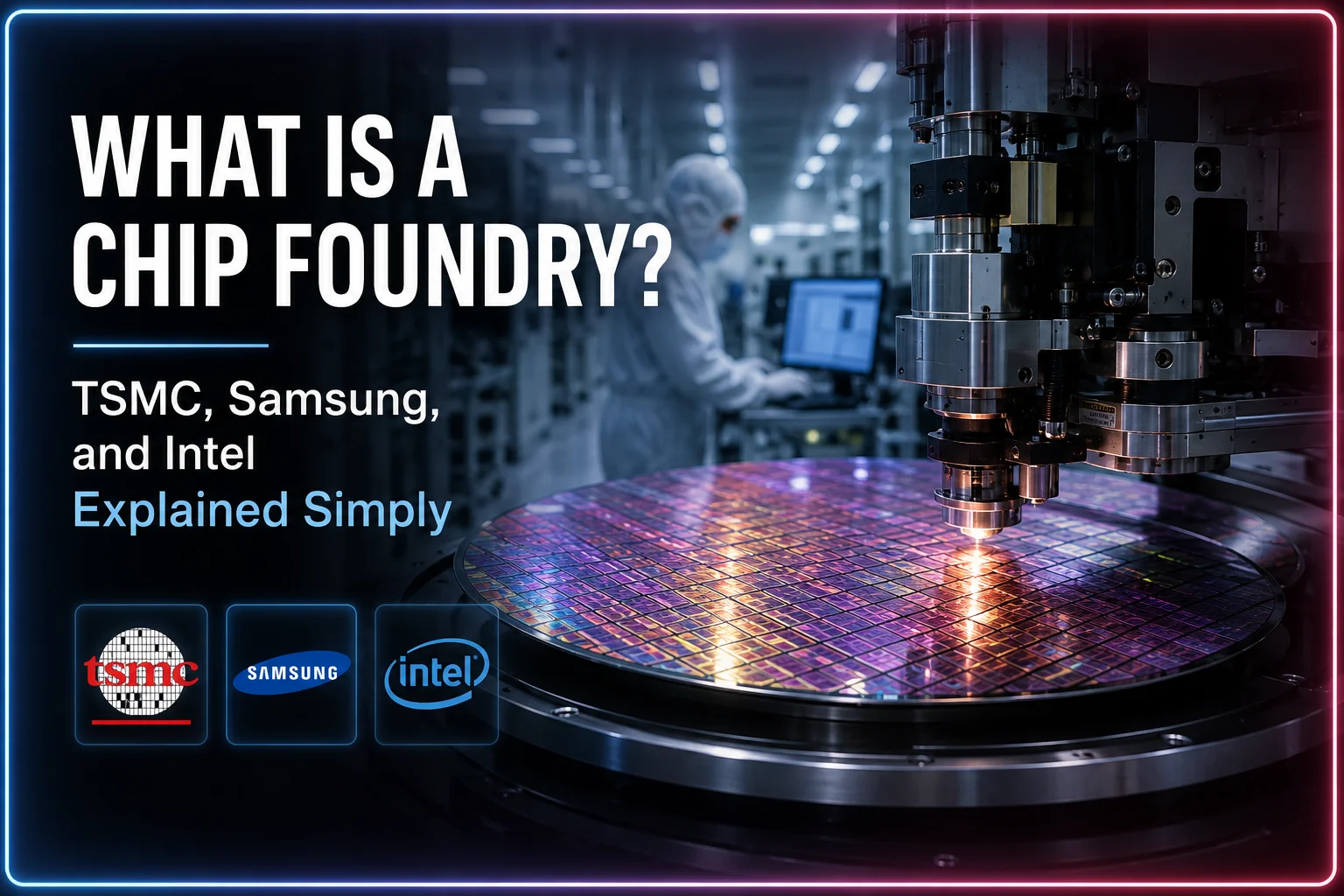
A foundry takes a chip designer's blueprint and turns it into physical silicon. That process starts with a thin, round slice of ultra-pure silicon called a wafer, usually around 300mm wide. Hundreds of chips get printed onto a single wafer at once, layer by layer.
The tool that prints those layers is a lithography machine, and at the cutting edge, that means EUV (extreme ultraviolet) lithography. There is exactly one company on the planet that makes these machines, and every advanced foundry — TSMC, Samsung, Intel, all of them — depends on it. You can read more about how that technology actually works on ASML's official EUV lithography page.
Process Nodes, in Plain English
You've probably seen terms like "3nm" or "2nm" thrown around in phone reviews. These numbers used to describe an actual physical measurement on the transistor, but today they're mostly a marketing label for a generation of manufacturing technology. Smaller numbers generally mean more transistors packed into the same space, which usually translates to better performance per watt.
We've actually broken this exact confusion down in detail when comparing the Apple A20 Pro against the Snapdragon 8 Elite Gen 6, where two chips share the same "2nm" label but behave very differently in real-world battery tests.
Meet the Big Three: TSMC, Samsung, and Intel
These three companies control almost the entire market for advanced chip manufacturing. Each one competes with a different strategy, and none of them are approaching it the exact same way.
TSMC — The Pure-Play Giant
Founded in 1987 in Taiwan, TSMC essentially invented the modern foundry model. It builds chips for hundreds of customers, including Apple, Nvidia, AMD, and Qualcomm, and holds the largest share of advanced manufacturing capacity in the world. You can see the scale of its operations on TSMC's official company profile.
Samsung Foundry — The Hybrid Challenger
Samsung is unusual because it designs its own chips (Exynos), makes memory, builds phones, and also runs a foundry business open to outside customers. This dual role gives it huge scale, but it also means Samsung is sometimes competing directly against its own foundry clients. Details on its current process lineup are on Samsung Foundry's official site.
Intel Foundry — The Comeback Story
Intel spent decades manufacturing chips only for itself. That changed recently, as Intel opened its fabs to outside customers under the Intel Foundry brand, betting its future on nodes like 18A to win back leadership. You can explore the technical claims on Intel Foundry's process technology page.
We covered how this three-way rivalry plays out on the smallest, most advanced nodes in our deep dive on the TSMC N2 vs Samsung SF2 foundry war.
| Feature | TSMC | Samsung Foundry | Intel Foundry |
|---|---|---|---|
| Business Model | Pure-play foundry | IDM + open foundry | IDM + open foundry |
| Headquarters | Hsinchu, Taiwan | Hwaseong, South Korea | Santa Clara, USA |
| Design Its Own Chips? | No | Yes (Exynos) | Yes (Core, Xeon) |
| Known Strength | Yield and volume at leading-edge nodes | Vertical integration, memory + logic | US-based advanced manufacturing |
| Major Foundry Clients | Apple, Nvidia, AMD, Qualcomm | Qualcomm (partial), IBM | Microsoft, growing client list |
Why Apple, Nvidia, AMD, and Qualcomm Don't Own a Single Fab
Building one leading-edge fab costs somewhere between 15 and 20 billion dollars, and it takes years before it even opens. Then it needs to run near-constant utilization just to be profitable, because the equipment inside depreciates fast and becomes outdated within a few short years.
For a fabless company, that's a terrible bet. Its way smarter to focus entirely on chip architecture and software, then pay a foundry for capacity as needed. That's exactly why Qualcomm can split orders between TSMC and Samsung depending on price and yield, something we explored in the Dimensity 9600 vs Snapdragon 8 Elite Gen 6 comparison.
Who Really Makes Your Chip?
| Company (Designs the Chip) | Foundry (Actually Builds It) | Example Product |
|---|---|---|
| Apple | TSMC | A20 Pro |
| Nvidia | TSMC | RTX / data center GPUs |
| AMD | TSMC | Ryzen CPUs |
| Qualcomm | TSMC & Samsung Foundry | Snapdragon 8 Elite Gen 6 |
| TSMC | Tensor G6 | |
| Huawei / HiSilicon | SMIC (domestic, limited nodes) | Kirin series |
Huawei's situation is a good example of why this matters beyond specs. Without access to the most advanced foundries, its chips fall behind on efficiency, a gap we measured directly in the Pixel 11 Pro vs Huawei Pura 90 Pro Max comparison.
Why Foundries Became a Geopolitical Chess Piece
Here's the part that turns a manufacturing story into front-page news. Roughly 90% of the world's most advanced chips are made in Taiwan, mostly by TSMC. That concentration is exactly why governments in the US, Europe, and Japan are pouring billions into building fabs on their own soil.
The strategic think tank CSIS has described Taiwan's role in this supply chain as effectively irreplaceable, calling it a genuine national security concern for allied nations in its "Silicon Island" analysis. We unpacked exactly what a worst-case scenario could look like in The Taiwan Chip Countdown, and how TSMC itself is hedging against the risk in TSMC Outside Taiwan.
This same anxiety is driving the broader manufacturing shift we've tracked across other industries too, not just chips — see our coverage of why global supply chains are quietly shifting away from China.
Pros and Cons of the Foundry Model
Pros
- Lets chip designers focus entirely on architecture, not factory operations
- Massively lowers the capital cost of entering the chip industry
- Foundries specialize deeply, often producing better yields than in-house fabs
- Multiple customers sharing one foundry keeps advanced nodes economically viable
Cons
- Fabless companies have zero control over pricing or capacity during shortages
- Extreme concentration in Taiwan creates a single point of failure for the whole industry
- Foundry customers sometimes compete for the exact same limited wafer capacity
- Switching foundries mid-generation is expensive and technically painful
Alternatives to the Big Three
TSMC, Samsung, and Intel dominate the headlines, but they're not the only foundries out there.
- GlobalFoundries — focuses on mature, cheaper nodes rather than the bleeding edge, popular for automotive and IoT chips.
- UMC — a Taiwanese foundry serving mid-range and specialty chip needs.
- SMIC — China's largest foundry, currently restricted from the most advanced EUV-based nodes due to export controls.
- Rapidus — a newer Japanese foundry startup aiming for 2nm production with government backing.
Verdict, Why This Actually Matters to You
Bottom line: Foundries are the quiet backbone of every device you own. TSMC leads on volume and advanced nodes, Samsung competes through vertical integration, and Intel is fighting to rebuild leadership on American soil. Whoever controls the most advanced foundry capacity effectively controls the pace of progress for the entire tech industry — phones, GPUs, AI chips, all of it.
Frequently Asked Questions
What is a chip foundry in simple terms?
A chip foundry is a factory-owning company that manufactures semiconductor chips designed by other businesses, rather than designing its own chips.
Is TSMC a chip designer or a chip manufacturer?
TSMC is purely a manufacturer. It has never sold a chip under its own brand and instead builds chips designed by customers like Apple, Nvidia, and AMD.
Why doesn't Apple build its own chips?
Building a leading-edge fab costs tens of billions of dollars and years to construct. Its far cheaper for Apple to design chips and pay TSMC for manufacturing capacity.
What does a "2nm" or "3nm" process node actually mean?
It's a naming convention for a generation of manufacturing technology, not a literal transistor measurement anymore. Smaller labeled nodes generally mean better performance per watt.
Which foundry makes the most advanced chips right now?
TSMC currently leads in advanced-node volume and yield, though Samsung and Intel are both racing to close the gap with competing 2nm-class processes.
Why is Taiwan so important to the global chip industry?
Taiwan, largely through TSMC, produces the vast majority of the world's most advanced chips, making it a critical and hard-to-replace link in global technology supply chains.


Comments 0
Be the first to comment!