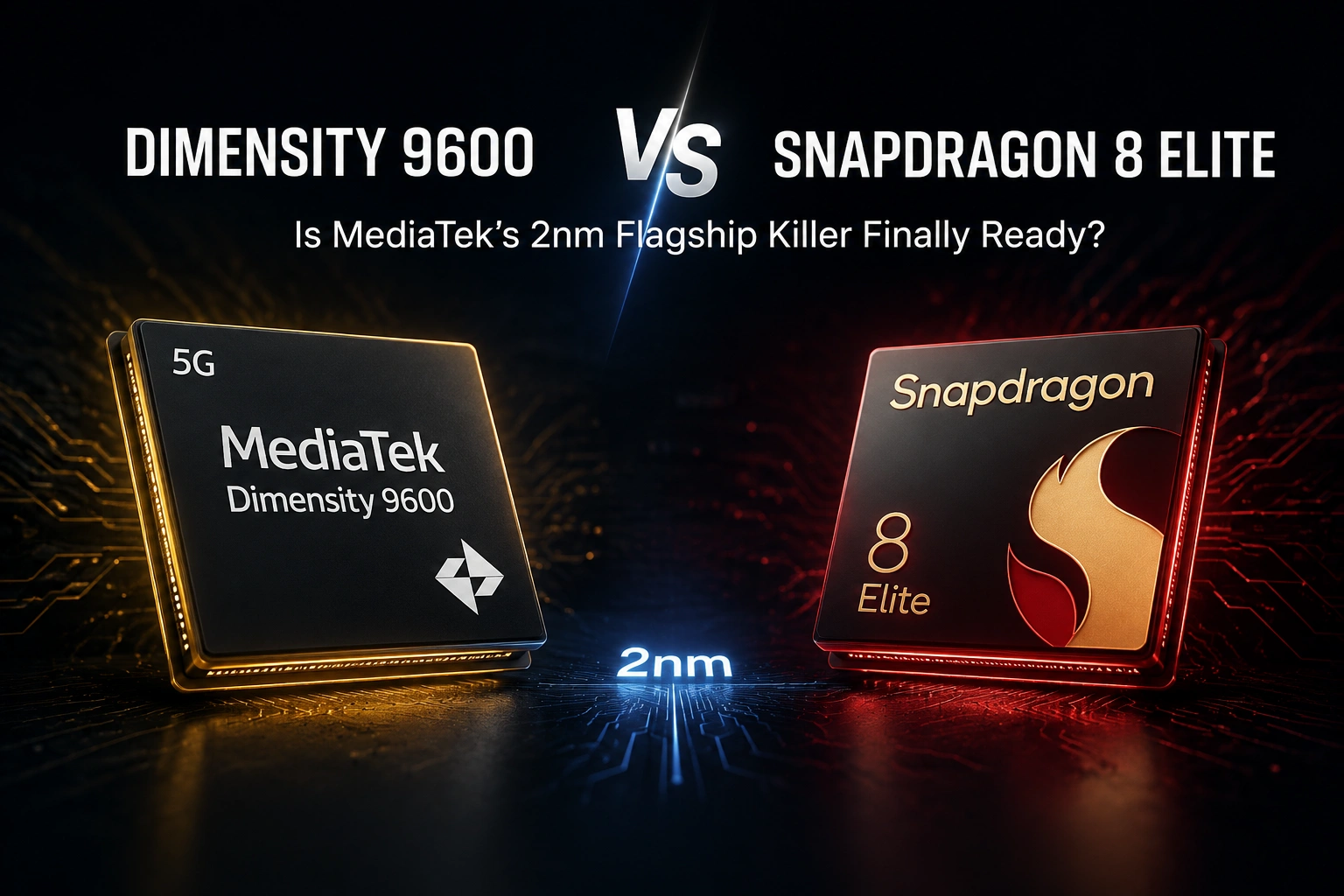
The annual September clash between MediaTek and Qualcomm hits differently this year. MediaTek took the lead by deploying its Dimensity 9600 on a 2nm process ahead of Qualcomm's flagship alternative, completely reshaping the competition. Here is a direct breakdown comparing the Dimensity 9600 against Qualcomm's upcoming Snapdragon 8 Elite Gen 6, as both chips go head-to-head for the flagship spotlight.
Fast Answer
Based on everything leaked so far, the Dimensity 9600 is genuinely competitive for the first time in years — its 2+3+3 all-big-core layout and TSMC 2nm process close most of the gap in raw CPU and GPU numbers. But Qualcomm still has the edge in modem maturity, camera ISP tuning across brands, and software optimization built over a decade of flagship partnerships. In short: MediaTek finally has the hardware to compete, but Qualcomm still wins on ecosystem trust.
So Why This Comparison Matters in 2026
For most of the last decade, "flagship killer" was a phrase reserved for mid-range phones punching above their price. This year it's being used differently — to ask whether MediaTek can punch at the very top, not just near it. That question only makes sense now because of one specific detail: node timing.
MediaTek is reportedly shipping the Dimensity 9600 on TSMC's 2nm N2P process, while Qualcomm's Snapdragon 8 Elite Gen 6 is expected to launch on the same node around the same month. For once, neither company has a manufacturing head start. That's rare, and it's exactly why this comparison is worth taking seriously instead of dismissing it as another marketing cycle.
Dimensity 9600 vs Snapdragon 8 Elite Gen 6: Specs at a Glance
| Spec | Dimensity 9600 | Snapdragon 8 Elite Gen 6 |
|---|---|---|
| Process node | TSMC 2nm (N2P) | TSMC 2nm |
| CPU layout | 2+3+3, Arm Cortex-C2 cores | 2+3+3, custom Oryon cores |
| Peak clock speed | ~5.0GHz (rumored) | ~4.4-5.0GHz depending on SKU |
| GPU | Arm "Magni" GPU, hardware frame interpolation | Adreno 845 (base) / Adreno 850 (Pro) |
| Memory support | LPDDR5X (LPDDR6 on Pro) | LPDDR5X (LPDDR6 on Pro) |
| Storage | UFS 4.0 / UFS 5.0 on Pro | UFS 5.0 |
| Expected launch | September 2026 | September 22-24, 2026 |
Note: MediaTek and Qualcomm haven't formally announced either chip yet, so specs above are compiled from repeated leaks, not official spec sheets. Treat clock speeds especially as directional rather than exact.
The 2nm Question: Does the Node Actually Matter?
This is where a lot of marketing gets ahead of itself. Moving to 2nm doesn't automatically make a chip faster or cooler — it raises the ceiling, but design decisions determine how close either company gets to that ceiling. We went deep on this exact tradeoff in our 2nm vs 3nm phone processors breakdown, and the same logic applies here: a well-tuned 3nm chip can still beat a rushed 2nm chip in daily use.
What we do know from TSMC's own N2 technology page is that the node targets a 10-15% speed gain at equal power, or up to 30% lower power at equal performance, compared to N3E. That's the baseline both MediaTek and Qualcomm are building on top of — and since MediaTek and Samsung's foundry choices haven't always lined up, it's worth reading how the foundries themselves stack up in our TSMC N2 vs Samsung SF2 comparison.
Verdict Box: The Node Isn't the Whole Story
2nm gives both chips headroom. It does not guarantee either one uses that headroom well. Execution — clock strategy, cache size, cooling design — still decides the winner.
CPU Architecture: Two Prime Cores, Two Philosophies
Both chips are reportedly abandoning the old single-super-core layout in favor of a 2+3+3 arrangement: two heavy-hitting "prime" cores instead of one. MediaTek is leaning on Arm's next-gen Cortex-C2 design, while Qualcomm continues down its custom Oryon path, which it inherited from the Nuvia acquisition years ago.
On paper this convergence is telling — when two rival chipmakers land on nearly identical core counts and clock targets in the same year, it usually means the industry has hit a genuine architectural sweet spot for sustained mobile workloads, not just peak burst scores. The practical difference will likely come down to scheduling software: how well each company's kernel decides which core handles which task, something that only becomes clear once real devices ship.
GPU and Gaming Performance
Gaming is arguably where MediaTek is pushing hardest this generation. The Dimensity 9600's rumored GPU is said to add native frame interpolation and resolution upscaling done at the silicon level rather than through a software layer, plus improved ray tracing. Qualcomm's Adreno 850 on the Pro variant reportedly answers with its own AI-assisted frame generation feature, paired with a noticeably larger graphics cache.
If these leaks hold, this could be the first generation where MediaTek's GPU isn't just "good enough" but a legitimate reason to pick a Dimensity phone over a Snapdragon one for mobile gaming specifically.
AI Processing: The New Battleground
Neither company is treating AI as an afterthought anymore. MediaTek is reportedly expanding its Compute Matrix Engine and Scalable Matrix Extension support, aimed at running on-device generative AI tasks faster without draining the battery. Qualcomm's approach centers on its Hexagon NPU lineage, which already has years of developer tooling behind it through the Snapdragon AI stack.
The gap here probably won't show up in benchmark charts — it'll show up in how fast your phone generates a photo edit, transcribes a voice note, or runs an on-device assistant without needing the cloud.
Power Efficiency and Thermal Behavior
This is the category that actually decides real-world experience, and it's also the hardest one to judge before phones ship. Both chips are ditching small efficiency cores entirely — an all-big-core design that sounds great for performance but puts real pressure on sustained thermal management. A phone that scores well in a five-minute benchmark can still throttle hard on a 45-minute gaming session if the cooling system underneath it isn't built for it.
Qualcomm's Gen 6 Pro is rumored to introduce a dedicated Heat Pass Block layer, similar to what Samsung already uses in the Exynos 2600, specifically to move heat away from the die faster. Whether MediaTek partners bring similar vapor chamber upgrades to their 2026 flagships will honestly matter more than the chip itself in day-to-day sustained performance.
Camera and Imaging
Image signal processing is one area where Qualcomm's decade of tight collaboration with camera-focused brands like Xiaomi and OnePlus still shows. Snapdragon ISPs tend to get more mature tuning at launch because so many flagship camera systems are co-developed around them. MediaTek has closed this gap significantly with recent Dimensity chips, and its dual-NPU design is rumored to split imaging tasks more efficiently between cores this generation, but Qualcomm likely keeps a slight edge here until more Dimensity 9600 phones actually ship and get reviewed.
Connectivity
Modem performance has historically been Qualcomm's quiet advantage, and it's not going away easily — Snapdragon's X-series modems have a long track record in real-world signal handling, especially in weak-coverage areas. MediaTek's integrated modems have improved a lot, but "improved" and "proven" aren't quite the same thing yet.
Pros and Cons
Dimensity 9600
- Pros: Confirmed 2nm process ahead of Qualcomm's typical timing, strong dual prime-core CPU design, gaming-focused GPU with hardware-level frame generation, competitive pricing likely for OEMs
- Cons: Camera ISP tuning still catching up, modem track record less proven at scale, standard variant may fall back to 3nm depending on supply
Snapdragon 8 Elite Gen 6
- Pros: Mature modem and RF performance, deep camera co-engineering with major OEMs, established AI developer ecosystem, higher device availability across price tiers
- Cons: Premium pricing historically passed onto consumers, Pro-tier features often reserved for the most expensive phones only
Alternatives Worth Considering
If neither chip fits your budget or region, it's worth widening the lens. Samsung's Exynos 2600 is chasing the same 2nm race with a different tradeoff profile, and Google's Tensor G6 takes a completely different AI-first approach — we compared that exact tradeoff in our Pixel 11 Pro vs Huawei Pura 90 Pro Max breakdown. And if you're shopping under $500 rather than at the very top, our guide to which $500 chipsets are actually worth buying in 2026 covers where these flagship trends trickle down.
Final Verdict
The Dimensity 9600 is, for the first time in a long while, not just "a good alternative to Snapdragon" — it looks like a genuine contender on raw silicon. But a flagship killer needs more then just good silicon; it needs the software polish, camera tuning, and modem reliability that come from years of iteration, and that's still Qualcomm's strongest card. If you care most about peak gaming performance and efficiency-per-dollar, Dimensity 9600 phones are worth serious consideration this year. If camera consistency and network reliability matter more to you, Snapdragon 8 Elite Gen 6 remains the safer bet — for now.
Frequently Asked Questions
Is the Dimensity 9600 actually released yet?
Not as of this writing. Both the Dimensity 9600 and Snapdragon 8 Elite Gen 6 are expected to launch around September 2026, with the first commercial phones following in the weeks after.
Will the Dimensity 9600 be cheaper than the Snapdragon 8 Elite Gen 6?
MediaTek chips have traditionally cost OEMs less to license than Qualcomm's flagship silicon, which is part of why Dimensity-powered flagships often launch at slightly lower prices. That pattern is likely to continue, though 2nm wafer costs are high for both companies this generation.
Which phones will use the Dimensity 9600 first?
Leaks consistently point to the Vivo X500 series and Oppo Find X10 lineup as the first devices, both expected around the same window as the chip's official unveiling.
Does 2nm mean better battery life automatically?
Not automatically. The node lowers the power ceiling, but actual battery life depends on how aggressively the phone maker tunes clock speeds, screen refresh behavior, and cooling — the chip is only one part of the equation.
Is MediaTek's Dimensity 9600 GPU really better for gaming?
Based on leaked specs, yes, it has a real shot — hardware-level frame interpolation and a larger GPU could genuinely help. But GPU driver optimization and per-game support usually take a few months to mature after launch, so early benchmarks alone won't tell the whole story.
For more chipset breakdowns like this one, browse our Technology & PC Games section — we'll be updating this comparison once official specs and independent benchmarks land in September.
Sources referenced: GSMArena, GSMArena, Gizmochina, and Tom's Hardware. All specs are pre-launch leaks and subject to change until MediaTek and Qualcomm confirm final details.

Comments 0
Be the first to comment!