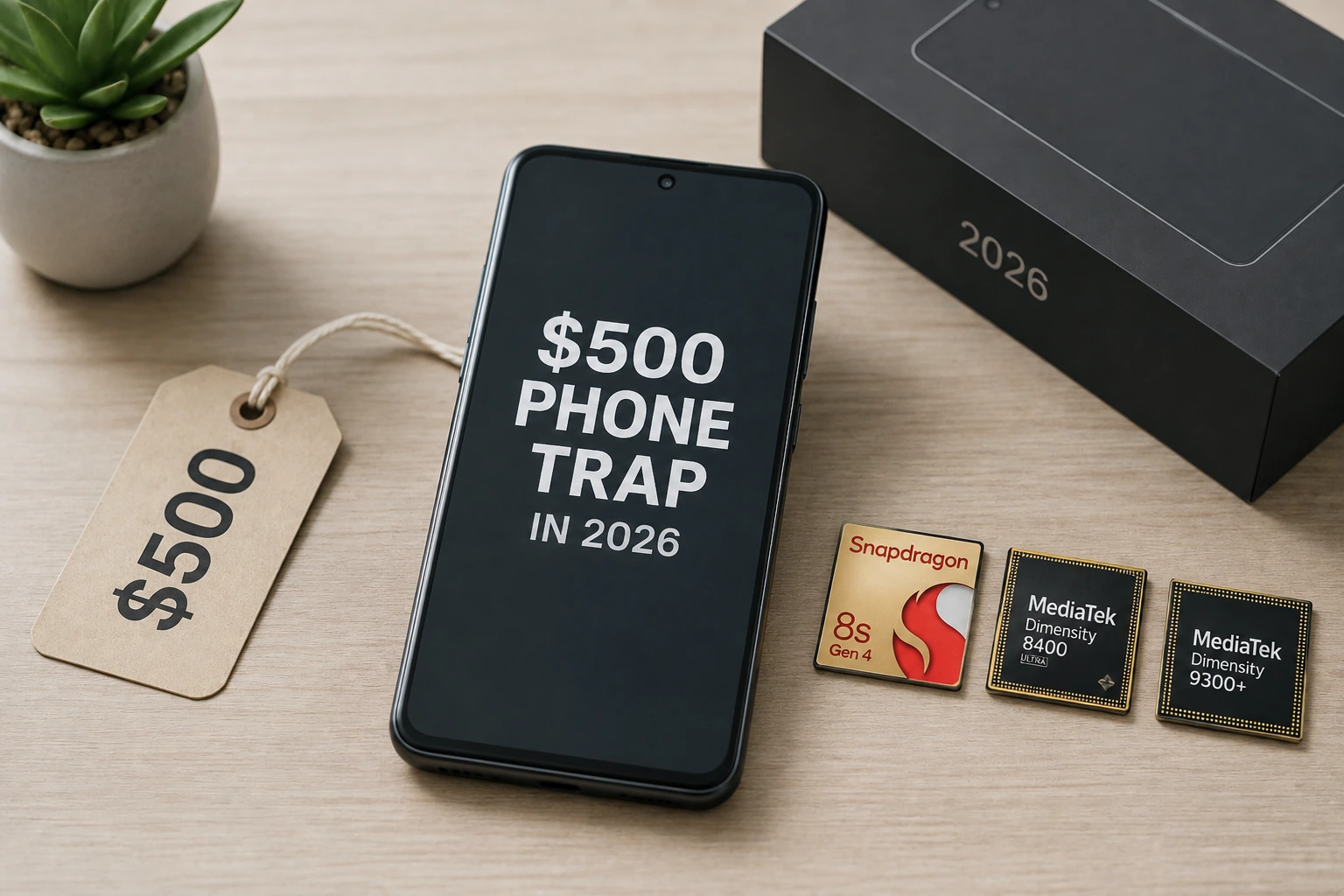
Okay, let's start talking quickly: $500 is still a reasonable budget for a smartphone in 2026, but it no longer buys what it did two years ago. Component costs, memory prices, and tariff-driven supply shifts have pushed real flagship silicon further up the price ladder, so brands now fill the $500 tier with renamed mid-tier chips and inflated spec sheets. The three chipsets still worth chasing at this price are the Qualcomm Snapdragon 8s Gen 4, the MediaTek Dimensity 8400 Ultra, and the MediaTek Dimensity 9300+ — everything else in this bracket is either a rebrand or a compromise you'll feel within a year.
Every "flagship killer" headline promises the same thing: near-flagship performance for half the price. In 2026, that promise is holding up a lot less often than it used to. The $500 phone hasn't disappeared, but what's actually inside the box has quietly shifted, and most buyers never find out until the phone starts stuttering eighteen months in.
This is what's really happening behind the spec sheet — where the money in a $500 phone actually goes, which cuts you'll never notice, and which three chips are still genuinely worth building a purchase around.
Okay So What Actually Changed in the $500 Phone Market
Three things pushed the $500 tier in a different direction this year. Memory and storage prices climbed industry-wide, tariff-driven manufacturing shifts raised landed costs for components sourced outside a brand's home region, and flagship chips themselves got more expensive to produce as node sizes shrank toward 2nm. None of that is speculation — it's simply the cost of building a phone in 2026 versus 2024.
Brands responded the only way they could without raising the sticker price: they moved the compromises somewhere less visible. Instead of a worse-looking phone, you now get a phone that looks nearly identical to last year's flagship on the outside, with quieter cuts to the parts a spec sheet doesn't fully capture — sustained performance, camera processing, and how long the software gets supported.
The "Flagship Killer" Label Isn't What It Used to Mean
Same Chip, New Marketing Name
A big share of $500 phones this year run silicon that's a year or two old wearing a fresh model number. Renaming a chip resets the perception of "new" without resetting the actual architecture underneath it. This isn't new behavior from manufactuers, but it's more common at $500 than at any other price point right now, because it's the cheapest way to look current.
RAM and Storage Padding
12GB and 16GB of RAM sound like a flagship spec. On paper it is. In practice, once a chip's memory controller and bandwidth cap out, extra RAM mostly sits idle or gets used for background app retention that most people never notice. It's a real number that photographs well in a spec comparison and does very little for daily use once you're past 8-12GB on a midrange platform.
The Silent Downgrade Pattern
The pattern repeats across categories: keep the headline number, quietly downgrade the part that actually determines how the number feels in your hand. A 50MP camera sensor with a cheaper ISP behind it. A 120Hz display with a lower-grade panel. A "flagship-class" chip built on an older node than the one it's compared against. None of these show up as a lie on the box — they just don't tell the full story.
Where Manufacturers Are Actually Cutting Corners at $500
Processor: Peak Benchmarks vs. What You Feel After 20 Minutes
Benchmark charts measure a burst of peak performance, usually in the first thirty seconds of a test. What actually matters — gaming for an hour, editing a long video clip, running navigation while streaming music — is sustained performance after the chip has been warm for a while. This is exactly the gap we found when we compared the Tensor G6 against Snapdragon on raw efficiency: the chip that wins the first benchmark run isn't always the one that's still fast twenty minutes later.
Camera: The Megapixel Number Was Never the Point
A 200MP sensor behind a weak image signal processor will lose to a well-tuned 50MP setup in almost every real shot. The ISP — not the sensor resolution — decides how much noise, HDR range, and shutter speed the camera can handle in a normal living room or a moving car. Our Pixel 11 Pro vs Galaxy S26 Ultra camera and AI comparison covers this same gap at the flagship level — it only gets wider once you drop to $500 hardware.
Display: Reading the Spec Sheet Correctly
"120Hz AMOLED" tells you almost nothing about panel grade, color accuracy, or peak brightness under direct sun. Two phones can share that exact spec line and differ by hundreds of nits in outdoor visibility. The refresh rate number sells the phone; the panel binning behind it is what you actually live with.
Build Quality: Where the Metal and Glass Go
Glass backs, aluminum frames, and IP68 ratings are the first things to quietly disappear or get asterisked at $500. Watch for "IP68-rated" footnoted with a narrower testing condition than the full standard, or a "glass-like" polycarbonate back described in marketing copy without the word plastic ever appearing.
Software Support: The Update Clock Nobody Puts on the Box
This is the cut with the longest tail. Flagship phones from the top two brands now recieve up to seven years of combined OS and security updates. Most $500 phones still land in the two-to-four-year range, and that gap alone determines whether your phone is secure and app-compatible in 2029 or already stalled out. Android Authority tracks every major manufacturer's current commitment, and the spread between brands at this price is bigger than most buyers expect.
Battery: The Silicon-Carbon Gap
Silicon-carbon anode batteries are the real battery story of 2026 — they pack 30-50% more capacity into the same physical size compared to older graphite cells. Counterpoint Research's January 2026 tracking shows average global battery capacity climbing sharply as the technology spreads. The catch: it's still concentrated in phones sold in China, and it's rolling out to global $500 models more slowly than the marketing suggests.
Connectivity: Wi-Fi 7 Stickers, Sub-6 Reality
Wi-Fi 7 and mmWave 5G both look great on a spec sheet and matter far less than advertised. Most home routers and ISPs can't touch Wi-Fi 7's peak speeds yet, and mmWave coverage in most cities is still limited to a handful of stadiums and downtown blocks. A chip that skips mmWave and sticks to sub-6GHz 5G — like the Snapdragon 8s Gen 4 — isn't cutting a feature you'll actually miss.
The 3 Chips Actually Worth Buying at $500 in 2026
After sorting through what's marketing and what's real, three platforms consistently deliver more than their price tag promises.
| Chip | Process | CPU Design | Best For | Watch Out For |
|---|---|---|---|---|
| Snapdragon 8s Gen 4 | 4nm (TSMC N4P) | 1+3+2+2, all-performance cores, no efficiency cluster | General speed, AI features, sustained multitasking | No mmWave 5G support |
| Dimensity 8400 Ultra | 4nm | 8x Cortex-A725, All Big Core design | Gaming sessions, thermal stability | Weaker single-core ceiling than flagship silicon |
| Dimensity 9300+ | 4nm (3rd-gen TSMC N4P) | 4x Cortex-X4 + 4x Cortex-A720, All Big Core | GPU headroom, ray tracing, on-device AI | Older architecture, found mostly in discounted/last-gen models |
1. Qualcomm Snapdragon 8s Gen 4
Qualcomm dropped the small efficiency cores entirely on this chip, running all eight cores as performance-tier silicon. The result is a claimed 31% CPU gain and 49% GPU gain over its predecessor, alongside a 39% efficiency improvement — numbers that hold up reasonably well against real usage, not just a single benchmark pass. Full specs are on Qualcomm's official Snapdragon 8s Gen 4 page.
Pros
- Strong sustained CPU and GPU performance for the price tier
- Wi-Fi 7 and UFS 4.0 support, both genuinely useful for future-proofing
- Solid AI ISP for computational photography on a budget sensor
Cons
- No mmWave 5G (rarely matters, but worth knowing)
- Uses ARM reference Kryo cores, not Qualcomm's custom Oryon architecture
Quick take:
The best all-rounder in this price class if you want one chip that handles everything competently without a glaring weak spot.
2. MediaTek Dimensity 8400 Ultra
MediaTek's All Big Core approach — eight Cortex-A725 cores with no small efficiency cluster — trades a bit of idle battery efficiency for sustained performance that holds up during long gaming sessions instead of throttling after ten minutes. Details are on MediaTek's Dimensity 8400 product page.
Pros
- Excellent thermal stability under extended load
- 41% multi-core gain and 44% lower peak power vs its predecessor
- Mali-G720 GPU with hardware ray tracing at this price is unusual
Cons
- Single-core performance trails the Snapdragon 8s Gen 4 slightly
- AI feature set is a step behind MediaTek's true flagship tier
Quick take:
The pick for anyone who games for real — the chip that stays fast instead of just starting fast.
3. MediaTek Dimensity 9300+ (Last Year's Flagship, This Year's Bargain)
This is the chip most people overlook because it doesn't have a "new" number. It was a genuine flagship platform, and as the phones carrying it get discounted toward $500, it's quietly become one of the better values in the segment — proof that being first to a new number doesn't automatically mean being best, a pattern we broke down in our look at the race to 2nm chips. Official specs are on MediaTek's Dimensity 9300+ page.
Pros
- True flagship-class GPU with hardware ray tracing
- LPDDR5T memory support for genuinely fast multitasking
- Strong on-device generative AI headroom
Cons
- Getting older — expect it to be phased out of new launches through 2026
- Availability at $500 depends on catching a discounted model, not a fresh release
Quick take:
If you can find it, it's the closest thing to a genuine flagship experience anywhere near this price.
Chips That Look Fine on Paper But Aren't Worth Chasing
Not every chip wearing a "flagship killer" phone is worth building a decision around. A few patterns to watch for:
- Older 7-series Snapdragon chips rebadged into a "new" phone launch a year or more after their original release
- Entry Dimensity 6000/7000-series chips paired with a 120Hz display to disguise weaker sustained performance
- Older Exynos silicon in budget Samsung models, which historically lags Snapdragon-equipped variants of the same phone
None of these are unusable. They're simply the chips where the spec sheet is doing more selling than the silicon is doing working.
Real Spec vs. Marketing Spec: A Quick Cheat Sheet
| What the Box Says | What Actually Matters |
|---|---|
| Megapixel count | ISP quality and processing pipeline |
| RAM size (past 12GB) | Memory bandwidth and app retention behavior |
| Wi-Fi 7 support | Whether your router and ISP can use it at all |
| Peak AnTuTu score | Sustained performance after 20+ minutes of load |
| "Up to" charging wattage | Real-world 0-50% time and long-term battery health |
| IP68 rating on the box | Whether the footnote narrows the actual testing conditions |
Alternatives If $500 Isn't Quite Right For You
If You Can Stretch to $650-700
This is where you start seeing genuine flagship chips without the "last year's model" caveat, along with camera systems closer to what we covered in our Pixel 11 Pro vs Galaxy S26 Ultra breakdown. Worth it if photography or long-term software support is your top priority.
If You Want to Drop to $350-400
Expect the RAM padding and marketing-spec problem to get worse, not better. At this tier, prioritize update policy over every other spec — a phone with three years of security patches will outlast one with a slightly faster chip and one year of support.
A Word on RAM Chasing
The temptation to chase 16GB of RAM at any price point mirrors a pattern we already dug into with DDR5 vs DDR4 in 2026 — a bigger number doesn't always translate to a proportional real-world gain once you're past the point where the platform can actually use it.
Final Words: $500 is still a legitimate smartphone budget in 2026, but only if you buy for the chip and the update policy first, and let the marketing spec sheet come second. The Snapdragon 8s Gen 4, Dimensity 8400 Ultra, and Dimensity 9300+ are the three platforms that consistently deliver more than their price tag promises — everything else in this bracket asks you to pay for numbers that look better than they perform.
Frequently Asked Questions
Is $500 still a good price for a smartphone in 2026?
Yes, but the value has shifted. $500 no longer guarantees genuine flagship silicon by default — it guarantees it only if you specifically shop by chipset rather than by marketing tier.
What is the best chipset for a $500 phone in 2026?
The Snapdragon 8s Gen 4 currently offers the best all-around balance of sustained performance and efficiency at this price, with the Dimensity 8400 Ultra a close second for gaming-focused buyers.
Are flagship killer phones actually flagships?
Rarely in the strictest sense. Most run chips that were flagship-tier a generation or two ago, or midrange chips marketed with flagship-adjacent language. A few, like phones carrying the Dimensity 9300+, come genuinely close.
How many years of software updates should I expect on a $500 phone?
Realistically two to four years, well short of the five-to-seven years now common on true flagships. Always check the manufacturer's stated policy before buying, not just the phone's launch-year specs.
Does Wi-Fi 7 or 5G mmWave matter on a budget phone?
For most buyers, no. Router and ISP infrastructure hasn't caught up to Wi-Fi 7's ceiling, and mmWave 5G coverage remains limited to small pockets of most cities.
Should I wait for 2nm chips before buying a $500 phone?
Not at this price point. 2nm silicon is landing in true flagships first and will take at least a generation or two to trickle down to $500 hardware, so waiting mostly just delays a purchase you could make today.

Comments 0
Be the first to comment!