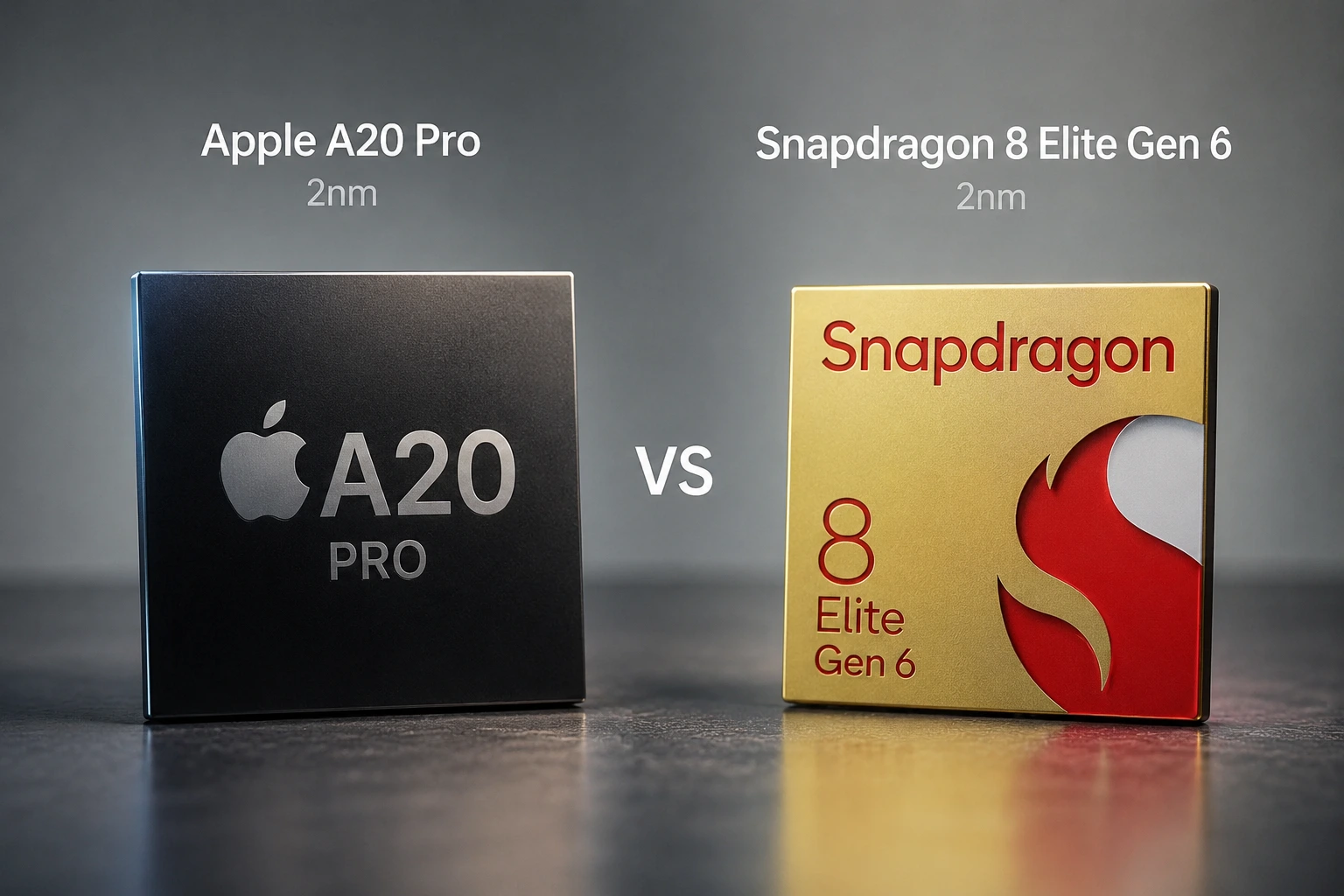
Both chips will carry the same headline number this year. Apple's A20 Pro and Qualcomm's Snapdragon 8 Elite Gen 6 Pro are landing within weeks of each other, both built on a TSMC 2nm process, both promising the usual slide full of efficiency percentages. But "2nm" is a manufacturing generation, not a battery guarantee, and the two companies made very different bets underneath that shared label.
This isn't a benchmark leaderboard. It's a look at what's actually happening behind the number — CPU cluster design, GPU thermal behaviour, modem power draw, and how much of the efficiency story comes down to software rather than silicon.
On paper, Apple's A20 Pro has the edge in idle and light-use battery life, mostly because Apple controls the entire stack — chip, modem, OS, and thermal design — and ships it on exactly one hardware target. Qualcomm's Snapdragon 8 Elite Gen 6 Pro runs on the more refined N2P node and reportedly wins in sustained, heavy workloads like extended gaming, but real-world battery life will vary sharply across Android phones depending on how each OEM tunes it. Node size decides the ceiling. Integration decides how close each phone actually gets to it.
Let's Start: The 2026 Chip Scoreboard: What's Actually Different
| Spec | Apple A20 Pro | Snapdragon 8 Elite Gen 6 Pro |
|---|---|---|
| Node | TSMC N2 (base 2nm) | TSMC N2P (enhanced 2nm) |
| Packaging | WMCM, DRAM placed beside the die | Standard flip-chip package |
| CPU layout | Reported 6-core, high-efficiency core split | 2+3+3 Oryon (2 prime, 3 performance, 3 efficiency) |
| GPU | Apple-designed, new ray tracing cores | Adreno 850 (Pro tier) |
| Memory | Unified memory, LPDDR5X-class | LPDDR6 (Pro tier only) |
| Modem | Apple C2, in-house design | Snapdragon X-series, integrated |
| Expected launch | ~Sept 9, 2026 | Sept 22–24, 2026 (Snapdragon Summit, Maui) |
| First phones | iPhone 18 Pro, Pro Max, Fold | Xiaomi 18, OnePlus 16 |
We covered the launch order and full node breakdown in our 2026 2nm race explainer, and the packaging and CPU detail there sets up everything below.
Why Two 2nm Chips Can Still Behave Differently
Both chips use Gate-All-Around (GAA) nanosheet transistors, the design that replaced FinFET at the 2nm generation. GAA wraps the gate fully around the current channel instead of just three sides, which cuts leakage — the main source of both heat and idle battery drain. We went through the mechanics of this shift in our 2nm vs 3nm processor breakdown, and the short version applies here too: the node sets a ceiling, execution decides how close each chip actually gets.
The difference this year is which version of 2nm each company is using. Apple's A20 Pro runs on TSMC's base N2 process. Qualcomm's Snapdragon 8 Elite Gen 6 Pro uses N2P, a refined follow-up node with improved power-delivery capacitors. According to TSMC's own N2 technology page, N2P builds on the base process with further efficiency gains layered on top — meaning Qualcomm's chip technically sits on a more mature version of the same node family, even though it ships two weeks later.
CPU Architecture: Efficiency Cores Aren't Just a Marketing Line
Apple's Bet: Fewer Variables, Tighter Packaging
Apple's real advantage isn't just the CPU core design — it's the Wafer-Level Multi-Chip Module packaging that places DRAM beside the processor instead of stacking it directly on top. That layout gives the chip more room to dissipate heat before it needs to throttle, which matters just as much for battery life as raw core efficiency does, since a chip that stays cooler doesn't need to boost voltage to maintain clock speed. Apple also reportedly locked up more than half of TSMC's early 2nm wafer allocation this cycle, a capacity story we detailed in the TSMC vs Samsung foundry breakdown.
Qualcomm's Bet: A Wider Cluster for More Workload Flexibility
Qualcomm's Oryon cluster splits into 2 prime cores, 3 performance cores, and 3 efficiency cores — a wider spread than Apple's typical setup. That gives the chip more granular control over which cores handle which task, in theory letting light background work run almost entirely on the efficiency cores while gaming or video export wakes the prime cluster. The catch is that this only pays off if the OS scheduler actually assigns tasks correctly, and Android's scheduler behaviour varies noticably between Xiaomi's HyperOS and OnePlus's OxygenOS, even on identical silicon.
GPU and Sustained Load: Where Batteries Actually Get Drained
Short bursts barely move the needle on battery life. The real drain happens during 20, 30, 45-minute stretches — gaming, video calls, navigation with the camera running. This is where thermal design starts to matter more than the spec sheet.
| Factor | A20 Pro | Snapdragon 8 Elite Gen 6 Pro |
|---|---|---|
| Sustained gaming | Helped by WMCM thermal separation, throttles later | Strong on paper with Adreno 850, but cooling depends entirely on the phone OEM's vapor chamber design |
| Thermal consistency | Consistant across every iPhone 18 Pro unit sold | Varies by OEM — a Xiaomi 18 and a budget-tier phone with the same chip won't throttle the same way |
| Ray tracing / AI upscaling | New RT cores reportedly reduce compute load per frame | Adreno 850 adds dedicated AI Frame Fusion blocks for upscaling and frame generation |
Try This Yourself
If you're comparing phones in a store, don't just glance at the benchmark app score. Run a 15-minute game session on each phone, then check the temperature near the camera bump and see how much the frame rate dropped from minute 2 to minute 15. That gap tells you more about real battery drain than any single peak number ever will.
The Modem: The Quiet Battery Killer Nobody Photographs
Modems rarely show up in marketing slides, but they're historically one of the biggest hidden battery drains in any flagship phone. Apple's A20 Pro reportedly pairs with the company's own C2 modem, continuing Apple's shift away from Qualcomm modems entirely, a move covered in AppleInsider's iPhone 18 Pro rumor roundup. An in-house modem lets Apple tune power states specifically for its own chip and antenna layout instead of adapting a general-purpose part.
Qualcomm's Snapdragon X-series modem is integrated directly into the Snapdragon 8 Elite Gen 6 Pro package, which is efficient in its own right, but every OEM implements antenna design differently. We saw this exact pattern already with the modem swap discussed in our Tensor G6 vs Snapdragon efficiency comparison — the modem, not the CPU, is often the real reason one phone's battery outlasts another using the exact same chip.
NPU and On-Device AI: Power Per Task, Not Just Speed
Neither company is chasing 2nm purely for CPU speed anymore. AI compute is the real driver, and it directly affects battery life because on-device AI tasks that run inefficiently either drain the battery fast or get pushed to the cloud, which costs even more power over a cellular or Wi-Fi connection.
Apple's Neural Engine reportedly grew again this generation to run Apple Intelligence entirely on-device without a noticeable battery hit. Qualcomm's answer is dedicated Matrix ALU blocks for what it calls AI Frame Fusion, detailed in GSMArena's specification leak coverage, blending AI upscaling and frame generation at the hardware level rather than running it through the general GPU. Both approaches genuinely lower power per AI task compared to last generation. The question is whether either company's AI features actually run often enough during a normal day to move the battery-life needle in a way you'd feel.
Thermal Engineering: One Company Controls the Whole Stack
This is arguably the most underrated factor in the entire comparison. Apple builds the A20 Pro for exactly three device types this generation, with a WMCM package designed specifically around the iPhone 18 Pro's internal layout, including the new foldable covered in our iPhone Fold release guide. Every unit that ships gets the same cooling solution and the same firmware tuning.
Qualcomm sells the Snapdragon 8 Elite Gen 6 Pro to dozens of OEMs, each with different vapor chamber sizes, different thermal paste, and different power-limiting firmware. That flexibility is good for the industry, but it means the exact same silicon can deliver noticeably different battery results depending on whether it's sitting inside a Xiaomi flagship with an aggressive cooling system or a mid-tier phone that cut corners on thermal hardware.
Software and Battery Management: Apple's Real Advantage?
Raw silicon efficiency only tells half the story. iOS ships on a single hardware target every year, which lets Apple tune per-app power capping, background task scheduling, and display refresh rate coordination with unusually tight precision. Android's power management has improved a lot, but it still has to work seemlessly across hundreds of device configurations, which limits how aggressively any single OEM can optimize without breaking something else.
This mirrors a pattern we've already tracked on the laptop side of Qualcomm's business in our Snapdragon X Elite 2 vs Apple M5 architecture breakdown — Qualcomm's silicon is frequently competitive or ahead on paper, but Apple's tight hardware-software integration closes or reverses the gap once you measure real battery life instead of synthetic benchmarks.
Apple A20 Pro: Pros and Cons
- Pros: WMCM packaging improves sustained thermal behaviour, in-house C2 modem tuned specifically for the chip, single hardware target means consistent battery results across every unit, tighter OS-level power management.
- Cons: Base N2 node, not the more refined N2P version Qualcomm is using, smaller CPU cluster on paper, limited to Apple's own three device lines this generation.
Snapdragon 8 Elite Gen 6 Pro: Pros and Cons
- Pros: More mature N2P node, wider 2+3+3 CPU cluster for flexible workload handling, dedicated AI Frame Fusion hardware, LPDDR6 support on Pro-tier phones.
- Cons: Real-world battery life depends heavily on which OEM builds the phone, thermal consistency isn't guaranteed across the Android lineup, standard non-Pro SKU drops to Adreno 845 and LPDDR5X.
Alternatives Worth Considering
If you'd rather not pay the early-2nm premium at all, a well-tuned 3nm flagship remains a genuinely smart buy — our $500 phone trap breakdown covers which mid-range chipsets actually hold up against flagship silicon without the inflated price tag. If camera and AI matter more to you than the node race entirely, our Pixel 11 Pro vs Huawei Pura 90 Pro Max comparison shows how a "worse" node on paper still out-benchmarked a newer one this year.
Finally: Neither chip wins battery life on the node alone — they're both 2nm, and the raw efficiency ceiling is close. Apple's A20 Pro is the safer bet for consistent, predictable battery life because Apple controls the modem, the packaging, and the OS all at once. The Snapdragon 8 Elite Gen 6 Pro has real technical advantages, a sharper node and a wider CPU cluster, but how much of that translates into your actual battery life depends entirely on which phone you buy it in. Bottom line: if you want the most predictable efficiency, the A20 Pro's integration edge matters more than N2P's paper advantage. If you're buying a well-cooled flagship Android phone from a top-tier OEM, the gap mostly closes.
Frequently Asked Questions
Is the Snapdragon 8 Elite Gen 6 Pro really on a better node than the A20 Pro?
Technically, yes. Qualcomm's chip uses TSMC's N2P, a refined follow-up to the base N2 process Apple's A20 Pro uses. N2P adds improved power-delivery capacitors on top of the same core node.
Does a smaller or newer node always mean better battery life?
No. Node maturity is one input among several. Modem design, thermal packaging, and software power management often matter just as much, sometimes more, than which specific version of 2nm a chip uses.
Why does Apple's modem matter for battery life?
Apple's C2 modem is designed in-house specifically for Apple's own chip and antenna layout, which allows tighter power tuning than a general-purpose modem that has to work across many different phone designs.
Will every Snapdragon 8 Elite Gen 6 Pro phone get the same battery life?
No. Because Qualcomm sells the same chip to multiple OEMs, actual battery results will vary based on each phone's cooling design, battery capacity, and software tuning, even with identical silicon inside.
Which chip is better for sustained gaming specifically?
On paper, the Snapdragon 8 Elite Gen 6 Pro's Adreno 850 GPU looks stronger for sustained gaming, but actual results depend heavily on the phone's cooling system. Apple's WMCM packaging gives the A20 Pro an edge in thermal consistency regardless of which iPhone 18 Pro model you buy.
Should I wait for independent battery tests before buying either phone?
Yes, if battery life is your main priority. Node specs and CPU cluster layouts predict potential, not guaranteed results — independent sustained-use and screen-on-time testing after launch will tell the real story, the same way it did with earlier 2026 2nm chips.



Comments 0
Be the first to comment!