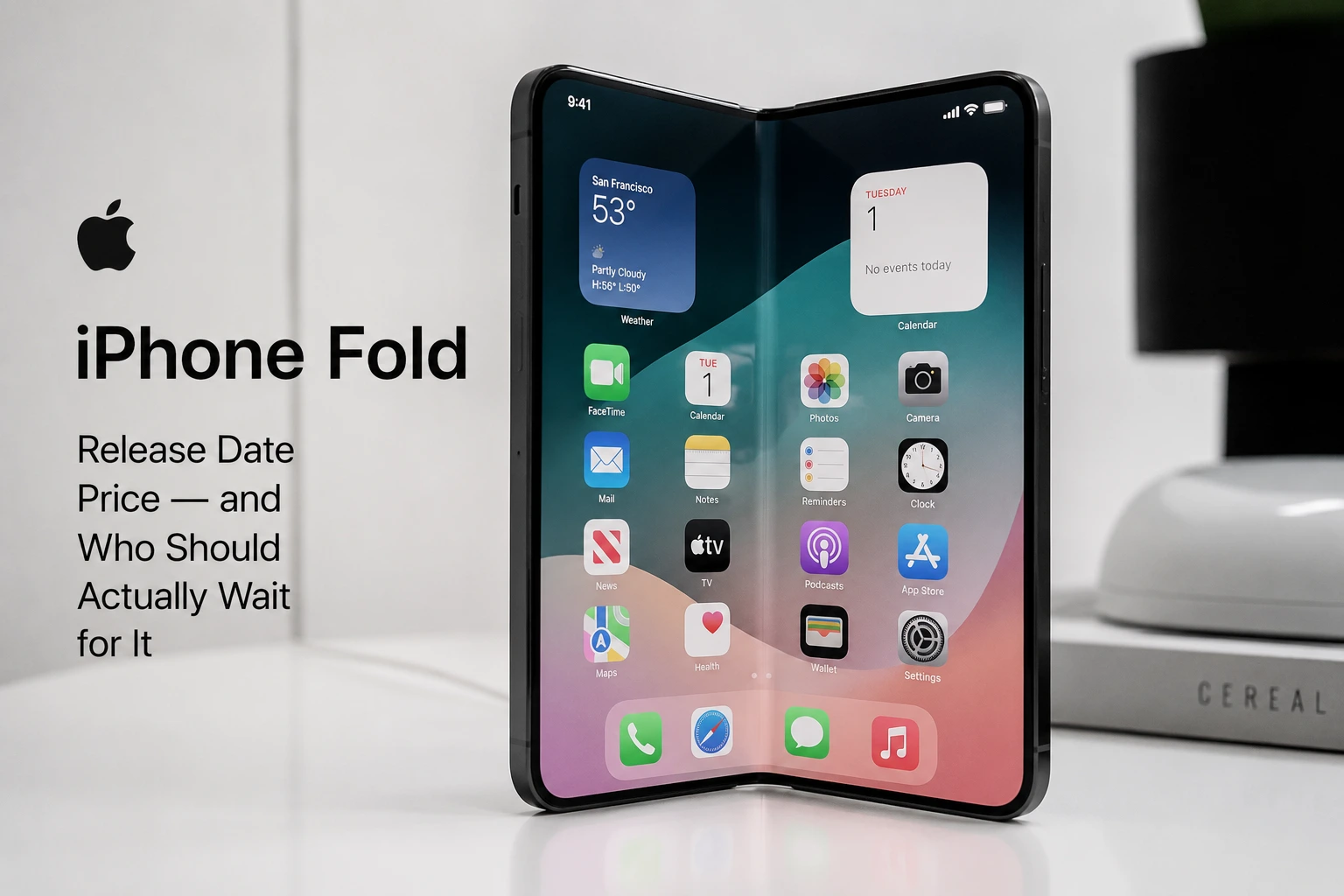
Apple has spent roughly eight years not making a foldable phone. That's not an accident, and it's not because the engineers in Cupertino couldn't figure out a hinge. Every leak, every supply-chain report, and every patent filing from the last two years points to the same conclusion: Apple waited on purpose, and it's about to charge you handsomely for the wait.
Here's what's actually happening behind the scenes with the iPhone Fold — the real release window, the real price, the compromises nobody's advertising, and an honest answer to the question everyone actually cares about: should you wait, or just buy a flagship now?
Let's dive into quick answer
The iPhone Fold (possibly branded "iPhone Ultra") is expected to launch alongside the iPhone 18 series in September 2026, with a starting price around $1,999 for 256GB. It's rumored to ship with a 7.8-inch crease-reduced inner display, a 5.5-inch outer screen, an A20 chip, Touch ID instead of Face ID, and no telephoto camera. If you need a phone today, want the best camera system, or care about proven durability, buying a current flagship makes more sense. If you're patient, ecosystem-locked, and mainly want a bigger screen for reading and multitasking, waiting could be worth it.
So Now What We Actually Know About the iPhone Fold Release Date
Nothing here is official — Apple hasn't confirmed a name, a date, or a price. But the rumor mill has moved from speculative to fairly consistent over the past few months, and that consistency is itself informative.
| Milestone | Timing |
|---|---|
| Mass production start | August 2026 (reportedly slipped 1–2 months from earlier plans) |
| Announcement event | September 2026, alongside iPhone 18 Pro / Pro Max |
| Carrier network certification | Already underway — prototype units reportedly shipped to carriers |
| Retail availability | Possibly staggered into October–December due to tight supply |
The part that matters for buyers: even if Apple announces on stage in September, that doesn't guarantee you can walk into a store and buy one. Reports of yield issues with the folding panel's surface-mount components suggest early stock could be limited, the way it was for the first Galaxy Fold and, more recently, some iPhone Pro Max colors. If you're dead set on being a day-one buyer, budget for a wait beyond the announcement itself.
iPhone Fold Price: What It's Actually Going to Cost
This is where the "first foldable iPhone" excitement runs into a very unexciting number. Estimates have moved around over the past year, but they've converged in a tight band recently.
| Storage | Estimated U.S. Price |
|---|---|
| 256GB | ~$1,999 |
| 512GB | ~$2,199 |
| 1TB | ~$2,399 |
For context, that's more than double the price of an iPhone 17 Pro Max, and it lines up closely with what Samsung charges for its own top-tier foldable. Samsung's Galaxy Z Fold8 Ultra, announced in July 2026, starts at $2,099.99 — so Apple isn't even trying to undercut the competition on price. It's positioning the Fold as a status device first and a practical upgrade second, which honestly tracks with how Apple has priced the Pro Max line for years.
Design and Display: Why Apple Is Taking a Slower, Different Road
Samsung, Honor, Oppo, and Google have all shipped foldables with a visible crease running down the middle of the inner screen. Apple, according to multiple reports including MacRumors, has reportedly refused to ship with a crease that's noticeable in daily use — and that stubbornness is a big reason this device took so long to reach production.
The Crease Obsession
Apple's approach reportedly involves a custom hinge geometry combined with a display stack engineered specifically to reduce the fold line, rather than just hide it with software tricks or matte coatings. Analyst Ming-Chi Kuo has described the goal as effectively crease-free; Bloomberg's Mark Gurman, who tends to be more conservative, has called it "reduced" rather than eliminated. The truth is probably somewhere between marketing copy and reality, and we won't know for sure until reviewers get one in hand.
Thin, But at a Cost
Leaks put the unfolded thickness at roughly 4.5–4.8mm and folded thickness around 9–9.5mm, which would make it thinner than most current foldables when open. That thinness is genuinely impressive engineering, but it's also the direct cause of two of the biggest compromises on this list — so keep reading before you get too excited about the spec sheet.
The Trade-offs: What Apple Is Cutting to Make This Work
This is the part most hype-driven coverage skips over. A phone this thin, with a hinge and two displays crammed inside, has to give something up. Here's what's reportedly on the chopping block.
No Face ID
Multiple independent sources agree: there's no room for the TrueDepth camera array. Apple is expected to use a Touch ID sensor built into the side power button instead, the same solution used on the iPad Air and iPad mini. For anyone who's used an iPhone with Face ID since the iPhone X, this is a genuine downgrade in day-to-day convenience — no more glance-to-unlock, no more automatic Apple Pay authentication just by looking at the screen. It's a real trade, not a lateral move, even if Touch ID is fast and reliable in its own right.
Camera Compromises
Rumors consistently describe a dual rear-camera system rather than the triple-lens Pro setup — meaning no dedicated telephoto lens. That's a notable first for an Apple device priced above $2,000. If you already lean on optical zoom for portraits or travel photos, this is one of the sharpest trade-offs to weigh, and it's worth comparing directly against what current flagships already deliver — we broke this down in our look at the Pixel 11 Pro vs Galaxy S26 Ultra camera and AI comparison, and the gap between a dedicated camera flagship and a foldable's camera setup is usually where the real disapointment shows up for buyers.
Battery Math
The rumored battery sits around 5,400–5,800 mAh, split across dual cells to work around the hinge — which would make it the largest battery ever in an iPhone, ahead of the iPhone 17 Pro Max's roughly 5,088 mAh. On paper that sounds generous, but remember it's powering two displays and a much larger inner panel. Expect solid all-day battery life under light use, and a noticeably faster drain the moment you start using the big screen for video, gaming, or heavy multitasking.
Software: Can iOS 27 Catch Up to Seven Years of Android Foldables?
Hardware is only half the story. The iPhone Fold will run iOS 27, not iPadOS, which matters more than it sounds. Expect split-screen support for two apps side by side, sidebar-based layouts when unfolded, and smoother transitions between the outer and inner screens — but not full Stage Manager-style windowing.
The bigger question is app readiness. Samsung's One UI and Google's Android have had roughly seven years to convince developers to build proper tablet-style layouts for foldables, and plenty of apps still default to a stretched phone view. Apple is starting from close to zero on this front. It'll give developers new tools to adapt existing iPhone apps for the 4:3 canvas, but how many major apps actually take advantage of that on day one is genuinely unclear. The chip underneath all this — reportedly the A20 — should have plenty of headroom for it; you can see how that generation of silicon is shaping up in our piece on which phone gets Apple's 2nm chip first.
iPhone Fold vs Galaxy Z Fold8 Ultra: Side-by-Side
| Spec | iPhone Fold (rumored) | Galaxy Z Fold8 Ultra |
|---|---|---|
| Starting price | ~$1,999 | $2,099.99 |
| Inner display | ~7.8 inches, book-style | 8 inches, book-style |
| Unfolded thickness | ~4.5–4.8mm | 4.1mm |
| Biometrics | Touch ID only, no Face ID | Face unlock + fingerprint |
| Telephoto camera | Reportedly none | Yes |
| Chip | A20 (rumored) | Snapdragon 8 Elite Gen 5 for Galaxy |
| Availability | Expected Sept–Dec 2026 | Available now (since Aug 7, 2026) |
Notice something interesting: on raw thinness, Samsung's already ahead. Apple's supposed advantage is the crease, not the numbers on the spec sheet — a much harder thing to prove in a table.
Pros and Cons of Waiting for the iPhone Fold
Reasons to Wait
- You're deep in the Apple ecosystem and want a bigger screen without switching platforms
- You mainly use your phone for reading, documents, and browser tabs where more screen real estate genuinely helps
- You're not in a rush and don't mind being a first-generation adopter with all the risk that involves
- A near crease-free display is a real priority for you, not just a nice-to-have
Reasons to Skip It (For Now)
- You rely on Face ID for speed and convenience
- Camera quality, especially zoom, is a top priority
- You want proven long-term hinge durability — this is Apple's first attempt, not its fifth
- You're not willing to pay a $700–900 premium over a standard Pro Max for a bigger screen
- App support for the foldable format needs time to mature, and you don't want to be a beta tester
Who Should Actually Wait for the iPhone Fold?
Strip away the hype and this really comes down to how you use your phone.
Wait if: you're a heavy reader, a frequent traveler who wants a tablet-and-phone hybrid, someone who does a lot of side-by-side app work (email plus calendar, notes plus browser), or simply someone who wants the newest thing Apple makes regardless of price.
Don't wait if: your current phone works fine, you photograph a lot, you want Face ID, or $2,000 is a stretch. A current-generation iPhone 17 Pro or Pro Max will outperform the Fold in daily reliability, camera versatility, and price-to-value for the vast majority of people.
Alternatives Worth Considering Right Now
- iPhone 17 Pro Max — best all-around iPhone camera and battery life today, no waiting required
- Galaxy Z Fold8 Ultra — already shipping, thinner than the rumored iPhone Fold, includes a telephoto lens
- Galaxy Z Fold8 (Wide) — Samsung's answer to a wider, more iPad-like foldable, at a lower price than the Ultra
If cameras and AI features are your main decision factor rather than form factor, our Pixel 11 Pro vs Galaxy S26 Ultra comparison is a good next read before you commit to anything. And if you're curious how Apple's chip strategy compares across its whole lineup, not just iPhone, we covered that in Snapdragon X Elite 2 vs Apple M5.
Verdict
The iPhone Fold is shaping up to be an impressive engineering achievement wrapped around a genuinely awkward first-generation product. The crease-reduction work is legitimately interesting, and the ecosystem pull is real for loyal Apple users. But between the missing Face ID, the missing telephoto lens, the sky-high price, and an app ecosystem that hasn't caught up yet, this isn't a phone for most people in year one. Unless you specifically need the bigger screen and don't mind paying a premium to be an early adopter, a current flagship — Apple or Samsung — will serve you better right now.
Frequently Asked Questions (People Also Ask)
When will the iPhone Fold be released?
Current reports point to a September 2026 announcement alongside the iPhone 18 series, with retail availability possibly extending into the following months due to limited early supply.
How much will the iPhone Fold cost?
Estimates converge around $1,999 for the base 256GB model, rising to roughly $2,399 for 1TB of storage.
Will the iPhone Fold have Face ID?
Most reports say no. Apple is expected to use Touch ID built into the side power button instead, similar to the iPad Air, because there isn't enough internal space for the TrueDepth camera system.
Is the iPhone Fold worth buying over a Galaxy Z Fold?
It depends on your priorities. Samsung's Galaxy Z Fold8 Ultra is already available, is physically thinner, and includes a telephoto camera. The iPhone Fold's main selling points are its crease-reduction technology and Apple's software ecosystem, not raw specifications.
What chip will power the iPhone Fold?
Rumors consistently point to Apple's A20 chip, the same generation expected in the standard iPhone 18 lineup, giving it enough performance headroom for multitasking and camera processing.
Should I wait for the iPhone Fold or buy an iPhone now?
If you need a phone today, prioritize camera quality, or want proven durability, buy a current iPhone now. If you specifically want a larger folding screen and don't mind paying a premium as an early adopter, waiting could make sense.
Apple's foldable gamble is less about catching up to Samsung on specs and more about proving that "iPhone-quality" software and a near-invisible crease are worth paying a four-figure premium for. Whether that bet pays off will depend entirely on what happens after reviewers — not leakers — finally get their hands on one.
Sources: MacRumors, Macworld, CNBC, Samsung Newsroom, and Apple. All iPhone Fold specifications remain unofficial and subject to change until Apple confirms them.



Comments 0
Be the first to comment!