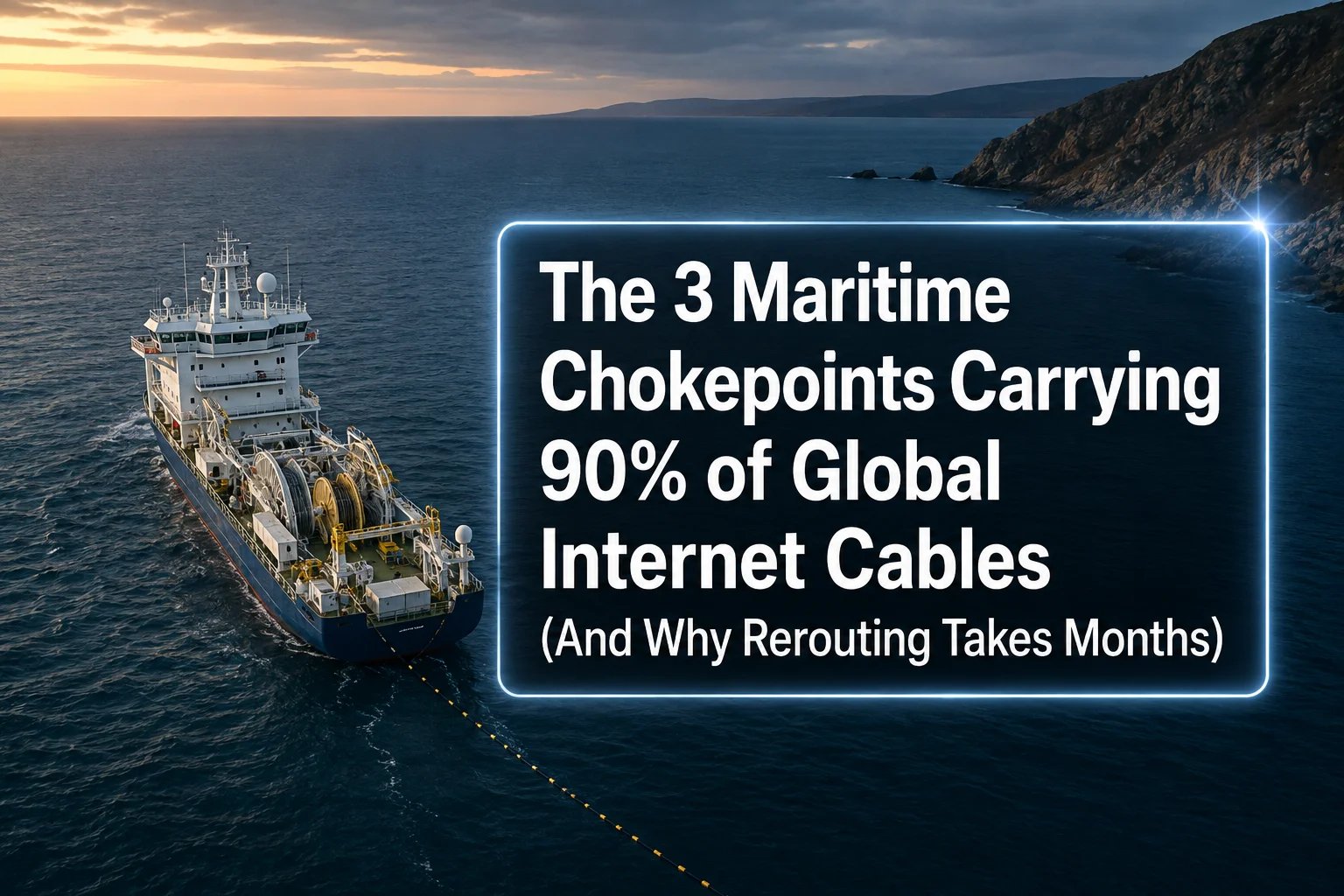
Somewhere off the coast of Egypt, in water barely deep enough to hide a school bus, there's a bundle of glass tubes thinner than a garden hose carrying a meaningful slice of the entire planet's internet traffic. No firewall. No backup generator humming nearby. Just cable, sand, and the occasional fishing trawler dragging an anchor across it like it's nothing.
That's the part people never picture when they hear "the cloud." The cloud is wet. It's heavy. And almost all of it — somewhere north of 95% of intercontinental data, according to Lawfare's national security research — squeezes through a small number of narrow sea passages that most people couldn't find on a map if their Netflix depended on it. Which, honestly, it kind of does.
This article breaks down the three maritime chokepoints where the world's submarine cables bunch together, why that concentration exists in the first place, and why "just reroute it" is one of the most misleading sentences in tech journalism.
Brief Explanation
The three biggest submarine cable chokepoints are the Luzon Strait (between Taiwan and the Philippines), the Red Sea–Suez–Bab el-Mandeb corridor (via Egypt), and the Strait of Malacca (between Malaysia, Indonesia, and Singapore). Together, these narrow waterways carry the vast majority of Europe–Asia and Asia–global internet traffic. When a cable breaks there, it can't be rerouted instantly because spare capacity is limited, repair ships are scarce (fewer than 65 exist worldwide), and physical repairs typically take two to eight weeks — sometimes several months in contested or hard-to-reach waters.
Why Does the Internet Even Run Through the Ocean Floor?
Satellites get all the marketing budget, but they carry a rounding error's worth of global data. A single modern fiber-optic cable can move more traffic than the entire Starlink constellation combined. Undersea cables are cheaper, faster, and far higher capacity — so almost every email, video call, bank transfer, and cloud backup that crosses an ocean travels through one.
There are roughly 600 to 700 of these systems currently active or under construction worldwide, spanning well over a million kilometers of seabed. Most of them don't spread out evenly. They cluster, because geography and geopolitics leave engineers with only a handful of realistic paths between continents. That clustering is the whole story.
The Three Chokepoints, Explained
1. The Luzon Strait — Taiwan's Digital Front Door
Cables connecting East Asia to the rest of the world funnel through this narrow gap between Taiwan and the Philippines because the alternative — routing through the Taiwan Strait itself — sits directly in one of the most politically sensitive waters on the planet. That decision quietly makes Hong Kong, Taiwan, and much of Northeast Asia dependent on a single corridor.
In 2006, a magnitude-7 earthquake off southern Taiwan snapped more than twenty cable segments in this exact strait, knocking out internet and banking connectivity across Asia for weeks. It's still cited as the textbook example of what happens when a chokepoint fails. If you want the fuller geopolitical picture of why this region carries outsized risk for global technology supply chains, our breakdown of what a Taiwan Strait closure would mean for global chips covers a lot of the same fault lines.
2. Red Sea – Suez Canal – Bab el-Mandeb (Egypt Corridor)
This one is arguably the most fragile stretch of internet plumbing on Earth. Egypt alone carries an estimated 17% of global internet traffic and over 90% of Europe–Asia data, according to CSIS's Egypt case study. Cables physically come ashore, cross a narrow strip of Egyptian land, then dive back into the Red Sea toward the Bab el-Mandeb Strait — which pinches down to about 26 kilometers wide between Yemen and Djibouti.
Multiple cable systems, including SEA-ME-WE 3, SEA-ME-WE 4, FLAG, EIG, and AAE-1, are bundled together in this same narrow lane. In 2024, cable damage in the Red Sea disrupted around a quarter of Europe–Asia internet traffic in one go. Regional instability hasn't helped — for context on how naval pressure in this general area has escalated lately, see our piece on Iran's economic blockade and what it signals about naval risk in the wider Gulf region.
3. The Strait of Malacca — Asia's Colonial-Era Bottleneck
The Strait of Malacca, wedged between Malaysia, Indonesia, and Singapore, narrows to under two nautical miles at its tightest point. It's been a strategic chokepoint since the spice trade, and it never really stopped being one — it just swapped cargo ships for fiber.
Singapore sits at the center of it, hosting one of the densest concentrations of cable landing stations anywhere on the planet. That makes the city-state incredibly well connected, and also a single point that a huge share of Southeast Asian, Chinese, and Indian traffic quietly depends on.
Chokepoint Comparison Table
| Chokepoint | Region | Narrowest Width | Approx. Traffic Share | Main Risk |
|---|---|---|---|---|
| Luzon Strait | Taiwan–Philippines | ~250 km | Backbone of East Asia connectivity | Earthquakes, Taiwan Strait tensions |
| Red Sea / Suez / Bab el-Mandeb | Egypt–Yemen–Djibouti | ~26 km (Bab el-Mandeb) | ~17% global, 90%+ Europe–Asia | Regional conflict, anchor drags, shallow water |
| Strait of Malacca | Malaysia–Indonesia–Singapore | ~2.8 km at narrowest | Core route for Southeast Asia & Indo-Pacific | Congestion, piracy history, single-nation concentration |
What Actually Happens When a Cable Snaps
It's not as dramatic as a light going out. It's more like a very expensive, very slow scavenger hunt.
- Detection: Network operators notice a signal loss almost instantly through automated monitoring.
- Localization: Engineers send test pulses down the fiber to estimate where the break sits, often within a few kilometers.
- Ship dispatch: A specialized cable repair ship is mobilized — if one happens to be nearby, which isn't guaranteed.
- Recovery: A grapnel hook or a remotely operated vehicle (ROV) physically lifts the damaged section off the seabed.
- Splicing: Technicians cut out the damaged section and fuse in a new piece of cable, fiber by fiber, in a floating clean room.
- Testing and reburial: The splice is tested, then the cable is lowered and reburied into the seafloor.
Under ideal conditions — shallow water, a ship already close by, calm weather, no permitting delays — this can wrap up in under two weeks. In practice, industry estimates put average repair time somewhere between 10 days and two months, and the 2024–2025 Red Sea incidents show some repairs stretching past five months.
Why "Just Reroute It" Doesn't Really Work
This is the part that trips people up. The internet feels decentralized, so surely traffic just flows around a damaged spot like water around a rock, right? Not quite.
| Assumption | Reality |
|---|---|
| "There's always another cable" | Often true, but many alternate cables run through the exact same narrow corridor — one earthquake or one dragged anchor can hit several at once. |
| "Rerouting is instant" | Traffic can shift within minutes, but the remaining cables now carry extra load, increasing latency and packet loss for everyone. |
| "Satellites can cover the gap" | Satellite capacity is a fraction of a single fiber cable's throughput — useful for emergencies, not a real substitute. |
| "Repairs happen fast once you know the location" | Permits, weather windows, ship availability, and water depth all add weeks, sometimes on top of each other. |
Pros and Cons of Emergency Rerouting
- Pro: Restores partial connectivity within minutes to hours, often invisible to casual users.
- Pro: Buys time for a proper physical repair without total blackout.
- Con: Congests remaining cables, raising latency for video calls, gaming, and trading platforms.
- Con: If the backup route shares the same chokepoint, it offers little real protection.
- Con: Doesn't fix anything — the underlying cable still needs a ship, a crew, and weeks of work.
The Repair Ship Bottleneck Nobody Talks About
Here's the uncomfortable number: there are fewer than 65 cable repair and laying ships in the entire world, and roughly half are approaching the end of their working life. That's the whole global safety net for over a million kilometers of undersea infrastructure. When several chokepoints get hit around the same time — which has happened in the Red Sea, the Baltic, and near Taiwan within recent years — ships get stretched thin fast, and queues form.
Building a new repair ship isn't quick either; it can take years from order to delivery, which is a big part of why fleet growth hasn't kept pace with cable growth.
Geopolitics Makes It Worse
Chokepoints attract more than just accidents. The Red Sea corridor has faced repeated cable damage tied to regional conflict since 2023–2024. Cables near Taiwan's outlying islands have been cut by vessels under murky circumstances more than once. And Baltic Sea cables have suffered a string of anchor-related incidents that NATO now treats as a security concern rather than routine maritime clumsiness.
None of this happens in a vacuum — it tends to track the same broader tensions covered in stories like our look at how countries get cut off from global financial infrastructure like SWIFT. Physical cables and financial messaging systems are different layers of the same underlying idea: modern life runs through a small number of chokepoints, and whoever controls or threatens them gains leverage far beyond their size on a map.
What's Being Done About It
- Arctic cables: Projects like Polar Connect aim to build an entirely new Europe–Asia route through the Arctic Ocean, bypassing the Red Sea and Malacca corridors altogether.
- Terrestrial backup routes: Overland fiber through Saudi Arabia, Jordan, and Israel gives some Europe–Asia traffic a way around the Red Sea when needed.
- More repair ships: The US Cable Security Fleet Act and similar initiatives in Europe and Asia are funding new dedicated repair vessels, though delivery is slow.
- Cable protection zones: Some governments now restrict anchoring and fishing near known cable corridors to cut down on the accidental damage that causes most faults.
Final Conclusion
The internet looks borderless from a browser tab, but its physical backbone is anything but. Three narrow strips of ocean — the Luzon Strait, the Red Sea corridor, and the Strait of Malacca — quietly carry the overwhelming majority of the world's international data. Damage in any one of them isn't a five-minute fix; it's a logistics operation involving specialized ships, months-long queues, and geography that simply can't be argued with. Redundancy helps, but as long as so much traffic funnels through the same few chokepoints, "the cloud" will keep depending on a handful of very real, very vulnerable stretches of seabed.
Frequently Asked Questions
How many submarine cables actually exist worldwide?
Around 600–700 systems are active or under construction globally, according to TeleGeography's industry-standard cable map, spanning well over a million kilometers of seafloor.
What causes most submarine cable damage?
The majority of faults come from ship anchors and fishing gear dragging across cables in shallow water — not sabotage. Natural events like underwater earthquakes and landslides account for a smaller share.
Can one country really control global internet traffic through a chokepoint?
Not fully control it, but a single incident in a dense corridor like the Red Sea can measurably slow traffic across an entire continentto-continent route, which is enough to cause real economic disruption.
Why don't companies just build more redundant cables?
They are, but new cables still need to physically pass through the same limited set of geographically sensible corridors, so redundancy reduces risk without eliminating the chokepoint problem entirely.
Is satellite internet a real backup for submarine cables?
Only in a limited sense. Even large satellite constellations carry a small fraction of the data capacity of a single modern fiber cable, so they help during emergencies but can't replace undersea infrastructure at scale.
For more on how concentrated global supply chains create outsized risk in unexpected places, our coverage of the global race for rare earth metal alternatives explores a very similar pattern — just with rocks instead of fiber optics.


Comments 0
Be the first to comment!