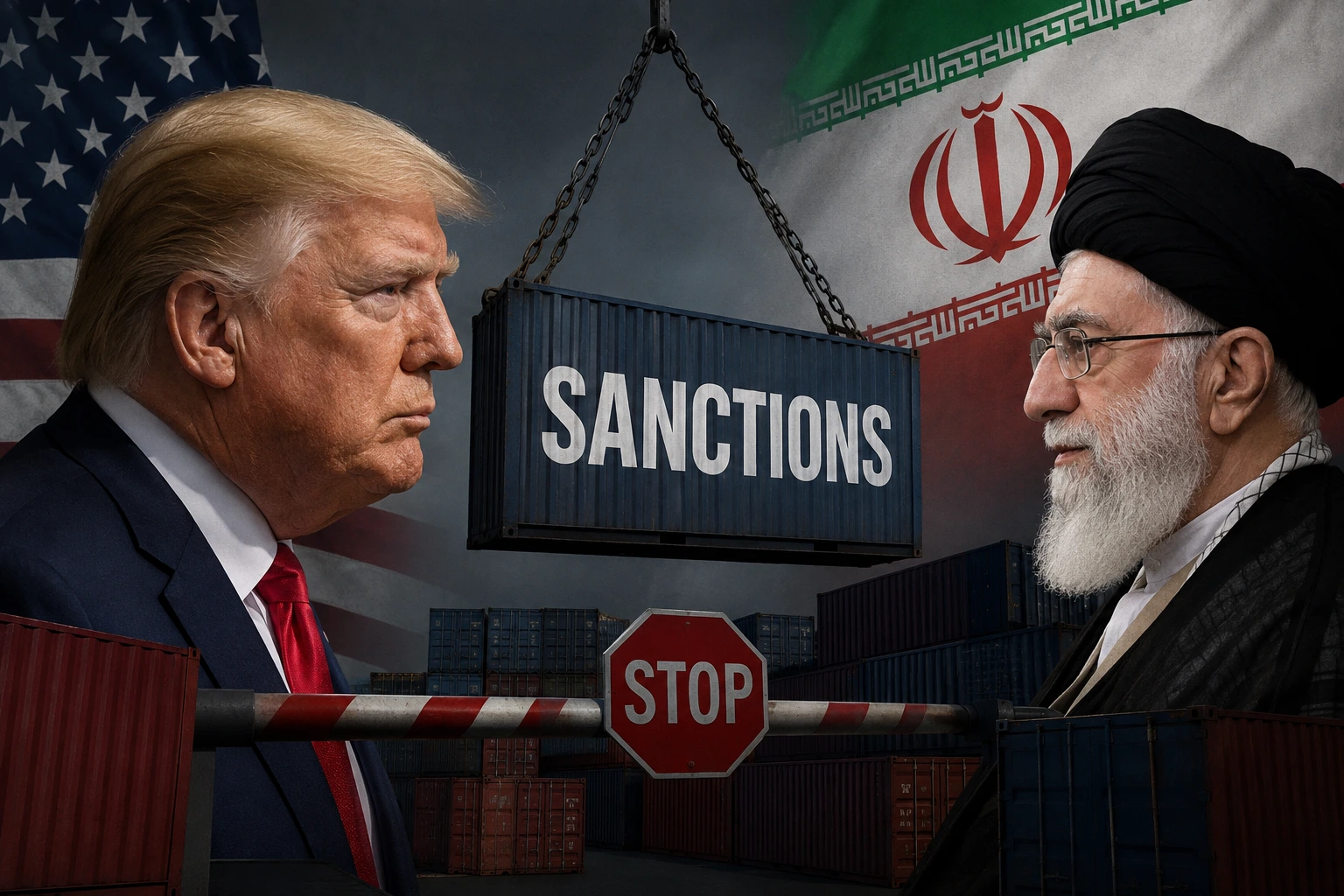
Trump keeps calling it different things — "Economic D-Day," the "most crushing economic operation ever taken against any country," a "one-two punch." Strip away the branding and what's left is a genuinely aggressive attempt to strangle Iran's economy without firing another missile. The question everyone in Washington, Tehran, and every oil-trading desk in between is asking: does an economic siege this severe actually change Tehran's behaviour, or does it just make the next war more likely?
Trump has layered a naval blockade of the Strait of Hormuz on top of the deepest sanctions regime Iran has ever faced, and is now threatening any country, bank, or shipping company that helps Tehran evade it. It has already crushed Iran's oil exports and pushed inflation past 50%. Whether it forces concessions or backfires into renewed fighting depends almost entirely on how desperate Iran's leadership gets — and desperate regimes don't always negotiate.
Let's Talk About What Trump Actually Announced
On August 19, 2026, Trump used a Truth Social post to warn that any country letting its banks, airports, or businesses give Iran a "lifeline" would face what he called tremendous economic consequences. Oil smuggling, currency swap lines, cash transfers, exchange houses, ship registries, front companies — he listed them all, then added a line that read almost like a dare: "you know who you are."
Treasury Secretary Scott Bessent had previewed the move a week earlier, telling reporters the administration was preparing "measures like have never been seen in the history of economic isolation on a country," designed to work alongside the existing naval blockade as a combined squeeze. The Al Jazeera reporting on the announcement noted Al Jazeera that Iran's own foreign minister, Abbas Araghchi, dismissed the threat almost immediately as a distraction from America's own debt problems.
So Now How We Got Here: A Very Short Recap
This didn't come out of nowhere. The US and Israel launched "Operation Epic Fury" against Iran back in February, and we've already covered whether that confrontation ever really ended — short version, it didn't, it just changed shape. When the bombing campaign stalled and a 60-day memorandum of understanding expired without a follow-up deal, Trump pivoted back to the tool he's used against Iran since his first term: economic strangulation, this time branded internally as "Operation Economic Fury."
A naval blockade of Iranian ports has been running since April 13, and it's part of a broader reshuffling of US military priorities in the region — the same logic that recently led Trump to scale back military drills with South Korea, freeing up resources and attention for the Iran file. What changed on August 19 is the scope: this is no longer just about Iran's oil, it's about anyone anywhere who touches Iran's economy.
And What a "Blockade" Actually Means in Practice
The Naval Blockade
US warships intercept and, where possible, turn back tankers trying to move Iranian crude through or near the Strait of Hormuz. CENTCOM has reported dozens of vessels intercepted and several seized outright. Trump insists the strait is "open and operating," which is technically true — a trickle of traffic still gets through — but it's a fraction of the roughly one-fifth of global oil supply that once flowed there.
The Secondary Sanctions Web
This is the less visible, arguably more damaging half. Secondary sanctions don't just punish Iranian entities, they punish anyone outside Iran who deals with them — foreign banks, insurers, shipping registries, even the exchange houses that let Iranians convert rial into hard currency. It's the same "come at every link in the supply chain" playbook we've seen used elsewhere, including in how chip export bans are used as economic weapons against entire industries rather than single companies.
The Shadow Fleet Crackdown
Iran has spent years building a "shadow fleet" — tankers with murky ownership, spoofed transponders, and ship-to-ship transfers at sea, designed to disguise Iranian oil as something else by the time it reaches a buyer, mostly in China. OFAC has sanctioned well over a hundred of these vessels this year alone, plus the brokers and insurers that keep the network running.
Iran's Economy, By the Numbers
| Indicator | Before the blockade | August 2026 |
|---|---|---|
| Seaborne oil exports | ~2 million barrels/day | ~200,000 barrels/day |
| Estimated daily revenue loss | — | ~$435 million/day |
| Inflation rate | ~40-43% | 53.9% |
| IMF 2026 GDP forecast | Modest growth | ~6% contraction |
| Active US sanctions on Iran | — | 6,000+ (2nd most-sanctioned country globally) |
Numbers this big can start to feel abstract, so it's worth putting it plainly: an oil exporter that loses 90% of its seaborne export volume overnight isn't dealing with a slowdown, it's dealing with a fiscal crisis that reaches every ministry, every subsidy program, and every public sector salary.
Why Washington Thinks This Will Work
Trump has said, more than once, that he only launched the February strikes after "50 years of economic pressure" failed to stop Iran's nuclear ambitions — which sounds like an argument against sanctions, until you realize his actual bet is that sanctions plus a fresh military defeat plus a blockade is a different animal than sanctions alone. The theory: a regime that just lost its Supreme Leader and a chunk of its military command has far less capacity to absorb economic pain than it did a year ago.
It's a gamble that's paid off for Washington before — the original 2015 nuclear deal only happened after Iran's economy buckled under an earlier round of sanctions. Whether a battered, post-war Iran responds the same way as a merely sanctioned Iran is the open question nobody can actually answer yet.
How Iran Could Respond, Behind the Scenes
Playing for time
Tehran's default move for years has been to negotiate just enough to avoid total isolation without giving up real leverage — the same slow-walk tactic used in the Oman-mediated Hormuz talks that have dragged on for weeks without a comprehensive result.
Leaning harder on China
China remains the single biggest buyer of discounted Iranian crude, and Beijing has little appetite for enforcing US sanctions on its own behalf. Expect more shadow fleet workarounds, more ship-to-ship transfers, and quieter barter-style deals that dodge the dollar system entirely.
Turning the screws on Hormuz again
Iran has already shown, in March, that it's willing to shut the strait outright when cornered. A fully choked economy gives Tehran less to lose from doing it again — and a shut Hormuz is one of the fastest ways to force Washington back to the negotiating table, or into a fight neither side has fully budgeted for.
Regional proxies and asymmetric moves
With Hezbollah degraded and Iran's own air defenses badly weakened, direct retaliation is riskier than it used to be. That pushes Tehran toward cheaper, harder-to-attribute options — cyber operations, attacks on shipping insurance and infrastructure, or pressure on Gulf states like the UAE, which just imposed its own trade embargo on Iran after accusing it of firing missiles at Emirati territory, a claim Iran denies.
Pros and Cons: Does Economic Warfare Actually Work?
The case for it
- Cheaper and politically safer than more bombing, especially with US munitions stocks already stretched thin
- Historically it has brought Iran to the table before, most notably in 2015
- Targets the regime's ability to fund proxies and weapons programs, not just its diplomacy
The case against it
- Sanctions this broad tend to hurt ordinary Iranians — food and medicine imports, hospital equipment, everyday costs — long before they touch the regime's inner circle
- A cornered leadership with less to loose can become more unpredictable, not less
- Third countries resentful of secondary sanctions may quietly help Iran evade them, undercutting the whole strategy
- It hasn't produced a signed peace deal in six months of trying
Will This Lead to a Wider War? Three Scenarios
1. The Squeeze Continues (most likely near-term)
No new fighting, but no deal either. Iran's economy keeps shrinking, Hormuz stays a partial chokepoint, and both sides wait to see who blinks first. This is roughly where the region has sat since April.
2. Tehran Comes Back to the Table
If the economic pain becomes unmanageable for the new leadership fast enough, a revived version of the June memorandum could get signed — Hormuz reopens fully, some sanctions relief, in exchange for verified nuclear limits. Iran's demand for reparations makes this a hard sell in Washington, but not an impossible one.
3. Renewed Military Escalation
If Iran closes Hormuz again, or a UAE-Iran incident spirals, or Tehran decides economic collapse is a bigger threat to regime survival than another round of strikes, the fighting resumes — likely with oil prices spiking well past the $120 peak seen in March. This is the scenario the Mecca Joint Defence pact between Saudi Arabia, Pakistan, and Turkey was quietly built to hedge against.
Last Words: The blockade is working exactly as designed on paper — it's inflicting real, measurable damage on Iran's economy. What it hasn't done is produce a signed deal, and history suggests economic pressure alone rarely forces a cornered regime to capitulate quickly. The honest read is that this campaign lowers Iran's capacity to fight a long war, but it doesn't lower the odds of a shorter, sharper one if Tehran feels it has nothing left to lose.
Alternatives Washington Considered
- Targeted, narrower sanctions — hitting specific officials and military units instead of the entire economy, seen as too slow to change behaviour
- A full return to bombing — reportedly shelved due to depleted munitions stockpiles and political fatigue with an unpopular war
- Multilateral pressure through the UN or EU — considered but distrusted by the administration as too slow and too easy for Iran to wait out
- Doing nothing new and letting the June memorandum lapse quietly — rejected as a sign of weakness after Hormuz disruptions in July
FAQ
Is the Strait of Hormuz actually blockaded right now?
Partially. The US naval blockade has cut Iranian seaborne oil exports by roughly 90%, though Trump maintains the strait itself remains technically open to traffic.
Is this the same as the sanctions from Trump's first term?
It builds on them but goes further, combining a physical naval blockade with threats against third countries and a post-war Iran that has far less military capacity to push back.
Could this really trigger another war?
Yes, and analysts treat it as a real possibility, not a fringe scenario. The main trigger points are a renewed Hormuz closure or a serious incident involving a Gulf state like the UAE.
Who does the economic pain actually hit hardest?
Ordinary Iranians tend to feel it first, through inflation and shortages, while the regime's leadership and military apparatus generally have more insulation and alternative revenue streams.
Does China keep buying Iranian oil despite the sanctions?
Yes, largely through shadow fleet vessels and discounted deals, which is one reason the blockade hasn't fully cut Iran's oil revenue to zero.
What would actually end this standoff?
A verified nuclear agreement paired with a full, guaranteed reopening of Hormuz and some sanctions relief — the same package the June memorandum tried and failed to lock in.
For ongoing coverage of how this pressure campaign is reshaping the wider region, see our continuing reporting in Hot News Around World, including our look at what 2026's overlapping global crises really mean and how global supply chains are already adapting to chokepoint risk.
Comments 0
Be the first to comment!