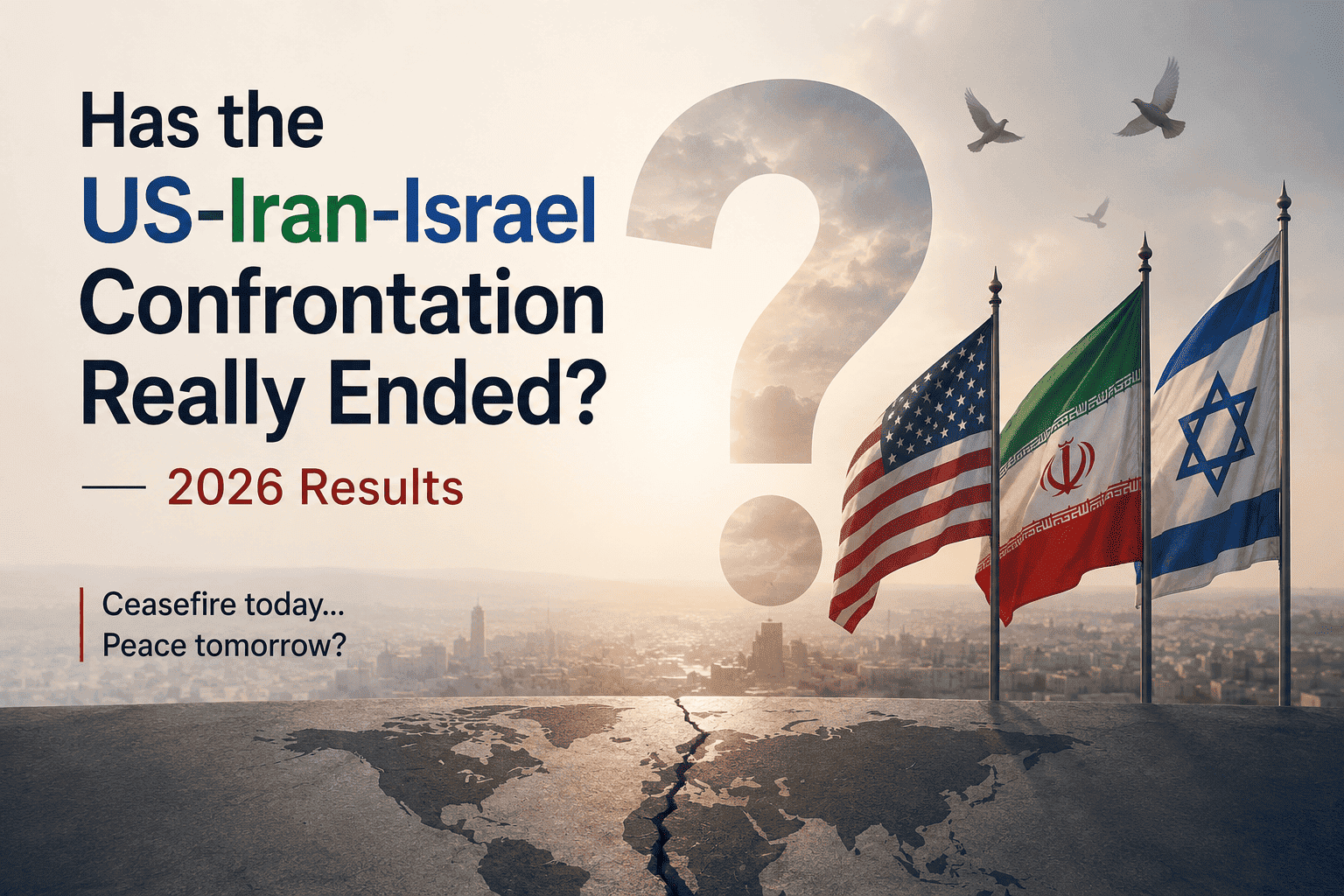
Every few weeks since February, someone declares the Iran war "basically over." Then a tanker gets boarded near Hormuz, or a strike hits southern Lebanon, and the headlines flip right back. So which is it — did this thing actually end, or are we just living inside a very long pause?
So, to be honest, fair, and impartial, let's give a quick answer
No, it hasn't fully ended — it's been downgraded. The large-scale bombing campaign that started on February 28, 2026 stopped within weeks, and a series of ceasefires and one interim memorandum of understanding have held back full-scale war since April. But the core disputes — control of the Strait of Hormuz, Iran's nuclear program, sanctions relief, and Lebanon — remain unresolved as of August 2026. What we have is a managed standoff, not a peace deal.
Mmmm So How We Got Here: A Fast Timeline
On February 28, 2026, the United States and Israel launched coordinated strikes against Iran, aiming to cripple its nuclear and missile infrastructure after months of stalled diplomacy. The strikes killed Supreme Leader Ali Khamenei and dozens of senior officials in a single blow — something that had never happened to Iran's top leadership before.
The Retaliation Phase
Iran hit back with missile and drone strikes against Israel, US bases across the region, and several Gulf states. It also shut the Strait of Hormuz on March 4, choking off roughly a fifth of the world's oil supply almost overnight. Hezbollah joined from Lebanon, and Israel responded with a ground offensive there too.
The Ceasefires That Kept Slipping
A Pakistan-brokered ceasefire between the US and Iran took hold on April 7-8, though Israel struck Lebanon hours later in what became known as "Black Wednesday," killing over 350 people and nearly unraveling the truce before it started. A separate Israel-Lebanon ceasefire followed on April 16.
Then on June 14, US and Iranian negotiators — again with Pakistan mediating — signed an interim memorandum meant to end the war within 60 days: reopen Hormuz, halt the Hezbollah-Israel front, and get Iran to reaffirm it wouldn't pursue nuclear weapons. It didn't fully stick. In July, fighting flared again after Iran struck three commercial vessels that had bypassed its approved shipping corridor.
Where Things Stand in August 2026
As of this week, Iran and Oman are negotiating temporary arrangements for ships crossing Hormuz, with Tehran reportedly pushing for a say — and possibly fees — over the waterway it now treats as leverage. Oil prices have been ticking back up on the uncertainty. No comprehensive settlement has been signed.
The Military Scoreboard
Casualty figures from a war this chaotic vary a lot depending on who's counting, but the rough, cross-checked picture as of early August looks like this:
| Country / Group | Estimated Killed | Notable Impact |
|---|---|---|
| Iran | ~3,500–6,000+ | Leadership decapitated; over 82,000 civilian structures damaged, per Iran's Red Crescent |
| Lebanon | ~3,400–4,300+ | 1.2 million+ displaced; Hezbollah's command structure badly degraded |
| Israel | 35–57 | Nearly 8,000 injured; sustained missile barrages on cities |
| United States | 13–20 | Roughly $5 billion in equipment losses, including a downed tanker aircraft |
| Gulf states (Iraq, UAE, Kuwait, etc.) | ~150+ combined | Bases and infrastructure hit despite staying formally neutral |
Totals across every front run somewhere between 7,000 and 18,000 dead, depending on the source — a genuinely wide range that reflects how hard it is to verify numbers inside Iran and southern Lebanon.
And Now Who Actually Got What They Wanted?
This is the part most coverage skips past. Everyone claimed victory in public. The reality, when you look at declared goals versus outcomes, is messier.
United States
- Achieved: Removed Khamenei, degraded Iran's air defenses and missile stockpiles, forced Iran into direct talks it had avoided for years.
- Fell short on: No confirmed destruction of Iran's enriched uranium stockpile (still estimated above 400kg at 60% purity), no verified nuclear inspections resumed, and Hormuz remains a live pressure point months later.
Israel
- Achieved: Struck deep into Iranian territory and Lebanon largely unopposed by any credible air defense, weakened Hezbollah considerably.
- Fell short on: Sustained direct missile fire on its own cities for the first time at this scale, and the "Black Wednesday" strikes damaged trust with Washington and mediators at a delicate moment.
Iran
- Achieved: Survived as a state, kept the regime intact through a rapid, if bruising, succession, and turned Hormuz into genuine long-term leverage.
- Fell short on: Lost its Supreme Leader and a large slice of military command in one strike, its economy is under a de facto naval blockade, and its "nuclear fatwa" — the religious ban on weapons — looks shakier than ever under the new leadership.
The Economic Fallout Nobody Can Ignore
Whatever you think of the military outcome, the economic bill is not in dispute. Oil went from around $60 a barrel in January to over $90 on average by March, with Brent briefly spiking past $120 when Hormuz shut completely. Some analysts warned of $150-200 oil if the closure dragged on.
Qatar, which has no pipeline workaround for its LNG exports, declared force majeure. Combined Gulf oil output reportedly dropped by 6-10 million barrels a day at the peak of the crisis. Global GDP losses for 2026 are estimated at around $1.3 trillion under the current "stalemate" scenario — real money that shows up as higher pump prices from Ohio to Ho Chi Minh City.
It's a pattern we've touched on before when covering how global supply chains are quietly shifting away from single points of failure — energy routes are just the latest chokepoint getting the same treatment.
The Bigger Strategic Shift: A New Regional Bloc
Maybe the most under-covered result of this whole war isn't military at all. On August 7, Saudi Arabia, Pakistan, and Turkey signed the Mecca Joint Defence Agreement — a mutual-defense pact that treats an attack on any one signatory as an attack on all three, language that echoes NATO's Article 5.
Read between the lines and it's a hedge. Gulf states watched a superpower ally fail to stop repeated strikes on their own soil and decided they needed a backup plan that doesn't depend entirely on Washington. It's the same logic we've seen play out in tech, where countries stopped waiting on a single dominant supplier and started building parallel systems instead — only here it's air-defense treaties, not chips.
Iran, for its part, has leaned on the same playbook of quiet workarounds and sanctions evasion that we've seen elsewhere — not unlike the improvised supply routes that let companies keep operating under export restrictions, just applied to oil shipments and military parts instead of semiconductors.
Pros and Cons: Has the "Pause" Actually Worked?
What's Working
- Large-scale bombing has stopped since April
- Direct US-Iran diplomatic channels exist for the first time in years
- Oman is actively brokering interim Hormuz arrangements
What's Not
- No signed comprehensive peace deal, only rolling ceasefires
- Iran's nuclear stockpile status is unverified and unmonitored
- Hormuz shipping risk premiums remain elevated
- Lebanon's ceasefire has already been broken more than once
What Could Happen Next: Three Scenarios
1. Extended Stalemate (Most Likely)
Hormuz stays partially open under temporary Iran-Oman terms, sporadic strikes continue, and both sides avoid a return to full war because neither can afford the cost. This is roughly where things sit today.
2. Negotiated Settlement
A durable deal covering Hormuz access, sanctions relief, and some form of nuclear verification gets signed. Possible, but Iran's demand for reparations and "guarantees against future aggression" is a tough sell in Washington.
3. Renewed Escalation
Talks collapse again — as they nearly did in July — Hormuz closes fully, and oil spikes past $150. The Mecca pact's actual teeth would get tested for the first time under this scenario.
Real Verdict
The confrontation is paused, not resolved. The active bombing campaign is over. The war that produced it — over Iran's nuclear future, control of Hormuz, and the balance of power across the Gulf — is very much still being fought, just with negotiators and naval patrols instead of airstrikes. Anyone telling you this is "finished" hasn't looked at a shipping manifest lately.
FAQ
Did the US and Israel win the war against Iran?
Militarily, yes, in the narrow sense — they struck Iran's leadership and infrastructure largely without effective resistance. Strategically, it's less clear-cut: Iran's nuclear stockpile wasn't confirmed destroyed, and Hormuz remains contested.
Is Iran now building a nuclear weapon?
There's no confirmed evidence either way. What's changed is the political mood inside Iran — the old religious ban on nuclear weapons appears increasingly unpopular under the new leadership, even without a formal reversal.
Is the Strait of Hormuz open again?
Partially, and inconsistently. Iran and Oman are negotiating temporary routing arrangements, but full, guaranteed free passage hasn't been restored.
What is the Mecca Joint Defence Agreement?
A mutual-defense pact signed August 7, 2026 by Saudi Arabia, Pakistan, and Turkey, treating an attack on one member as an attack on all three — widely read as a hedge against both Iranian threats and doubts about US security guarantees.
Could full-scale war restart?
Yes. Talks have already collapsed once, in July, and the core disputes — Hormuz, sanctions, the nuclear file — remain unsettled. Analysts generally treat renewed escalation as a real, if not the most likely, outcome.
How much has this cost the global economy?
Estimates put 2026 global GDP losses around $1.3 trillion under the current stalemate scenario, driven mostly by oil price shocks and shipping disruption through Hormuz.
For more on how conflicts like this one are reshaping global alliances and trade routes, see our ongoing coverage in the Hot News Around World section.
Comments 0
Be the first to comment!