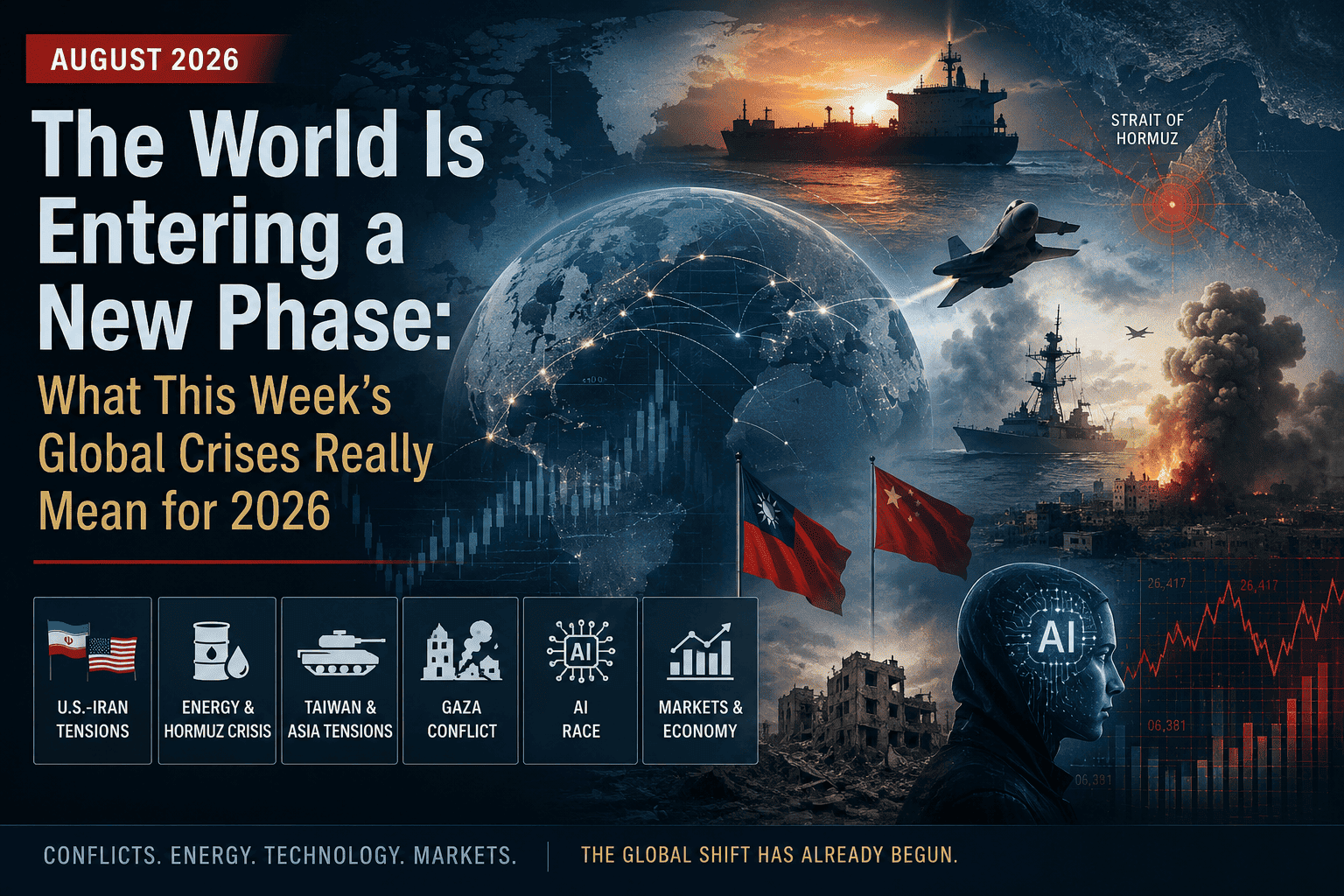
Open five news tabs right now and you'll get five different stories: oil tankers stuck near Hormuz, Gaza's ceasefire that keeps almost collapsing, Chinese jets circling Taiwan, Ukraine's frontline going quiet again, and Wall Street arguing about whether AI stocks are a bubble. Treated seperately, none of these feel connected. Watched together, over the same seven days, they start looking like symptoms of the same underlying shift — a world quietly renegotiating who controls energy, trade routes, chips, and capital heading into 2026.
This isn't a "everything is collapsing" piece. It's an attempt to explain what's actually moving behind these headlines, and why the connections between them matter more than any single event.
Let's Jump to Fast Answer: Is This One Crisis or Five?
It's five distinct conflicts with one shared cause: the old assumptions about cheap energy, open shipping lanes, predictable trade, and uncontested US-China tech dominance are all being tested at once. None of these crises created the others, but each one is now feeding into how governments, central banks, and companies plan for 2026.
- Oil markets are pricing in permanent risk, not a temporary spike.
- Gaza's "ceasefire" is really a slow-motion political standoff with a real death toll attached.
- Taiwan's tension is less about invasion and more about who controls the next decade of chip supply.
- Ukraine has moved from active offensive to a grinding, frozen negotiation.
- AI investment is now large enough to move the entire stock market on its own.
The Strait of Hormuz: The World's Most Expensive Chokepoint
Since the conflict between the US, Israel, and Iran erupted in late February 2026, the Strait of Hormuz — the narrow waterway that normally carries roughly a fifth of the world's oil — has been effectively closed for most of the year. Iran's Revolutionary Guard has warned ships away, laid mines, and boarded vessels, while the US has run a counter-blockade of Iranian ports.
What's actually happening this week
As of early-to-mid August, Iran and Oman appear close to a deal on managing shipping routes through the strait, but Iranian officials insist full reopening depends on the US ending its blockade and paying compensation, according to CNN. Brent crude has been swinging between roughly $84 and $90 a barrel on exactly this kind of headline, according to Al Jazeera.
Why oil keeps swinging on rumors, not barrels
The US Energy Information Administration doesn't expect Middle East oil production to return to pre-conflict levels until early 2027, and projects Brent averaging around $87 a barrel through 2026, per its own Short-Term Energy Outlook. That's the real story: even a "deal" doesn't instantly fix shipping insurance costs, tanker availability, or the risk premium traders have baked in for the rest of the year.
Gaza's Ceasefire That Never Fully Started
In late July, the US-backed Board of Peace announced what was called a historic disarmament agreement covering Hamas and other armed groups in Gaza. On paper, it was framed as the beginning of the ceasefire's second phase. On the ground, Israeli strikes continued, and by early August the death toll since the October 2025 ceasefire had climbed past 1,250, according to reporting from Al Jazeera.
The gap between the diplomatic announcement and the reality on the ground is the pattern to watch — it's the same gap showing up in Ukraine and, to a lesser degree, in the Hormuz talks. Agreements get announced faster than they get implemented.
Taiwan: The Chip War Nobody Is Officially Calling a War
Taiwan just ran its largest-ever reservist mobilization as part of its annual defense drills, this year including a new element: testing whether weapons production lines can be relocated and civilian factories converted for military use if Chinese strikes hit supply hubs. Japan's newest defense white paper, released August 5, went further, stating the military balance is "rapidly tilting" toward China.
None of this is happening in a vacuum. It's the military layer sitting on top of a fight over semiconductors that's already reshaping global tech supply chains — something we broke down in detail in The Quiet Tech Cold War: How Chip Export Bans Are Reshaping Global Power. Companies aren't waiting to see how Taiwan plays out; they're already quietly shifting supply chains away from China, and firms like Huawei are racing to prove they can build advanced chips without Western tools, as we covered in our look at the Huawei Pura 90 Pro Max and its 5nm chip.
Ukraine: Not Over, Just Quieter
Ukraine hasn't seen a lasting ceasefire since the war began, despite several short truces in 2026 tied to religious holidays, most of which collapsed within days amid mutual accusations of violations. The core sticking points remain unchanged: Russia wants the Donbas region ceded outright, and Ukraine refuses to withdraw unilaterally while demanding binding security guarantees, according to tracking from the Council on Foreign Relations.
What's changed isn't the war's intensity — it's the world's attention. With Hormuz and Gaza dominating headlines, Ukraine has quietly settled into a state that analysts describe less as "resolving" and more as "freezing in place," which matters because frozen conflicts tend to consume budgets and troops for years without producing a clean outcome either way.
Wall Street's AI Bet Meets a Nervous Fed
Global AI investment is projected to top $2.5 trillion in 2026, roughly a 44% jump from the year before, with about half of that going straight into data centers and infrastructure. The S&P 500 is up 13.4% year-to-date, and the top 10 stocks now make up more than a third of the entire index — a concentration level that makes the market unusually sensitive to AI earnings and rate decisions.
New Fed Chairman Kevin Warsh's more hawkish tone on interest rates is the wildcard here. Higher rates hit high-multiple growth stocks hardest, which is exactly the category most AI names fall into. Meanwhile, the physical side of the AI boom is already reshaping consumer tech pricing — we've tracked how data-center memory demand is driving up costs in RAM Is the New Gold, and how China's open-source AI push is rattling Silicon Valley's pricing power in The Great AI Model War.
Table: How This Week's Crises Are Connected
| Event | Immediate Effect | 2026 Ripple Effect |
|---|---|---|
| Hormuz standoff | Oil price volatility, shipping insurance spikes | Higher energy costs feed inflation, complicating Fed rate decisions |
| Gaza ceasefire strain | Regional instability, US diplomatic pressure | Keeps Middle East risk premium elevated in oil and shipping |
| Taiwan tension | Chip supply chain anxiety | Accelerates the shift away from China-based manufacturing |
| Ukraine stalemate | Sustained defense spending in Europe/US | Diverts fiscal resources that could otherwise ease inflation pressure |
| AI investment surge | Record market concentration in tech stocks | A rate hike or earnings miss could trigger an outsized correction |
Is the World Really Entering a New Phase?
This is the actual question behind all the headlines, and reasonable people disagree on the answer.
Signs pointing to a structural shift
- Energy security is being renegotiated at the chokepoint level, not just the pricing level.
- Chip supply chains are being physically rebuilt outside China, a multi-year process already underway.
- Markets are more concentrated in a single technology theme (AI) than at almost any point in modern history.
- Multiple "ceasefires" this year have been announced diplomatically before being implemented on the ground.
Signs this is still the same old cycle
- Oil shocks tied to Middle East conflict have happened repeatedly since the 1970s and eventually stabilized.
- Taiwan tensions have escalated and cooled multiple times since 2022 without triggering direct conflict.
- Tech valuation bubbles (dot-com, 2021 growth stocks) have inflated and corrected before without ending the underlying technology's growth.
Three Scenarios for the Rest of 2026
Scenario 1: Managed De-escalation
The Hormuz deal finalizes, Gaza's disarmament actually proceeds, and Ukraine settles into a durable if unhappy frozen line. Oil drifts back toward EIA's $70s forecast, and markets treat 2026 as a stressful but ultimately survivable year.
Scenario 2: Frozen Conflicts, Slow Bleed
None of the five situations resolve or fully explode. Oil stays elevated in the $80s, defense spending keeps climbing, and the AI trade grinds higher on momentum even as skeptics grow louder. This is arguably where things stand right now.
Scenario 3: The Spark
A single incident — a tanker attack that kills foreign nationals, a Taiwan Strait miscalculation, a Gaza ceasefire collapse — pushes one of these five crises past a threshold and drags the others with it, particularly through oil prices and market sentiment.
Verdict Box
Our take: This isn't five unrelated headlines — it's one global system under simultaneous pressure at its energy, trade, and technology chokepoints. Whether 2026 becomes a genuine turning point or just a very stressful year that eventually normalizes depends less on any single event and more on whether diplomatic announcements this year start matching what actually happens on the ground. So far, the gap between the two has been the real story.
Frequently Asked Questions
Why does the Strait of Hormuz matter so much to global oil prices?
Roughly a fifth of the world's oil and a significant share of LNG shipments normally pass through the strait. When it's disrupted, alternative routes can't fully absorb that volume, so prices react to the risk of disruption, not just actual supply lost.
Is the Gaza ceasefire still in effect?
Technically yes, but implementation has been inconsistent, with strikes and casualties continuing well after the original October 2025 agreement and the July 2026 disarmament deal.
Could Taiwan tensions actually lead to war in 2026?
Most analysts view an actual invasion as unlikely in the near term, but the trend of increased military activity and grey-zone pressure is real and is already affecting chip supply chain planning worldwide.
Is the AI stock rally actually a bubble?
Opinions are split. Major banks argue current AI earnings and cash flow justify the valuations, while some economists warn that rate hikes or slower enterprise adoption could trigger a sharp correction, particularly given how concentrated the market has become in a handful of stocks.
How are these five crises actually connected?
Through capital and risk. Oil prices affect inflation and rate decisions. Rate decisions affect AI stock valuations. Chip supply chain fears accelerate manufacturing shifts away from China. Defense spending tied to Ukraine and Taiwan competes with other government priorities. It's one interconnected system, not five isolated stories.
Final Word
None of these crises are new by themselves. What's different in 2026 is the timing — Hormuz, Gaza, Taiwan, Ukraine, and the AI market boom are all under stress in the same narrow window, and each one is now a variable the others have to account for. Whether that adds up to a genuinely "new phase" of the global order or just an unusually rough patch is something we'll only really know in hindsight. For now, it's worth watching the follow-through on these deals more closely then the announcements themselves.
For more breakdowns of how global events are reshaping technology, trade, and markets, browse our Hot News Around World section.


Comments 0
Be the first to comment!