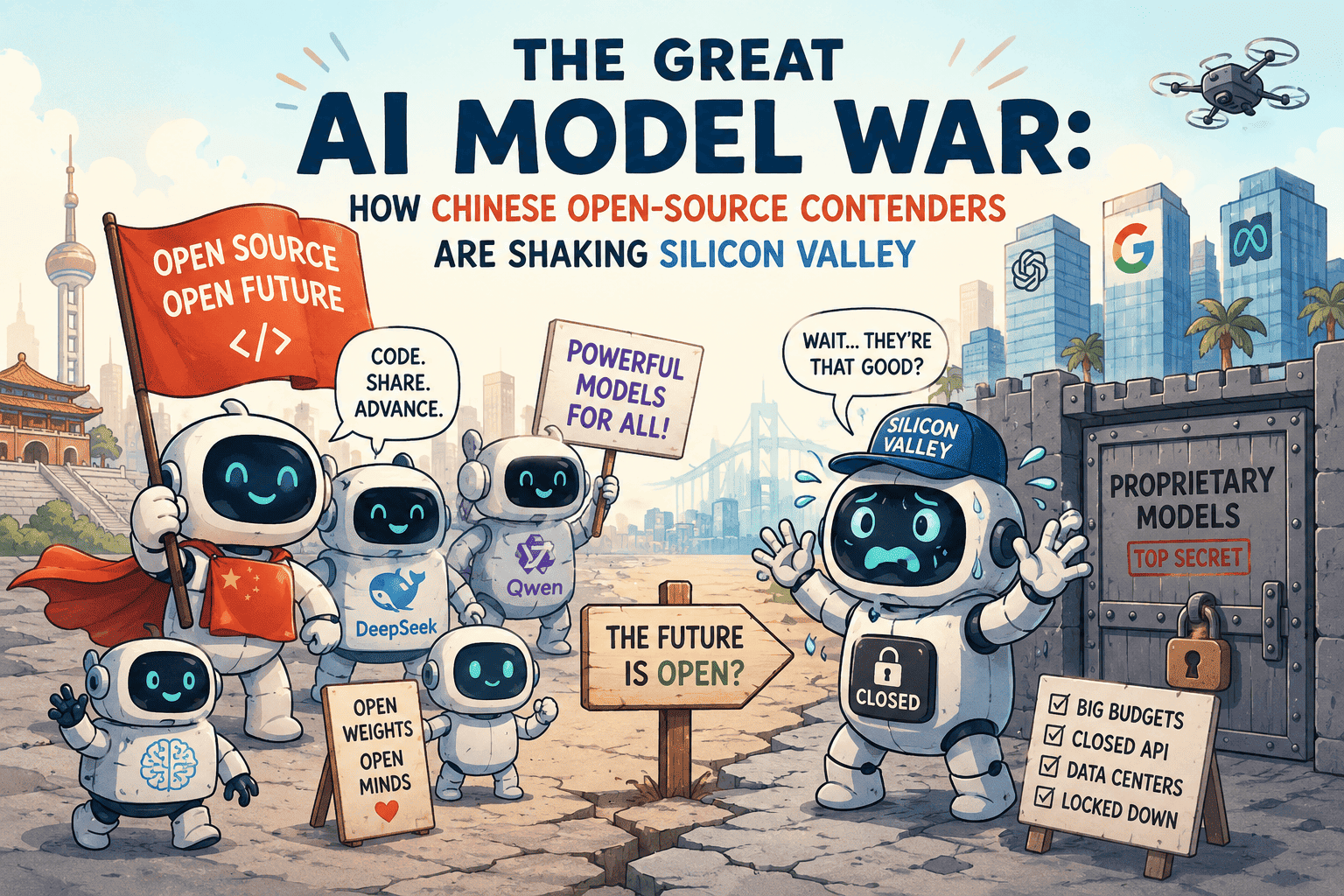
Every few weeks now, a Chinese lab most Western readers have never heard of quietly drops a model file on Hugging Face, and by the next morning half of San Francisco is talking about it. That's not hype anymore. It's a pattern, and it's been repeating since early 2025 with DeepSeek's R1 release.
What's actually going on behind the headlines isn't just "China caught up." It's a completely different business model for building frontier AI, one built around open weights, brutal efficiency, and pricing that makes American subscriptions look almost quaint. Here's what's really happening, and why it matters even if you never touch a Chinese chatbot.
Lest get started with Chinese labs like DeepSeek, Alibaba's Qwen team, and Moonshot AI are releasing open-weight models that rival or beat top U.S. systems on many benchmarks, at a fraction of the price. They're doing it despite restricted access to Nvidia's best chips, by leaning on mixture-of-experts architectures that activate only a sliver of their total parameters per task. The effect: AI inference costs are collapsing industry-wide, and Silicon Valley's closed-source moat looks a lot shallower than it did two years ago.
The Labs Actually Driving This
Three names come up constantly, and each is playing a slightly different game.
DeepSeek started the whole conversation with R1 in January 2025, then kept shipping. Its latest, DeepSeek-V4-Flash, launched July 31, 2026 with beefed-up autonomous agent skills and lower API costs, and reportedly performs close to Anthropic's Claude Opus 4.8 on complex coding tasks. The heavier V4-Pro variant targets quality-sensitive reasoning work instead of raw speed.
Alibaba's Qwen team took a different route: sheer scale plus open access. Qwen3.8-Max landed with 2.4 trillion total parameters, though it only activates around 95 billion of them per prompt thanks to its mixture-of-experts routing. Alibaba's stock jumped nearly 8% the day it was announced, and Qwen models have racked up hundreds of millions of downloads on Hugging Face — reportedly more than any other open-weight family on the planet.
Moonshot AI, maker of the Kimi line, is the one quietly winning over U.S. developers. Kimi K3, released mid-July 2026 with 2.7 trillion parameters, is already the backbone for parts of Cursor's coding agent and some of DoorDash's internal tooling, according to public statements from those companies' engineers. It's not cheap by Chinese standards, but it still undercuts equivalent American models by a wide margin.
Where the Big Three Stand Right Now
| Model | Total / Active Parameters | Context Window | Approx. Output Price (per 1M tokens) |
|---|---|---|---|
| DeepSeek V4-Flash | 284B / 13B | 128K–256K | ~$0.87 |
| Qwen3.8-Max | 2.4T / 95B | Up to 1M | Not fully open (flagship shifting to paid access) |
| Kimi K3 | 2.7T total | 1M | ~$15 |
For comparisson, a comparably capable closed U.S. model has been quoted at roughly $50 per million output tokens — which is the whole story in one sentence.
Why Open Weights Actually Change the Economics
Open-weight doesn't just mean "free to download." It means any startup, university lab, or solo developer can take the model, strip out what they don't need, fine-tune it on their own data, and run it on their own hardware without paying a per-token toll to anyone.
That single fact is quietly reshaping how AI startups get built. Instead of budgeting six figures a year for API calls to a closed model, a founder can self-host a Qwen or DeepSeek variant on rented GPUs and control the cost curve directly. Cloud providers, enterprise software vendors, and even hobbyists building on our Technology & PC Games coverage of consumer hardware all benefit from the same downward price pressure.
Mixture-of-experts architecture is the technical trick underneath almost all of this. Rather than firing every parameter for every request, the model routes each token to a small subset of specialized "expert" sub-networks. Qwen3.8-Max has 2.4 trillion parameters on paper, but only around 95 billion actually switch on per prompt — which is why it can run at a fraction of the compute cost you'd expect from a model that size.
Building Frontier AI Without Nvidia's Best Chips
Here's the part that surprises people most: none of this happened because China suddenly got easy access to top-tier American silicon. If anything, the opposite is true. Export rules on advanced AI chips have swung back and forth through most of 2026, and Chinese labs have had to build around the uncertainty rather than wait for it to resolve.
We covered the policy side of this in detail in The Quiet Tech Cold War: How Chip Export Bans Are Reshaping Global Power — the short version is that licensing rules, volume caps, and loophole-closing guidance have kept Chinese firms from simply buying their way to Nvidia's fastest hardware, even when a deal is technically approved on paper.
So Chinese labs optimized instead of waited. That's the real story behind Huawei's homegrown chip breakthrough, which we broke down in Huawei Pura 90 Pro Max: How Huawei Built a 5nm Chip Despite US Sanctions — stockpiled licenses, an EUV-free production workaround, and a domestic design toolchain built from scratch. The same scrappy engineering culture shows up in how DeepSeek and Moonshot squeeze frontier performance out of mixture-of-experts routing, aggressive quantization, and training tricks that need far fewer GPU-hours than the brute-force approach favored in the U.S.
It's also part of a bigger shift we've tracked in Why Global Supply Chains Are Quietly Shifting Away From China — the AI hardware story and the manufacturing supply chain story are two sides of the same decoupling process, just moving at different speeds.
How Close Are They Really to GPT, Claude, and Gemini?
Close enough that "catching up" undersells it in a few narrow categories. On the LM Arena leaderboard, Qwen3.8-Max reportedly ranks first among Chinese models and trails only Anthropic's Claude for text tasks, while placing second globally on visual data analysis. Kimi K3 has drawn comparisons to Anthropic's Fable-tier models on long-horizon coding and agentic tool use.
Where the gap still shows up is consistency across the hardest reasoning benchmarks, safety tooling maturity, and enterprise support infrastructure — areas where OpenAI, Anthropic, and Google DeepMind still have a multi-year head start. But for a huge share of everyday coding, writing, and data tasks, the practical difference has narrowed to the point where price becomes the deciding factor, not raw capability.
Pros and Cons of Betting on Chinese Open-Source Models
Pros
- Dramatically lower inference costs — often a tenth of comparable closed models
- Full control: self-host, fine-tune, and modify without vendor lock-in
- Rapid release cadence keeps capabilities improving every few weeks
- No API rate limits when you run the weights yourself
Cons
- Flagship tiers are increasingly shifting to paid or revenue-share access, not fully free anymore
- Data governance and compliance questions for regulated industries
- Smaller third-party safety and enterprise-support ecosystem compared to OpenAI or Anthropic
- Self-hosting still requires real GPU infrastructure and in-house expertise
Alternatives: Is Silicon Valley Answering Back?
Yes, though unevenly. Meta continues to push open Llama releases, and OpenAI has experimented with more permissive open-weight models after years of staying fully closed. A newer entrant, Thinking Machines Lab — founded by OpenAI's former CTO — released its first open model this year and has openly used Kimi's output to help train it, which says a lot about where the momentum currently sits.
Fireworks AI's leadership has publicly said they don't see a "fundamental barrier" to strong U.S. open-source models emerging. The ingredients exist. What's missing so far is the same aggressive release pace and rock-bottom pricing that Chinese labs have made their signature move.
Our Verdict
Chinese open-source AI isn't a side story anymore — it's a genuine structural threat to how Silicon Valley planned to make money from AI. Closed-source subscriptions still win on polish, safety tooling, and enterprise trust. But on raw price-to-performance, the open-weight Chinese models are setting the market's floor, and every closed lab now has to justify its premium against that floor.
For developers and businesses, the practical move is to treat these models as legitimate production options, not curiosities, while keeping an eye on how quickly "open" tiers keep shrinking as these companies look for revenue.
Frequently Asked Questions
Is DeepSeek actually open source, or just "open weight"?
Technically open weight — the trained model files are downloadable and usable, but the full training data and code pipeline aren't always released. Most people use the terms interchangeably in casual coverage, though they aren't identical.
Can I legally use Qwen or DeepSeek models for a commercial product?
In most cases yes, under permissive licenses like Apache 2.0, though top-tier flagship models are increasingly moving toward paid or revenue-share terms for heavy commercial use. Always check the specific model card before deploying.
Why are Chinese AI models so much cheaper to run?
Mostly mixture-of-experts architecture, which activates a small fraction of total parameters per request, combined with aggressive training efficiency built out of necessity due to restricted access to top-tier chips.
Do these models run on consumer hardware?
Smaller variants, yes — some distilled or "lite" versions run on a single high-end GPU. The largest flagship models still need serious multi-GPU clusters, which is why most people access them through an API instead of self-hosting.
Will U.S. chip export policy stop this trend?
Unlikely to stop it outright. Export rules have tightened and loosened repeatedly through 2026, and Chinese labs have consistently adapted their software efficiency faster than the hardware restrictions have tightened.
The AI model war isn't being fought over who has the biggest data center anymore. It's being fought over who can deliver the most usable intelligence per dollar — and for now, China's open-source labs are setting the pace.
Sources:



Comments 0
Be the first to comment!