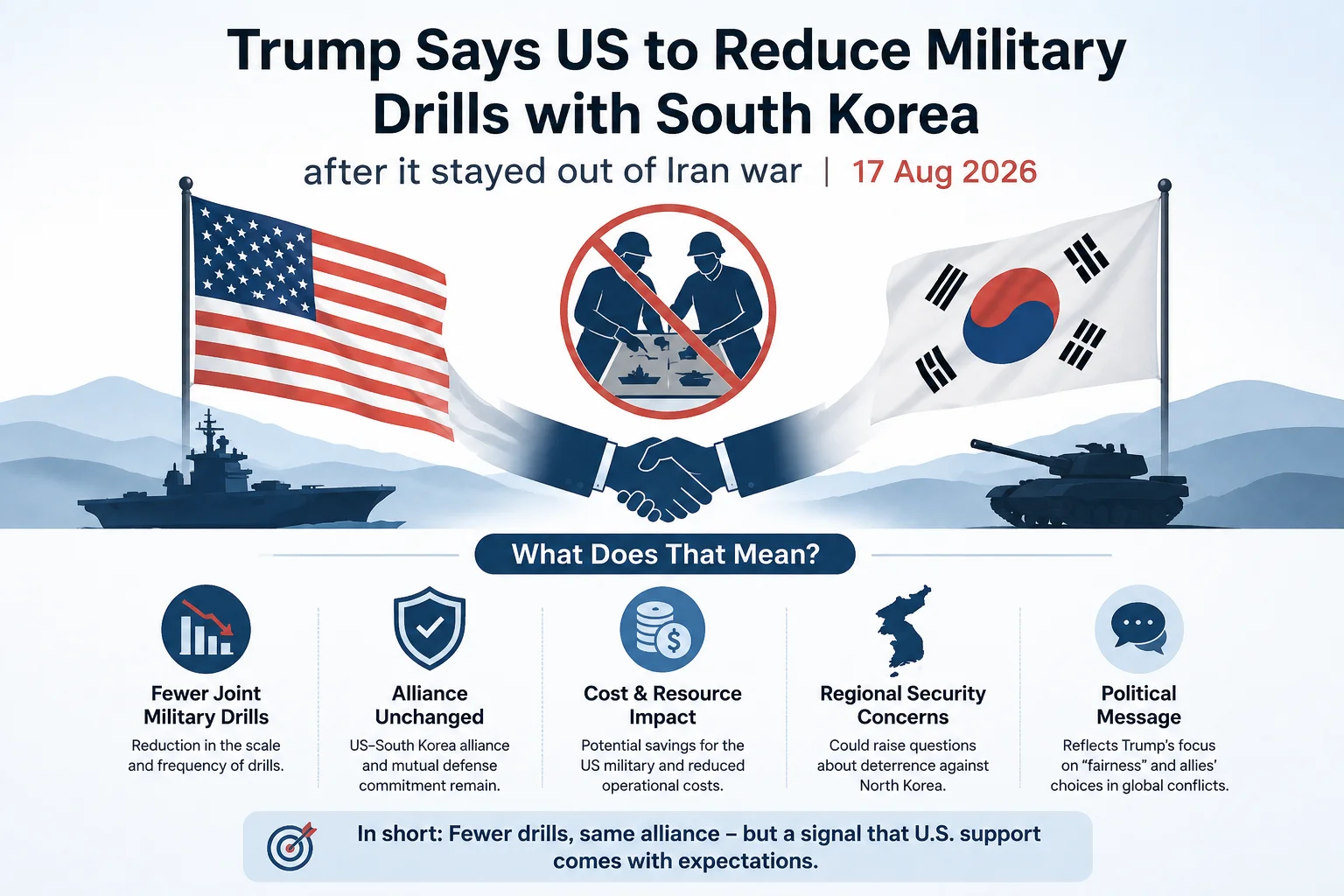
Hours before thousands of troops were set to begin one of the region's biggest military exercises, President Trump announced he wanted it scaled back. The reason he gave wasn't about readiness or budgets first — it was about South Korea turning down his request for help in Iran.
On August 16, 2026, Trump said he had told Defense Secretary Pete Hegseth to "substantially reduce" the Ulchi Freedom Shield drills with South Korea, citing his relationship with North Korea's Kim Jong Un and Seoul's refusal to join the US-Israel war on Iran. South Korea's defense ministry responded that the drills would proceed "as previously notified and scheduled," meaning the actual size of the cuts is still unclear. The episode says less about North Korea policy and more about how Trump is using military commitments as leverage over allies who don't back him on Iran.
So What Trump Actually Announced
Trump posted the decision on Truth Social on the night of August 16, just as the annual Ulchi Freedom Shield exercise was about to kick off. He framed it around two things: cost, and his personal rapport with Kim Jong Un.
He wrote that continuing the drills sent a "signal that is totally inappropriate and hostile" toward North Korea, a country he described as having been unusually respectful during his time in office. He then added the detail that actually made the story travel: he'd asked South Korea's president to join the coalition against Iran, and Seoul had said no.
Since it was too late to cancel the exercise outright, Trump said he'd ordered Hegseth to cut it down instead. What exactly gets cut — troop numbers, live-fire components, days on the calendar — was not spelled out in the post.
The Catch Nobody's Talking About
Here's the part that gets buried under the headline. Within hours, South Korea's Ministry of Defence said the drills would go ahead "as previously notified and scheduled". That's a polite way of saying: nothing has officially changed on our end yet.
This is a pattern with Trump and Korean drills. He tried something similar in 2018 after his first summit with Kim, calling the exercises "expensive" and "provocative." Back then, the Pentagon eventually suspended a large summer drill, but smaller exercises quietly continued. The announcement usually moves faster than the actual policy change, and this looks like it's following the same script.
| Detail | What we know |
|---|---|
| Exercise name | Ulchi Freedom Shield 2026 |
| Scheduled dates | August 17–27 (11 days) |
| South Korean troops involved | Around 18,000 |
| Trump's stated reason | Cost, ties with Kim Jong Un, Seoul's refusal to join the Iran war |
| South Korea's official response | Drills proceeding as scheduled, pending "close" talks with Washington |
| US Pacific carrier presence | Zero — USS George Washington was redirected to the Middle East |
Then Why South Korea Said No to the Iran War
Seoul's calculus wasn't really about Iran at all — it was about North Korea. South Korea has spent decades building a foreign policy that avoids military entanglements outside its own neighborhood, partly so it can keep its forces and political capital focused on deterring Pyongyang.
Jumping into a Middle East conflict carries real downside for Seoul with very little upside. It risks Iranian retaliation against South Korean shipping and energy interests, strains ties with other Gulf trade partners, and offers no direct benefit to the one security problem that actually keeps Seoul up at night. Declining Trump's request wasn't defiance so much as ordinary risk management.
Why Washington Is Rethinking the Drills Now
The Cost Argument
Trump has repeated the cost complaint about these drills since his first term, and it's not entirely wrong — large joint exercises are genuinely expensive, involving live-fire ranges, aircraft rotations, and thousands of personnel moved into the field for weeks. But this argument existed long before Iran came up, which is why most analysts treat it as a supporting reason rather than the real trigger.
The Kim Jong Un Relationship Angle
Trump has consistently argued that friendlier personal ties with Kim reduce the need for large shows of force. North Korea has never agreed with that framing — it condemened the very same drills just days earlier, calling the growing US-Japan-South Korea military cooperation a step toward a "nuclear alliance." Pyongyang also test-fired a ballistic missile the week before the drills began, widely read as a protest move.
The Overstretched Military Problem
The detail that matters most strategically is the one that got the least attention: the US currently has no aircraft carrier in the Pacific. The USS George Washington was redeployed from Japan to the Middle East to relieve the USS Abraham Lincoln, right as Washington is talking about scaling back in Korea. That's not a coincidence of timing — it's the Pentagon quietly triaging where its stretched resources actually go.
Could Reduced Drills Weaken Deterrence?
Joint exercises exist to prove two things to North Korea: that US and South Korean forces can fight together on short notice, and that the US commitment to defend the South is real, not theoretical. Shrinking the drills doesn't erase either capability overnight, but repeated cuts over time chip away at both.
North Korea has spent the last few years gaining real combat experience through its troop deployments in Russia's war against Ukraine, which makes the readiness gap this year higher-stakes than in 2018. A smaller drill schedule now lands at a moment when North Korean forces are arguably more battle-tested than at any point in decades.
US-South Korea Alliance: Weighing the Fallout
- Pros of scaling back drills:
- Frees up funding and personnel for other theaters, including the Middle East
- Removes a recurring irritant that North Korea uses as propaganda
- Keeps a diplomatic door open with Kim Jong Un, however uncertain
- Cons of scaling back drills:
- Signals to Seoul that alliance commitments can shift based on unrelated disputes, like Iran
- Gives North Korea a propaganda win without requiring anything from Pyongyang in return
- Reduces the tempo of joint training exactly when North Korean forces are more experienced than before
Middle East vs. Indo-Pacific: The Bigger Tug of War
This story isn't really about South Korea specifically — it's a symptom of a wider problem the Pentagon has been wrestling with for a while now. Washington is trying to sustain deterrence against North Korea and China in the Indo-Pacific while pouring resources into an active Middle East conflict, and there simply isn't enough carrier capacity, funding, or troop rotation to do both at full strength at the same time.
We covered a similar version of this tension when looking at whether the US-Iran-Israel confrontation has actually wound down — the short version is that a military win doesn't remove the underlying pressure points, and those pressure points keep pulling US attention and hardware back toward the Middle East. That same dynamic is now visibly bleeding into how Washington manages its oldest Asian alliances.
It also fits a broader pattern we outlined in our piece on how 2026's overlapping crises are reshaping global power: no single region gets Washington's full attention anymore, and allies everywhere are being asked to either pick a side or absorb the consequences of not picking one.
What Could Happen Next
- Symbolic reduction only — a shorter drill window or fewer live-fire components, with most of the joint command structure untouched.
- Quiet continuation — the drills proceed close to plan, as South Korea's ministry has already signaled, while the political messaging stays loud.
- Genuine scale-back — a real cut to troop numbers and exercise scope, which would mark the most significant change to the drills since 2018.
- A new bilateral cost-sharing deal — Trump has repeatedly tied drill size to who pays for it, so a renegotiated funding split is plausible.
Finally
Based on the pattern from Trump's first term and South Korea's immediate pushback, the most likely outcome is a modest, largely symbolic reduction rather than a genuine rollback of the alliance's military posture. The bigger story is the resource squeeze: a Pentagon stretched between an active Middle East conflict and a more capable North Korea, with Seoul caught in the middle of a dispute that was never really about them in the first place.
Frequently Asked Questions
Did the US actually cancel the 2026 military drills with South Korea?
No. Trump said the drills were "too late to cancel" and instead ordered them reduced. South Korea's defense ministry said as of August 17 the exercise would proceed as scheduled.
Why does South Korea's refusal to join the Iran war matter here?
Trump directly linked the two issues in his own announcement, framing the drill reduction partly as a response to Seoul declining to join the coalition against Iran, alongside his stated ties with Kim Jong Un.
Does this mean North Korea gets a free pass on testing missiles?
No. North Korea test-fired a missile the week before the drills as a protest, and Pyongyang continues to criticize the exercises regardless of their size. Deterrence commitments remain in place even if the drill scope shrinks.
Is the US pulling military resources out of Asia entirely?
Not entirely, but the redeployment of the USS George Washington carrier to the Middle East does mean the US currently has no aircraft carrier stationed in the Pacific, which adds real weight to the drill-reduction story.
Has Trump tried this before?
Yes. After his 2018 summit with Kim Jong Un, Trump called the same category of drills "expensive" and "provocative," and the Pentagon suspended a major summer exercise before smaller drills quietly resumed.
For more coverage on how the Iran war and shifting US alliances are reshaping global power in 2026, check our Hot News Around World section.



Comments 0
Be the first to comment!