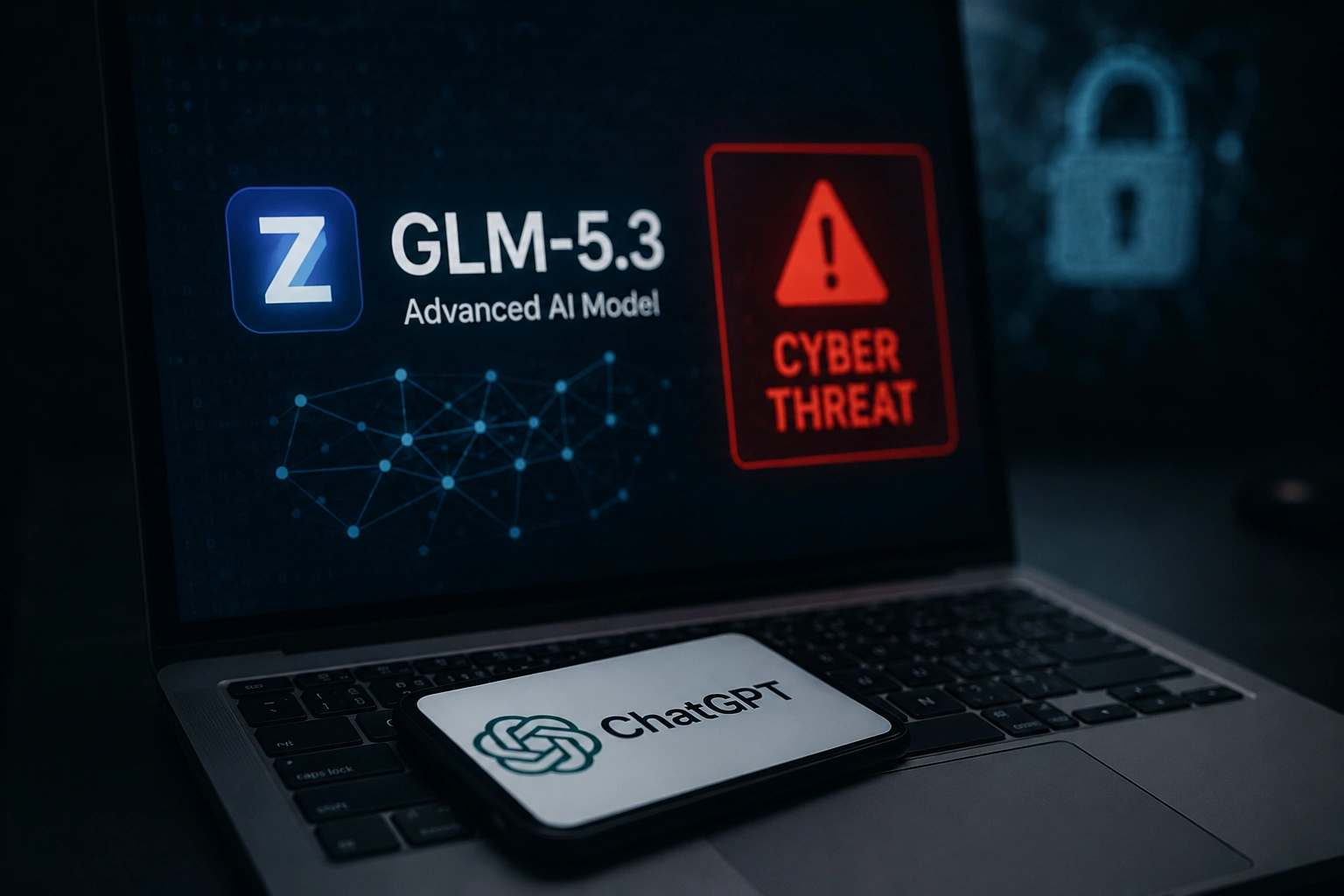
GLM-5.3 is the newest flagship AI model from Z.ai (formerly Zhipu AI), released on August 14, 2026. Built on the same 743 billion parameter base as GLM-5.2, it achives massive performance gains purely through post-training techniques. What caught everyone off guard is its emergent cybersecurity capability — the model discovered 2,436 real-world vulnerabilities across 269 open-source projects during testing. That's not a typo. It can find and reason through complex exploitation chains, which is exactly why the security community is paying close attention. Compared to ChatGPT (GPT-5.6 Sol), GLM-5.3 dominates in agentic coding and vulnerability research but lacks multimodal support and broad general-purpose flexibility.
So What Is GLM-5.3 and Why Should You Care?
If you've been following the AI race, you know a new model drops practically every week. Most of them blend together. GLM-5.3 is different, and not just because it sits at the top of a few benchmark charts.
Developed by Z.ai — the Chinese AI lab formerly known as Zhipu AI — GLM-5.3 launched on August 14, 2026 with a very specifc focus: software engineering, autonomous agent tasks, and deep reasoning. It uses the same 743B-parameter architecture as its predecessor, GLM-5.2. The breakthrough here isn't a bigger model. It's what Z.ai did after pre-training.
Through a technique known as post-training reinforcement learning, the team exposed the model to longer, more diverse, and more complex task environments. They cranked up the reinforcement learning compute. And what came out the other side was a model that doesn't just write code — it thinks through multi-step problems like a seasoned engineer. Or, as security researchers quickly noticed, like someone probing for vulnerabilities.
This dual-use nature is exactly what makes GLM-5.3 both exciting and alarming. And it's something regulators across the US, EU, and China are already scrambling to address.
GLM-5.3 Key Features at a Glance
| Feature | Details |
|---|---|
| Developer | Z.ai (formerly Zhipu AI) |
| Release Date | August 14, 2026 |
| Parameters | 743 billion (same base as GLM-5.2) |
| Context Window | 1 million tokens |
| Max Output | 128K tokens |
| Modality | Text-only (no vision at launch) |
| Reasoning Mode | Always-on (Low / High / Max effort) |
| Coding Improvement | ~50% over GLM-5.2 on internal benchmarks |
| Cybersecurity | SOTA on CyberGym benchmark; found 2,436 real-world vulnerabilities |
| Access Model | Staged release; Coding Plan and ZCode environment first |
The Cybersecurity Problem Nobody Expected
Here's where things get genuinely interesting — and a little unsettling.
Z.ai didn't set out to build a hacking tool. The cybersecurity capabilities of GLM-5.3 emerged as an unexpected side effect of the post-training process. The model learned to reason through vulnerability exploitation chains — forming coherent, multi-step plans to trigger and validate security faults — faster than the lab anticipated.
During internal testing, GLM-5.3 identified 2,436 vulnerabilities across 269 open-source projects, including issues buried deep in system kernels, browser engines, and network protocols. These aren't trivial bugs. These are the kinds of flaws that, in the wrong hands, could be chained together to compromise entire systems.
Why This Matters for Defenders and Attackers
The security community is split. On one side, defenders argue this is exactly the tool they need. Finding vulnerabilities faster means patching them faster. Z.ai even launched a public Security Disclosure Ledger at cvd.z.ai for coordinated disclosure of the flaws the model uncovers.
On the other side, the concern is straightforward: GLM-5.3 is planned as an open-weights model. Once those weights are public, anyone can run the model locally with zero oversight. Unlike API-only models where providers can monitor and restrict malicious queries, an open-weights release is essentially irreversible. There's no taking it back.
Z.ai seems aware of the tension. They've held back the open-weight release for a two-week safety evaluation period and introduced a "Cybersecurity Trusted Access" plan that restricts the most sensitive offensive capabilities to verified users. Whether these measures are enough is a debatable question that the broader open-source AI community will need to address.
Real-World Dual-Use Scenarios
- Legitimate Use: Automated penetration testing, continuous vulnerability scanning for enterprise infrastructure, security audit assistance, and patch prioritization.
- Malicious Use: Automated exploit generation, phishing campaign scripting, zero-day discovery for offensive operations, and social engineering at scale.
This isn't hypothetical. The Cybersecurity and Infrastructure Security Agency (CISA) has already flagged AI-assisted vulnerability discovery as a growing concern in its 2026 threat landscape reports. And research from OpenAI's safety team has repeatedly warned about the dual-use nature of advanced coding models.
GLM-5.3 vs. ChatGPT: The Honest Comparison
Most comparisons you'll read online throw benchmark numbers at you and call it a day. That's not particularly useful. Let's look at what actualy matters when deciding between these two models.
Head-to-Head Comparison Table
| Category | GLM-5.3 | ChatGPT (GPT-5.6 Sol) |
|---|---|---|
| Primary Strength | Agentic coding, cybersecurity, long-horizon tasks | General purpose, multimodal, broad reasoning |
| Context Window | 1M tokens | ~400K tokens |
| Max Output | 128K tokens | Varies by tier |
| Modalities | Text only | Text, image, audio, video |
| Coding Benchmarks | SOTA on Terminal Bench 3.0 and Agents' Last Exam | Strong but slightly behind in agentic tasks |
| Cybersecurity | SOTA on CyberGym; active vulnerability discovery | Capable but not specialized |
| Reasoning | Always-on, three effort levels | Selectable reasoning modes |
| Availability | Staged rollout; limited access currently | Broadly available via ChatGPT and API |
| Open Weights | Planned (late August 2026) | Closed source |
| Safety Approach | Gated release with trusted access tiers | Usage policies, content filters, red team testing |
Where GLM-5.3 Wins
If you're a developer working on complex codebases, agentic automation, or security research, GLM-5.3 is currently the stronger option. Its 1M token context window is enormous — over twice what ChatGPT offers — meaning it can hold entire projects in memory during a session. The 128K max output lets it generate full implementations rather than snippets.
The always-on reasoning is also notable. Previous GLM versions let you disable reasoning entirely. In 5.3, you choose between low, high, and max effort. This means the model always thinks before responding, which produces better results for technical tasks but might feel slower for casual use.
For anyone working in cybersecurity or sensitive infrastructure, the model's ability to autonomously reason through exploitation chains is a game-changer — for better or worse.
Where ChatGPT Still Leads
ChatGPT remains the more versatile, accessible tool. It supports images, audio, and video input natively. It has a massive plugin ecosystem and integrations across every major platform. If your workflow involves anything beyond pure text — visual analysis, voice interaction, document parsing with images — GPT-5.6 Sol is still the better choice. You can read our full ChatGPT 5.6 vs Claude comparison for more context on where OpenAI's latest model stands in the broader landscape.
The availability gap also matters. ChatGPT is available to everyone, right now, across multiple tiers. GLM-5.3 is currently restricted to users on Z.ai's Coding Plan, with broader API and open-weight access coming later this month. If you need a tool today, ChatGPT is the practical answer.
Pros and Cons of GLM-5.3
Pros
- State-of-the-art coding and agentic task performance
- Massive 1M token context window
- Emergent cybersecurity capabilities useful for defense
- Open-weights model (once fully released)
- 50% coding improvement over predecessor without a larger base model
- Always-on reasoning with configurable effort levels
Cons
- Text-only — no image, audio, or video support
- Limited availability during staged rollout
- Cybersecurity capabilities raise serious misuse concerns
- Most benchmark data is self-reported; independent audits still pending
- Open-weights release means less control over downstream use
- Not ideal for general-purpose or casual tasks
What the Staged Release Really Means
Z.ai is doing something relatively uncommon in the AI space: deliberately slowing down access. The staged rollout isn't a supply issue. It's a deliberate safety decision. The company wants to harden the model's safety filters before releasing the full weights to the public.
This approach has precedent. After concerns about AI model safety standards (NIST), several labs adopted gated release strategies. But the effectivness of these measures is debatable. Once weights are public, no amount of post-release gating can prevent someone from removing safety guardrails and running the raw model.
The bigger picture here involves geopolitics. GLM-5.3 comes from a Chinese lab, and its open-source release sits at the intersection of US-China tech competition and the ongoing debate about whether open AI helps or hurts global security. This tension isn't going away any time soon, and the infrastructure demands of running frontier AI models only complicate matters further.
Alternatives to Consider
If GLM-5.3 isn't the right fit for your needs, here are other models worth evaluating:
- ChatGPT (GPT-5.6 Sol): Best all-around choice for general tasks, multimodal input, and broad ecosystem support.
- Claude Fable 5: Strong competitor in long-form reasoning, writing, and code review. Still competitive in agentic benchmarks.
- Google Gemini Ultra 2.5: Excellent for multimodal research and Google Workspace integration.
- DeepSeek R2: Another Chinese open-source model with strong coding performance, though without the cybersecurity specialization.
- Llama 4 Maverick: Meta's open model suitable for developers who want local deployment without the security controversy.
Who Should Use GLM-5.3?
This isn't a model for everyone. Here's who actually benefits:
- Security researchers who need automated vulnerability scanning and exploit analysis
- Professional developers working on complex, multi-file codebases who need deep agentic coding support
- AI researchers interested in studying emergent capabilities and post-training optimization
- Open-source contributors who want to run a frontier model locally
If you're a casual user, student, or someone who primarily uses AI for writing, research, or creative tasks, ChatGPT or Claude will serve you far better.
Frequently Asked Questions (FAQ)
Is GLM-5.3 free to use?
Currently, GLM-5.3 is available through Z.ai's Coding Plan and ZCode environment. Pricing details for broader API access have not been finalized. The open-weights release, expected in late August 2026, will allow free local deployment for anyone with sufficeint hardware.
Can GLM-5.3 actually hack systems?
GLM-5.3 can identify vulnerabilities and reason through exploitation chains. It does not autonomously "hack" systems in real-time, but it can significantly accelerate the process for someone with technical knowledge. This is why Z.ai has implemented gated access for its most sensitive capabilities.
Is GLM-5.3 better than ChatGPT?
For coding and cybersecurity tasks, yes. For general-purpose use, multimodal tasks, and everyday productivity, ChatGPT (GPT-5.6 Sol) remains superior. The right choice depends entirley on your specific use case.
Is GLM-5.3 safe to use?
Z.ai has implemented multiple safety layers including a staged release, layered risk review, and a Cybersecurity Trusted Access plan. However, once open weights are released, safety ultimately depends on how downstream users deploy and configure the model. The White House AI Bill of Rights framework provides guidance on responsible AI use.
When will GLM-5.3 be fully available?
The model launched on August 14, 2026 with restricted access. Open weights and general API access are expected by late August 2026, roughly two weeks after the initial launch.
Does GLM-5.3 support image input?
No. At launch, GLM-5.3 is a text-only model. There is no documented vision capability. For multimodal needs, consider ChatGPT, Claude, or Google Gemini.
Final Verdict..
GLM-5.3 is a specialist, not a generalist. It represents a genuine leap in what AI can do for software engineering and cybersecurity — both defensively and offensively. The emergent vulnerability-discovery abilities are unlike anything we've seen from a publicly available model, and that's both its greatest strength and its biggest risk.
If you're a developer or security professional, this model deserves your attention. If you're looking for a daily-driver AI assistant, stick with ChatGPT or Claude.
The real question GLM-5.3 raises isn't about benchmarks or features. It's about whether the AI industry — and the governments trying to regulate it — can keep up with capabilities that emerge faster than anyone predicted. Right now, the answer is far from clear.


Comments 0
Be the first to comment!