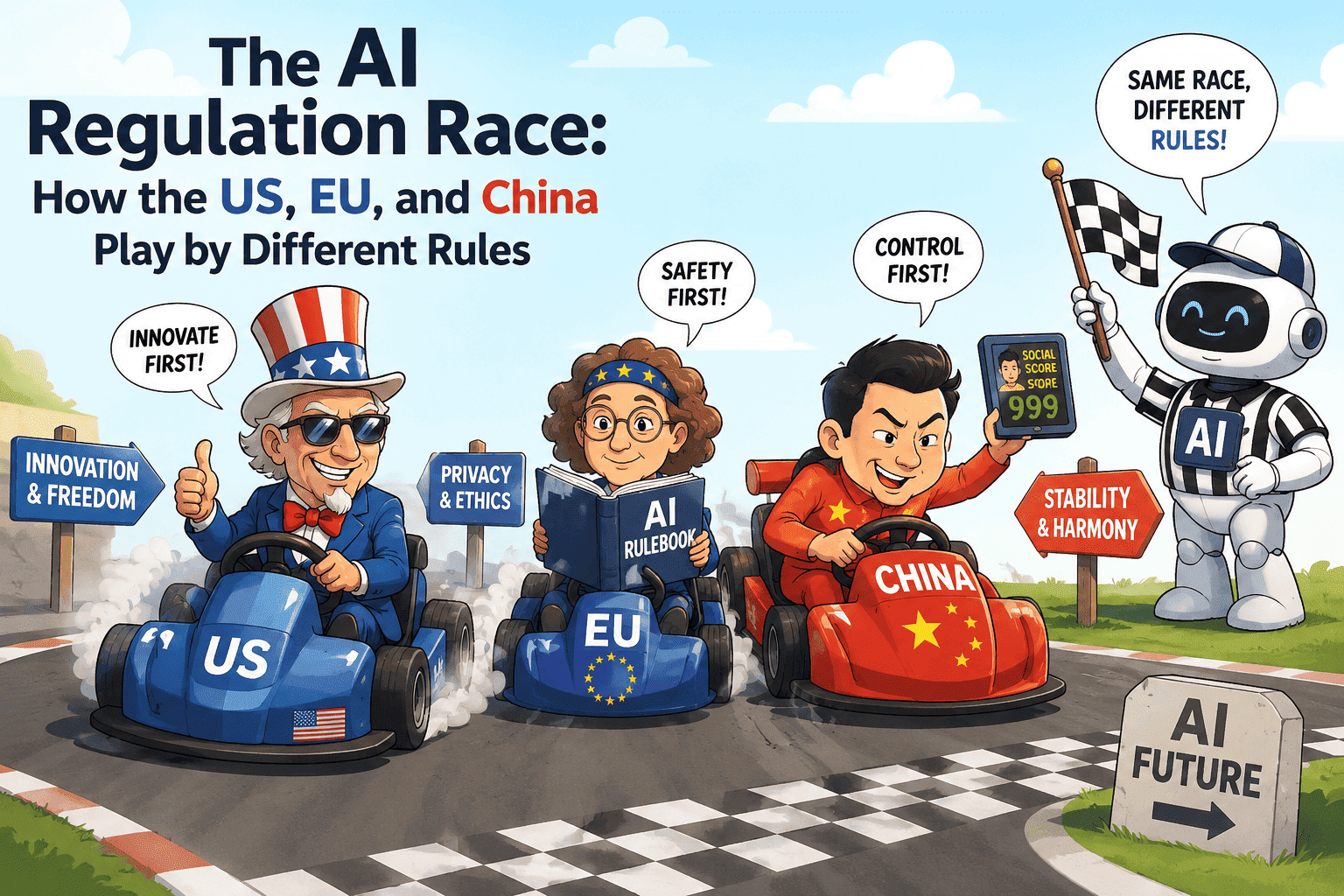
Ask three different governments what "safe AI" means and you'll get three completely different answers. In the US, it mostly means "don't slow us down." In the EU, it means "prove it before you ship it." In China, it means "we already know what's in it, because you filed it with us first." That's not a simplification for effect — it's basically how 2026 has played out.
Behind the headlines about "the global AI race," there's a quieter story: three regulatory systems built on three different assumptions about risk, power, and who gets to decide what AI is allowed to do. If you build AI products, run a business that uses them, or just use ChatGPT-style tools every day, these differences aren't abstract policy trivia — they shape what gets released where, what gets labeled, and what data ends up where.
Fast Answers you must know before start
- United States: No single federal AI law. A deregulatory federal stance (executive orders, not statutes) pushing "innovation first," while individual states like California, Colorado, Texas, and New York pass their own binding rules.
- European Union: One binding law — the EU AI Act — that sorts AI systems into risk tiers and bans some outright. Enforcement powers formally kicked in on August 2, 2026.
- China: No single AI law either, but a dense stack of CAC-administered rules covering algorithm filing, content labeling, and "socialist core values" compliance, enforced continuously rather than after the fact.
- Bottom line: The US bets on speed, the EU bets on predictability, and China bets on control. Each trade-off benefits different players — and creates different headaches for everyone else.
First: Why the World Split Into Three Different AI Playbooks
AI regulation didn't diverge by accident. Each region was solving for a different problem. The US worried about losing the innovation race to China. The EU worried about repeating its mistakes from the early internet era, when it regulated too late and ended up as a rule-taker rather than a rule-maker. China worried about information control and social stability first, competitiveness second (though the two are treated as connected).
Those starting points explain almost everything that follows — including why a chatbot that's perfectly legal in Texas might need a visible watermark in Shanghai and a documented risk assessment in Frankfurt before it can ship the same feature in all three places at once.
So The US Approach: Let the Market Lead, Let States Fill the Gaps
There is still no comprehensive federal AI statute in the United States as of 2026. Instead, the federal layer is built from executive orders and agency guidance. The Trump administration's "Winning the Race: America's AI Action Plan," released in July 2025, set the tone: reduce permitting friction for data centers, expand chip and energy access, and push American AI models abroad rather than restrict them at home. You can read the full plan directly on AI.gov, the official federal portal for it.
Washington vs. the States
Where it gets messy is the gap between what Washington wants and what states are actually doing. In December 2025, an executive order titled "Ensuring a National Policy Framework for Artificial Intelligence" directed the Department of Justice to challenge "onerous" state AI laws in court and threatened to tie federal broadband funding to states rolling back their own rules. But Congress hasn't passed a preemption law, and courts generally can't be told what to do by an executive order alone.
So the states kept legislating anyway. California's Transparency in Frontier Artificial Intelligence Act took effect January 1, 2026. New York's RAISE Act, Texas's TRAIGA, and Colorado's rewritten AI Act (pushed to January 2027) all add their own layer of obligations around bias testing, incident reporting, and disclosure. Child-safety rules and data-center regulation were explicitly carved out from the federal preemption push, so those keep moving regardless of what happens in DC.
What this actually means
- A US-based AI startup may need to comply with different rules depending on which state its users are in — a genuine patchwork, not a metaphor for one.
- Federal guidance leans on voluntary frameworks like the NIST AI Risk Management Framework rather than binding law, which businesses can adopt for credibility even without a legal mandate.
- Enforcement, where it exists, tends to come from existing consumer-protection and anti-discrimination law applied to AI, not a dedicated AI regulator.
But The EU Approach: Risk-Based Law With Actual Teeth
The EU AI Act is still the only comprehensive, binding AI law among the three regions. It doesn't treat all AI the same — it sorts systems into four risk tiers: unacceptable (banned outright, like social scoring), high-risk (medical devices, hiring tools, critical infrastructure), limited-risk (chatbots, deepfakes — mostly transparency duties), and minimal-risk (spam filters, most consumer apps).
The law entered into force in August 2024, but it rolls out in phases. Banned practices and AI-literacy duties applied from February 2025. Obligations on general-purpose AI model providers — think the companies behind large language models — started in August 2025. The big shift happened on August 2, 2026, when the European Commission's AI Office actually gained the power to investigate, demand documentation, and fine companies, according to the European Commission's own AI Act policy page. Transparency duties, like labeling AI-generated content and disclosing chatbot interactions, also became enforceable that same day.
Why it's called the "Brussels effect"
Because the EU is a big enough market that many global companies just apply EU-grade compliance everywhere rather than build separate versions of their product. It happened with GDPR and privacy law, and it's starting to happen with AI transparency labeling too — some platforms now label AI content globally instead of maintaining an EU-only version.
And The China Approach: Control at the Source, Not After the Fact
China has never passed one single "AI Act." Instead, the Cyberspace Administration of China (CAC), often working with three or four other ministries, has built a stack of targeted measures that started with the 2023 Generative AI Measures and the Deep Synthesis Provisions, then expanded steadily.
The most consequential recent rule is the Measures for Labeling AI-Generated Content, effective September 1, 2025, which requires both visible labels ("AI-generated") and invisible metadata watermarks on AI text, images, audio, and video. A newer measure covering "anthropomorphic" AI companions — chatbots designed to mimic human relationships — took effect July 15, 2026. For a good English-language rundown of how these pieces fit together, IAPP's coverage is a solid starting point.
Filing before you launch
The defining feature of China's model isn't the labeling — it's the filing regime. Generative AI services with "public opinion" or "social mobilization" capacity must register with local cyberspace authorities before they go live, not after a complaint or an audit. As of early 2026, hundreds of generative AI services had already completed this process. It's oversight built into the launch sequence rather than bolted on afterward, and it's part of why China's approach to AI hardware and compute has become tangled up with export controls — a dynamic we broke down in The Quiet Tech Cold War.
China's national "AI Plus" plan, released in August 2025, adds an economic layer on top: aggressive integration targets pushing AI penetration past 70% of key sectors by 2027 and 90% by 2030. Regulation and industrial policy move together here in a way that doesn't really happen in the US or EU.
Side-by-Side: US vs EU vs China in 2026
| Category | United States | European Union | China |
|---|---|---|---|
| Legal structure | No federal AI law; executive orders + state statutes | Single binding law (EU AI Act) | Layered CAC measures, no single act |
| Core philosophy | Innovation first, minimal federal friction | Risk-tiered, precaution first | State oversight and traceability first |
| Who enforces | States, FTC, courts (patchwork) | EU AI Office + national authorities | Cyberspace Administration of China |
| Penalties | Vary widely by state | Up to tens of millions of euros or a % of global turnover | Service suspension, filing revocation, takedown |
| Content labeling | Patchy, state-by-state | Mandatory under Article 50 since Aug 2026 | Mandatory explicit + implicit labels since Sept 2025 |
| Where it bites first | Frontier model developers, hiring/bias tools | High-risk systems, GPAI providers | Chatbots, deepfakes, "opinion-shaping" apps |
What It Means in Practice
For AI developers
- Building for the EU means documentation, risk assessments, and technical files before launch — not after a complaint.
- Building for China means registering the model or feature with authorities and baking in labeling from day one, not retrofitting it.
- Building for the US means watching state legislatures more closely then Congress, since that's where the actual binding obligations are landing.
For businesses deploying AI tools
- A hiring tool that's "minimal risk" in the US could be "high-risk" under the EU AI Act, requiring bias audits and human oversight.
- Marketing content generated with AI and published in China legally needs a visible label — skipping it isn't a minor oversight, it can mean a takedown.
- Multinational companies increasingly default to the strictest applicable standard across all markets, simply because maintaining three separate compliance tracks is more expensive then over-complying once.
For everyday users
- In the EU, you're more likely to know when you're talking to a chatbot or looking at AI-generated media, because disclosure is legally required.
- In China, that AI-generated video your cousin shared almost certainly carries a watermark, even if it's not obvious in the app's interface.
- In the US, disclosure depends entirely on which state you're in — some have clear labeling rules, many don't yet.
Pros and Cons of Each Model
United States
- Pros: Fastest path to market, lower compliance cost for startups, strong capital and compute access.
- Cons: Fragmented state rules create uncertainty, weaker consumer protections in states without their own AI law, ongoing legal fights over preemption add risk.
European Union
- Pros: Predictable rules once you know your risk tier, strong consumer trust and transparency, sets a de facto global standard.
- Cons: Slower time-to-market, heavier documentation burden, smaller companies can struggle with compliance costs.
China
- Pros: Clear, fast government feedback loop for approved products, strong domestic AI ecosystem growth — the kind of open-source momentum we covered in The Great AI Model War.
- Cons: Content and political constraints limit what models can say, foreign companies face a harder entry path, hardware access is complicated by the same export dynamics affecting global supply chains.
Verdict Box
Our take: There's no single "winning" model here — each region is optimizing for something different, and each trade-off shows up somewhere else down the line. The US model rewards speed but exports uncertainty. The EU model rewards predictability but slows deployment. China's model rewards control but narrows what's allowed to exist in the first place. If you're building or deploying AI across borders in 2026, the honest move is to design for the EU's standard by default (it's the strictest and most likely to become the global baseline), then adjust down for the US and sideways for China's labeling and filing rules.
Alternatives: What Other Countries Are Doing
The "big three" aren't the whole picture. The UK has taken a lighter-touch, sector-by-sector approach, relying on existing regulators (like its data protection authority) rather than a new AI law. Japan and South Korea lean toward voluntary guidelines paired with targeted legislation for specific risks like deepfakes. Brazil and India are drafting their own frameworks that borrow pieces from both the EU's risk tiers and China's registration instincts. None of these has the market size to set a global standard on their own yet — but they're worth watching, because they show that "regulate like the US, EU, or China" isn't actually the only menu on offer.
Frequently Asked Questions (faq)
Which region has the strictest AI regulation in 2026?
The EU, by a clear margin. It's the only one of the three with a single, binding, risk-tiered law and an enforcement body with real investigative powers as of August 2026.
Does the EU AI Act apply to companies outside Europe?
Yes, if your AI system's output is used within the EU. Like GDPR before it, the law applies based on where the effects land, not where the company is headquartered.
Will the US ever pass a federal AI law?
Possibly, but its not close as of mid-2026. Congress has twice rejected attempts to insert a state-law preemption clause into other bills, and a standalone federal AI statute hasn't gathered enough bipartisan support to move.
Is China's approach basically a ban on AI?
No — it's closer to the opposite. China is pushing rapid AI adoption through its "AI Plus" plan while keeping tight oversight over what generative models can output, especially around politically sensitive content.
What should a small AI startup actually do about all this?
Pick your primary market and comply fully there first. If you plan to expand into the EU eventually, build documentation habits early — retrofitting risk assessments later is far more expensive then designing for them from the start.
My Last Words ...
The AI regulation race isn't really a race with one finish line — it's three different bets on how to handle the same technology. The US is betting that speed wins. The EU is betting that trust wins. China is betting that control wins. Which one turns out to be right probably won't be clear for years, and it's likely the answer ends up being "pieces of all three." For now, anyone building, selling, or just using AI tools in 2026 needs to know which rulebook applies to them — because increasingly, it depends less on the technology and more on where you happen to be standing when you use it.
For more on how global tech policy is reshaping the industry, check out our ongoing coverage in Hot News Around World.


Comments 0
Be the first to comment!