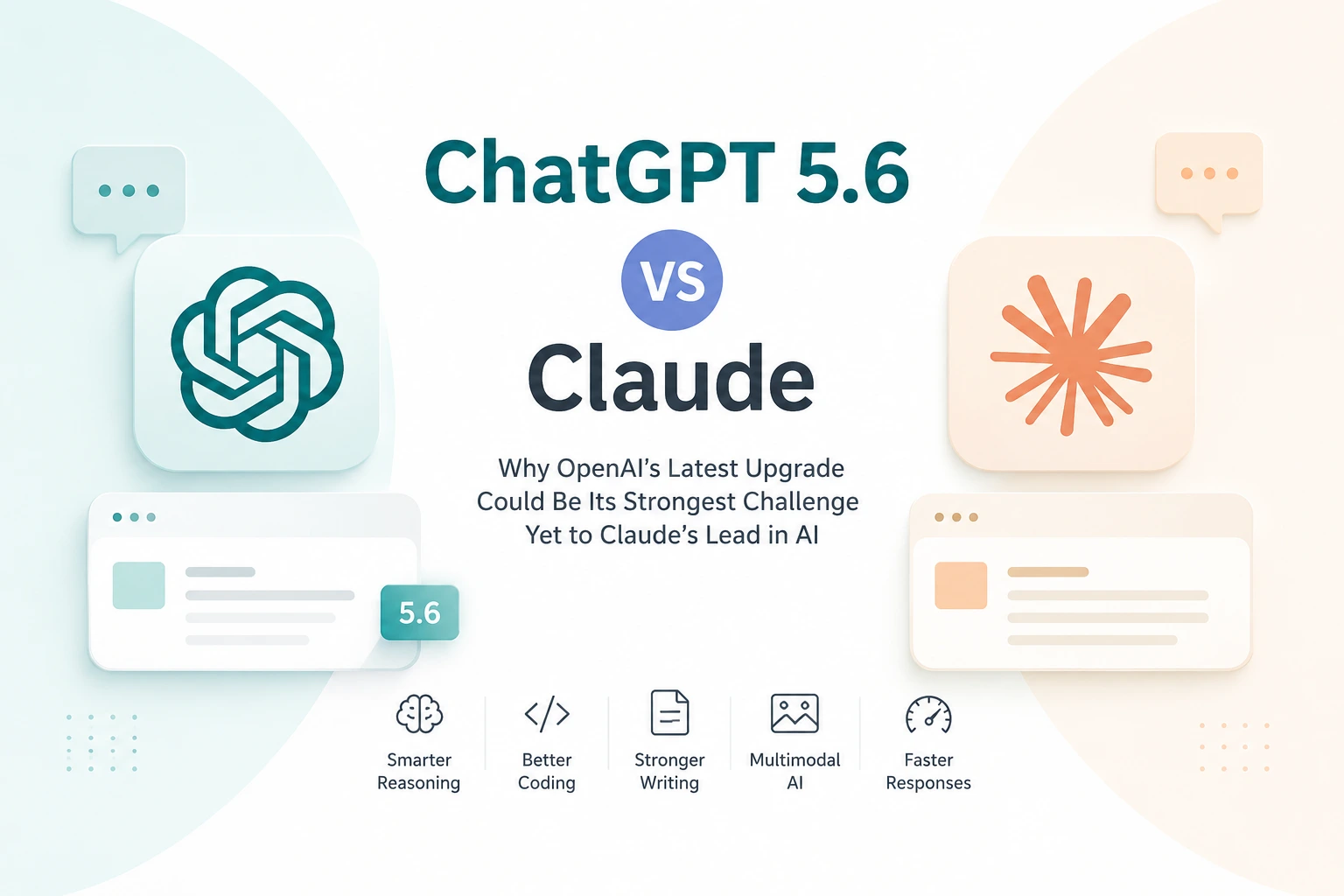
For most of 2025 and early 2026, "which AI is smarter" had a fairly consistent answer: Claude, especially for coding and long-form writing. GPT-5.6 is the first release from OpenAI that makes that answer genuinely harder to give. It isn't one model — it's a three-tier family, it comes bundled with a new agentic workspace called ChatGPT Work, and on a couple of hard coding benchmarks it now leads outright.
So does that mean Claude has lost its edge? Not exactly. It means the comparison has gotten more interesting, and more dependent on what you're actually trying to do.
Quick answer: GPT-5.6 (Sol, Terra, Luna) narrows or closes the gap on coding benchmarks and pulls ahead on terminal-based agent work and multimodal features like image generation and voice. Claude Sonnet 5 still edges ahead on general reasoning scores and is widely considered the stronger writer, with Claude Fable 5 still untouched on a couple of the hardest reasoning tests. Neither model wins everything — the right pick depends on whether your work is agent-heavy, writing-heavy, or split between both.
So What Actually Changed With GPT-5.6
OpenAI released the GPT-5.6 family on July 9, 2026, replacing the old single-flagship approach with three named tiers: Sol (the most capable, built for deep reasoning and coding), Terra (a balanced everyday tier), and Luna (fast and cheap, now the default for free ChatGPT users). OpenAI describes the numbers as the generation and Sol/Terra/Luna as capability tiers that can each improve on their own schedule going forward, according to OpenAI's own release notes.
The bigger shift is ChatGPT Work, a new agent that plans multi-step projects and executes them across connected apps and files, sometimes running for hours unattended. Alongside it, the standalone Codex app has been folded into the ChatGPT desktop client, so chat, agentic work, and coding now live under one roof rather than three seperate apps.
Okay so Where Claude Stands Going Into This Comparison
Claude's lineup looks different than it did a year ago. Sonnet 5 is now the default model across Claude's consumer and developer products, sitting between the fast, cheap Haiku 4.5 and the flagship Opus 4.8. Above Opus sits Anthropic's newer Mythos tier, which includes Claude Fable 5.
Fable 5's rollout wasn't smooth. It launched on June 9, 2026, was suspended just three days later to comply with U.S. Department of Commerce export controls, and only came back online on July 1, 2026 after the controls were lifted, per Anthropic's official statement. It's a reminder that AI competition in 2026 isn't just about who ships the best model — export policy and geopolitics are now part of the story too, something we've tracked in our own breakdown of the AI regulation race between the US, EU, and China.
Specs at a Glance
| Category | GPT-5.6 (Sol / Terra / Luna) | Claude (Sonnet 5 / Opus 4.8 / Fable 5) |
|---|---|---|
| Released | July 9, 2026 | Sonnet 5: June 30, 2026 · Fable 5: June 9, 2026 |
| Context window | Up to ~1.05M tokens | 1M tokens (Sonnet 5), 128K max output |
| Coding (SWE-bench Pro) | Terra ~63.4% | Sonnet 5 ~63.2% — essentially tied |
| Terminal agent work | Sol Ultra ~91.9% | Sonnet 5 ~80.4%, Opus 4.8 ~78.9% |
| Image generation | Native, built in | Not supported |
| Entry pricing (per 1M tokens) | Luna $1 / $6, Terra $2.50 / $15, Sol $5 / $30 | Sonnet 5 intro $2 / $10 (through Aug 31, 2026) |
| Consumer plan | ChatGPT Plus, $20/mo | Claude Pro, $20/mo |
Reasoning and Intelligence
On Artificial Analysis's combined Intelligence Index, Claude Sonnet 5 running at max reasoning effort scored 55 against GPT-5.6 Terra's 47, a real gap in Claude's favor at that tier. But comparing Sonnet 5 to Terra undersells GPT-5.6's ceiling, since Sol is the tier actually built for hard reasoning. Meanwhile Claude's own top tier, Fable 5, reportedly still leads Opus 4.8, GPT-5.5, and even GPT-5.6 on Humanity's Last Exam — nobody has published a number that beats it yet on that specific test.
The honest takeaway: there isn't a single clean number that settles "which is smarter." Both companies publish different benchmark suites, and the two firms aren't always testing the same tier against the same tier.
Coding Performance
Where they're tied
On SWE-bench Pro, the benchmark that measures fixing real repository bugs, Terra and Sonnet 5 land within a fraction of a point of each other. If your work is mostly in-repo bug fixes and code review, either model should get you a usable result on the first pass.
Where GPT-5.6 pulls ahead
Terminal and CLI-style agent tasks are where the gap widens. GPT-5.6 Sol running in its "Ultra" mode scored 91.9% on Terminal-Bench 2.1, well ahead of any published Claude score on the same test. Sam Altman has also claimed Sol is roughly 54% more token-efficient on agentic coding runs than its predecessor, which matters for anyone paying per token on long agent sessions.
Writing Quality
This is still Claude's strongest home turf. Independent testers and writers consistently describe Claude's prose as needing the least cleanup, holding tone better across a long document, and sounding less like a template. GPT-5.6 has genuinely closed some of that gap — testers note it produces less of the over-bulleted, boilerplate-heavy output older ChatGPT versions were known for — but Claude is still the more common first pick when the whole job is the writing itself: essays, reports, editorial drafts, nuanced rewrites.
Long-Context Handling
Both models can hold a substantial codebase or a long document in a single request. GPT-5.6 Terra's documented window is slightly larger at roughly 1.05 million tokens versus Claude Sonnet 5's 1 million, though both cap output around 128,000 tokens. In practice this difference rarely matters unless you're feeding in extremely long source material — what matters more is how well each model actually tracks details across that whole window, and reviewers still tend to rate Claude's long-document synthesis as the more careful of the two.
Multimodal Features
ChatGPT has the clearer multimodal edge. It generates images natively in the same conversation, supports voice conversations through GPT-Live, and now includes an optional Computer History feature that lets it reference recent activity across apps. Claude has computer-use tools too, but doesn't generate images at all, and multimodal input has never been the centerpiece of its pitch the way it is for GPT-5.6.
If your work involves a lot of visual analysis — reviewing product photos, camera samples, or design mockups — this is genuinely a category where ChatGPT does more out of the box. We ran into a version of this exact question testing the Pixel 11 Pro's AI-processed camera photos, where separating "real" detail from AI reconstruction is its own kind of multimodal judgment call.
Speed and Accuracy
Raw speed favors OpenAI's lower tiers. GPT-5.6 Terra generates around 108 tokens per second compared to Sonnet 5's roughly 68, and OpenAI's new Ultrafast API tier, running on Cerebras hardware, claims up to 14x the speed of standard processing for Sol in limited preview. For latency-sensitive support or live-chat style tools, that's a real advantage.
Accuracy is murkier and more task-dependent. Fable 5 still hasn't been beaten on SWE-bench Pro or Humanity's Last Exam by any published GPT-5.6 score, but that's Claude's top tier against numbers OpenAI hasn't released for the same tests. At the everyday Sonnet-versus-Terra level, the two are close enough that testing on your own workload will tell you more than any leaderboard.
AI-Powered Tools and Agents
Both companies have leaned hard into agents this cycle. ChatGPT Work and the newly merged Codex give OpenAI a single desktop app that handles chat, autonomous project execution, and coding in one interface. Claude's answer is Claude Code, Claude Cowork, and a "Dev Team" agentic mode available to API customers, plus Claude in Chrome and Claude in Excel for narrower, tool-specific tasks. Neither ecosystem is objectively "more complete." If your team is already built around Codex or GPTs, GPT-5.6 is a same-app upgrade with no migration cost. If you're already running Claude Code, Sonnet 5 slots in the same way.
Memory and Personalization
Both assistants now carry context across sessions rather than starting from zero every chat — Claude does this through a persistent memory system that can be toggled per conversation, and ChatGPT has its own memory and Projects features that reference past chats and files. Neither has published a head-to-head memory benchmark, so this category comes down more to how much control you want over what gets remembered and for how long, which is a personal workflow preference more than a performance gap.
Pricing and Everyday Usability
At the consumer level, they're priced identically: $20 a month for Claude Pro or ChatGPT Plus. On the API side, GPT-5.6's Luna tier undercuts Sonnet 5 on raw cost, while Sol costs more than Sonnet 5's standard rate. Anthropic also warns that Sonnet 5's updated tokenizer can turn the same text into up to 1.35x more tokens than before, which occassionally erases some of the sticker-price advantage once you're past the introductory pricing window that ends August 31, 2026.
Pros and Cons
GPT-5.6
- Pros: Leads on terminal/agent benchmarks, native image generation and voice, faster token output, unified Chat + Work + Codex app, aggressive entry pricing on Luna.
- Cons: Reasoning-tier scores trail Claude at comparable levels, writing still needs more editing on average, tiered naming (Sol/Terra/Luna) adds a learning curve.
Claude (Sonnet 5 / Fable 5)
- Pros: Stronger general reasoning and writing quality, Fable 5 still leads on the hardest published reasoning tests, tied on core repo-level coding, calmer and more editorially consistent long-form output.
- Cons: No native image generation, slower raw token speed, top-tier Fable 5 has already had one real export-control disruption, smaller day-to-day tool ecosystem than ChatGPT's.
Last Words from us ...
GPT-5.6 is the strongest challenge OpenAI has mounted in a long time, and on agentic coding and multimodal work it has a real, measurable lead. But "strongest challenge yet" isn't the same as "clear winner." Claude still holds the advantage in the two areas that matter most for knowledge workers and writers: reasoning depth at the top tier and prose quality that needs less cleanup. If your day is built around autonomous agents, image work, or voice, GPT-5.6 is worth the switch. If it's built around writing, research, and long-document reasoning, Claude is still the safer default in 2026.
Alternatives Worth Knowing
Neither model has the field to itself. Google's Gemini line remains a strong third option on price-to-performance, and Chinese open-source labs have closed a surprising amount of ground on raw benchmarks this year — we go deeper on that shift in The Great AI Model War. For more comparisons like this one, our Technology & PC Games section covers new hardware and AI releases as they land.
FAQ
Is GPT-5.6 actually better than Claude now?
It depends what you're doing. GPT-5.6 leads on terminal-based agent work and multimodal tasks; Claude Sonnet 5 and Fable 5 lead on general reasoning benchmarks and writing quality. There's no single winner across every category.
Which model is cheaper?
At the consumer level they're the same, $20/month. On the API, GPT-5.6 Luna is the cheapest entry point overall, while Sonnet 5's introductory pricing is competitive with Terra through August 31, 2026.
Can Claude generate images?
No. Claude does not include native image generation. ChatGPT does, built directly into the chat experience.
Is Fable 5 still available after the export control suspension?
Yes. Access was restored globally on July 1, 2026, after the underlying Commerce Department controls were lifted.
Which one should a developer pick for coding?
For in-repo bug fixes, they're close to tied. For terminal-heavy or long autonomous coding runs, GPT-5.6 Sol currently scores meaningfully higher on published benchmarks.
The honest way to close this out: benchmarks are directional, not definitive. If a model choice actually matters for your budget or your workflow, run the same real task through both before you commit to one.

Comments 0
Be the first to comment!