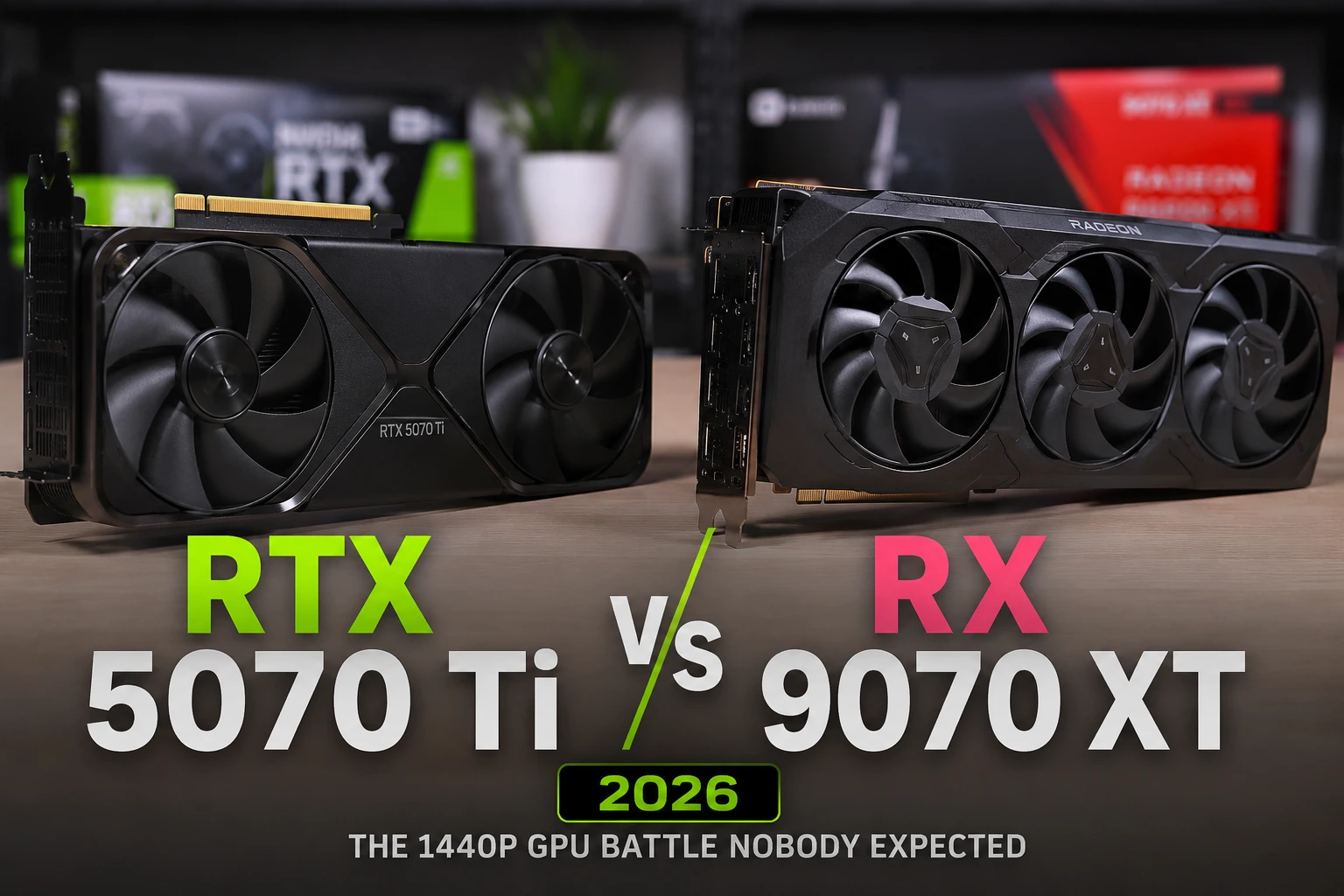
The RTX 5070 Ti and RX 9070 XT are closer than anyone predicted at 1440p in 2026. The RX 9070 XT leads in raw rasterization by roughly 15–20%, but the RTX 5070 Ti fights back hard with superior ray tracing, DLSS 4.5 multi-frame generation, and a more polished software ecosystem. Both cards carry 16GB of VRAM, so memory headroom is a draw. If you prioritize pure frame rates and value, AMD wins. If ray tracing, upscaling quality, and ecosystem stability matter more, NVIDIA takes the crown. It's genuniely that close.
Now Why This 1440p Battle Caught Everyone Off Guard
Nobody sitting around in early 2025 would have guessed we'd be here. Back then, the assumption was simple: NVIDIA owns the high-end, AMD fights for scraps in the mid-range, and that's that. But 2026 flipped the script in ways the spec sheets didn't predict.
AMD's RDNA 4 architecture matured faster than most people expected. The RX 9070 XT landed with genuinely impressive rasterization performance, and NVIDIA's RTX 5070 Ti — while technically the more expensive card — didn't blow it away in traditional gaming the way previous generations would have. The result? A real 1440p fight that's actually worth talking about.
If you're building a gaming PC right now and targeting 1440p, you're faced with one of the tightest GPU matchups in years. Let's break down what's really happenning behind the numbers.
RTX 5070 Ti vs RX 9070 XT: Specifications Comparison Table
| Specification | NVIDIA RTX 5070 Ti | AMD RX 9070 XT |
|---|---|---|
| Architecture | Blackwell (GB203) | RDNA 4 (Navi 48) |
| VRAM | 16GB GDDR7 | 16GB GDDR6 |
| Memory Bus | 256-bit | 256-bit |
| Ray Tracing Cores | 4th Gen | 2nd Gen (RDNA 4) |
| Upscaling Technology | DLSS 4.5 (Multi Frame Gen) | FSR 4.1 (ML-based) |
| TDP | ~300W | ~250W |
| Manufacturing Process | TSMC 4nm | TSMC 4nm |
| MSRP at Launch | $749 | $549 |
On paper, the RTX 5070 Ti looks like it should dominate. Higher power draw, newer GDDR7 memory, and NVIDIA's mature AI-powered features. But paper never tells the full story — especially at 1440p where both cards have plenty of headroom to work with.
Rasterization Performance: Where AMD Shines Brightest
Let's get this out of the way first. In pure rasterization — meaning traditional rendering without ray tracing — the RX 9070 XT is simply faster. Across a range of modern titles tested at 1440p with maxed settings, AMD's card posts frame rates roughly 15–25% higher than the RTX 5070 Ti.
That's not a small gap. In games like Cyberpunk 2077 (without RT), Starfield, and competitive shooters, the 9070 XT delivers noticeably smoother gameplay. AMD's RDNA 4 shader units are extremely efficent at pushing raw pixel throughput, and at 1440p that translates directly into more frames on screen.
This is one of the main reasons the RX 9070 XT has earned its reputation as one of the best GPUs for 1440p gaming in 2026 — it simply delivers more FPS per dollar in the games most people actually play.
Ray Tracing and Path Tracing: NVIDIA Still Leads — By a Lot
Here's where the conversation shifts entirely. Turn on ray tracing — especially full path tracing in titles like Cyberpunk 2077: Phantom Liberty or Alan Wake 2 — and NVIDIA's advantage becomes massive.
The RTX 5070 Ti's 4th-generation RT cores are significantly more capable than AMD's 2nd-gen implementation. In heavy ray tracing scenarios, NVIDIA can be 40–60% faster. That's not a minor edge; it's the difference between playable and slideshow in some games.
Add Ray Reconstruction on top — NVIDIA's AI-driven denoiser that replaces traditional denoising with a neural network — and image quality under RT gets even better on the green team's side. AMD has improved their ray tracing story with RDNA 4, no question, but the hardware gap in dedicated RT units is still substantial. According to NVIDIA's official specs, the Blackwell architecture was designed from the ground up with next-gen RT in mind.
DLSS 4.5 vs FSR 4.1: The Upscaling War Gets Closer
This is where things get genuinely interesting in 2026.
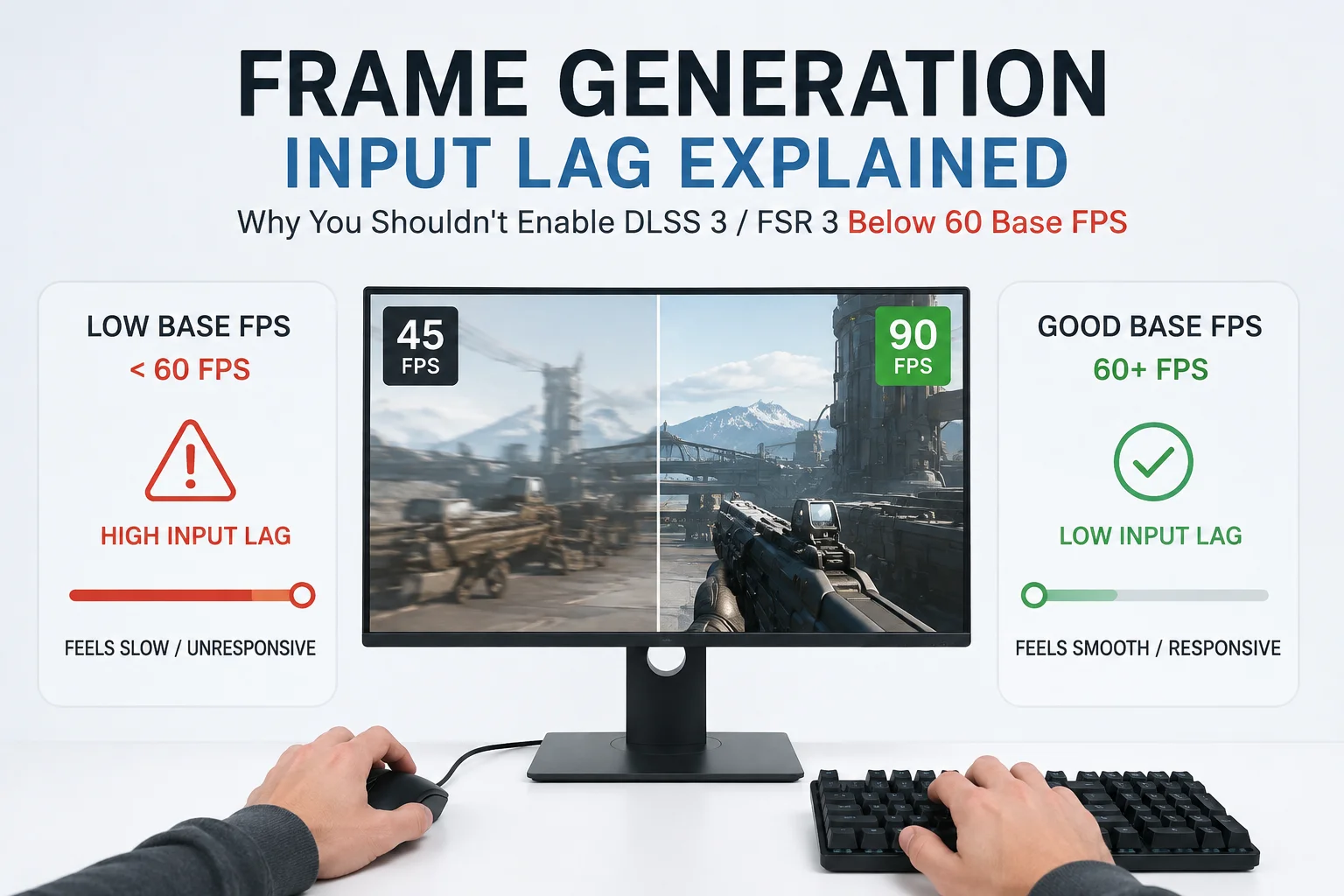
NVIDIA's DLSS 4.5 remains the gold standard. Multi-frame generation — where the GPU generates up to three extra frames between native ones — can effectively double or triple perceived frame rates. And it works. Frame pacing is tight, latency penalties are minimal (especially with Reflex 2), and game support is widespread.
AMD's FSR 4.1, however, is no longer the blurry afterthought it used to be. The switch to ML-based reconstruction on RDNA 4 hardware closed the image quality gap significantly. FSR 4.1 in Quality mode looks genuinely sharp at 1440p, and frame generation is now part of the package too.
The catch? DLSS still has broader game support. As of August 2026, over 400 titles support DLSS, while FSR 4 (the ML version, not the older spatial one) sits closer to 200. That matters if you're the type of player who wants upscaling to work in every game you launch. AMD's product page confirms ongoing efforts to expand FSR 4 adoption, but NVIDIA's head start remains real.
VRAM: A Rare Tie
Both the RTX 5070 Ti and RX 9070 XT ship with 16GB of VRAM. That's the single best thing about both cards for 1440p gaming in 2026.
Modern AAA titles are hungrier than ever for video memory. Texture packs, ray tracing buffers, frame generation overhead — it all adds up. Having 16GB means you're not constantly negotiating with settings to keep your VRAM usage in check. We covered this extensively in our guide on whether 16GB VRAM is enough for gaming in 2026, and the short answer is: yes, 16GB is the sweet spot for 1440p right now.
The RTX 5070 Ti does use faster GDDR7 memory, which gives it a slight bandwidth advantage. In most real-world gaming scenarios, though, you won't notice the difference. Both cards handle 1440p ultra textures without breaking a sweat.
Power Efficiency: AMD Takes the Efficiency Crown
The RX 9070 XT pulls around 250W under full load. The RTX 5070 Ti? Closer to 300W. That's a 50-watt difference — not deal-breaking, but it adds up over time.
For the performance the 9070 XT delivers, its power efficiency is genuinely impressive. AMD's RDNA 4 architecture manages to deliver more raw frames while consuming less power than NVIDIA's Blackwell in rasterized workloads. If you're building inside a smaller case or care about your electricity bill, that's worth thinking about.
NVIDIA claws some of this back when frame generation is active (since you're getting extra frames "for free" from the AI), but in a straight watt-to-frame comparison, AMD wins this round.
Game-to-Game Performance: It Depends on What You Play
This is the part most comparison articles skip, and it's arguably the most important.
The "best" card changes depending on what's installed on your SSD. Here's a rough breakdown:
RX 9070 XT Wins In:
- Competitive shooters (Valorant, CS2, Apex Legends) — raw FPS matters most
- Older and well-optimised AAA titles without heavy RT
- Games that rely heavily on rasterization and high shader throughput
- Open-world games where brute-force GPU power pushes through demanding scenes
RTX 5070 Ti Wins In:
- Ray tracing-heavy titles (Cyberpunk 2077 RT, Alan Wake 2, Indiana Jones)
- Games with DLSS 4 multi-frame generation support
- Nvidia-optimised titles that leverage CUDA, RT cores, or Reflex
- Content creation workflows (Blender, DaVinci Resolve, AI-based tools)
If you're planning a full gaming build, the GPU choice should match the type of games you actually spend time in. Our CPU, RAM, motherboard, and GPU combo guide for 2026 covers how to balance your entire system around either card.
Driver Stability and Software Ecosystem
Let's be honest about this. NVIDIA's driver ecosystem is more mature. GeForce Experience (now NVIDIA App) handles updates, optimization profiles, and streaming in a polished package. Game-ready drivers usually ship on launch day for major titles.
AMD has improved massively with the Adrenalin 2026 software, but reports of intermittent crashes in specific titles still pop up. It's not the disaster it was in the early RDNA days, but NVIDIA's driver stability remains a selling point — especially for gamers who don't want to troubleshoot their GPU after a game update.
This matters more than benchmarks for a lot of people. According to reviews on Tom's Hardware, driver-related performance inconsistencies remain one of the most common complaints from RX 9070 XT users, though AMD's response time on fixes has gotten much faster.
Pricing and Real-World Value in August 2026
At launch, the RTX 5070 Ti landed at $749 while the RX 9070 XT debuted at $549. That's a $200 gap — and it matters.
Street prices in August 2026 have shifted somewhat. The RTX 5070 Ti can be found around $700–$730 from major retailers, while the RX 9070 XT hovers between $500–$540. The value gap remains significant.
Here's the real question: is the RTX 5070 Ti worth paying $200 more? If you live in ray-traced titles, use DLSS constantly, and value NVIDIA's ecosystem — probably yes. If you're a rasterization-first gamer who cares about FPS-per-dollar, the RX 9070 XT is one of the best values in PC gaming right now.
Building a new rig on a tight budget? Take a look at our best budget gaming PC builds for late 2026 to see how either card fits into a full system.
Pros and Cons Summary
NVIDIA RTX 5070 Ti
Pros:
- Dominant ray tracing and path tracing performance
- DLSS 4.5 multi-frame generation is best-in-class
- Mature driver ecosystem with strong day-one game support
- Ray Reconstruction and Reflex 2 add real value
- Strong for content creation and AI workflows
Cons:
- $200 more expensive than the RX 9070 XT
- Higher power draw (~300W TDP)
- Slower in pure rasterization at 1440p
- Features like DLSS require game-by-game support
AMD RX 9070 XT
Pros:
- 15–25% faster in rasterized 1440p gaming
- $200 cheaper — significantly better value
- Lower power consumption (~250W TDP)
- FSR 4.1 has closed the upscaling quality gap
- 16GB VRAM handles everything at 1440p
Cons:
- Ray tracing performance trails NVIDIA by a wide margin
- FSR 4 game support is still catching up to DLSS
- Occasional driver quirks in specific titles
- Weaker for content creation and AI-powered tasks
Alternative GPUs Worth Considering
If neither the RTX 5070 Ti nor the RX 9070 XT feels like the right fit, here are some alternatives for 1440p gaming in 2026:
- RTX 5070 (~$599): A step below the Ti, but still excellent for 1440p with full DLSS 4.5 support. Less raw power, but the price-to-performace ratio is solid.
- RX 9070 (~$449): Non-XT version that trades some clock speed for a lower price. Still a strong 1440p card if you don't need every last frame.
- RTX 5060 Ti 16GB (~$449): Best for budget 1440p builds where DLSS matters more than native performance.
- Intel Arc B580 (~$249): Only if you're stretching a tight budget and willing to accept 1080p as the primary target with occasional 1440p.
For upcoming games with heavier demands, we also broke down what GPU you'll need for GTA 6 on PC when it eventually launches.
Final Verdict: Which GPU Should You Buy?
Buy the RTX 5070 Ti if: You play ray tracing-heavy games, want the best upscaling technology available, and don't mind paying a premium for NVIDIA's ecosystem. It's the better card for future-proofing against increasingly RT-dependent game engines.
Buy the RX 9070 XT if: You want the most frames per dollar at 1440p, play mostly rasterized games, and prefer a card that runs cooler and cheaper. AMD's offering is genuinely one of the best value GPUs of this generation.
The bottom line: There's no wrong choice here. This is one of those rare GPU matchups where both sides have legitimate strengths. The "winner" depends entirely on what you value in your gaming experience. And honestly? That's good for everyone. Competition this tight is exactly what PC gaming needs.
Before you buy, make sure the rest of your system can keep up. Our guide on DDR5 vs DDR4 in 2026 helps you figure out whether your RAM setup is ready for either card.
Frequently Asked Questions (FAQ)
Is the RTX 5070 Ti worth $200 more than the RX 9070 XT?
It depends on your priorities. If ray tracing, DLSS 4.5, and NVIDIA's software ecosystem are important to you, the premium is justified. For pure rasterized gaming performance at 1440p, the RX 9070 XT delivers more FPS for less money.
Which card is better for 1440p 144Hz gaming?
Both can hit 144fps in many titles at 1440p. The RX 9070 XT reaches it more consistently in rasterized games, while the RTX 5070 Ti maintains it better in RT-heavy titles thanks to DLSS frame generation.
Does the RX 9070 XT have enough ray tracing performance for 2026 games?
For lighter RT effects (reflections, shadows), yes. For full path tracing in games like Cyberpunk 2077, it struggles without FSR 4 upscaling. NVIDIA handles heavy RT much better. More details on GPU requirements for upcoming games are available in our GTA 6 PC GPU requirements guide.
Is 16GB VRAM really enough for 1440p in 2026?
Yes. Both cards feature 16GB and that's currently the sweet spot for 1440p gaming. It handles max textures, ray tracing buffers, and frame generation overhead without issues in all current titles. Check our VRAM analysis for 2026 for a deeper look.
Which GPU runs cooler and quieter?
The RX 9070 XT, thanks to its lower 250W TDP. Most aftermarket cooler designs keep it comfortably under 75°C during sustained gaming. The RTX 5070 Ti runs hotter at 300W but custom cooler designs from partners like ASUS and MSI manage thermals well too.
Can either card handle 4K gaming?
Both can manage 4K in less demanding titles, but they're optimized for 1440p. For dedicated 4K gaming, you'd want to look at the RTX 5080 or higher.
Which has better resale value?
Historically, NVIDIA cards hold their value slightly better on the second-hand market due to stronger brand perception. However, the RX 9070 XT's lower entry price means your total loss on depreciation tends to be smaller in dollar terms. As reported by PCWorld, AMD's recent cards have been retaining value better than previous RDNA generations.


Comments 0
Be the first to comment!