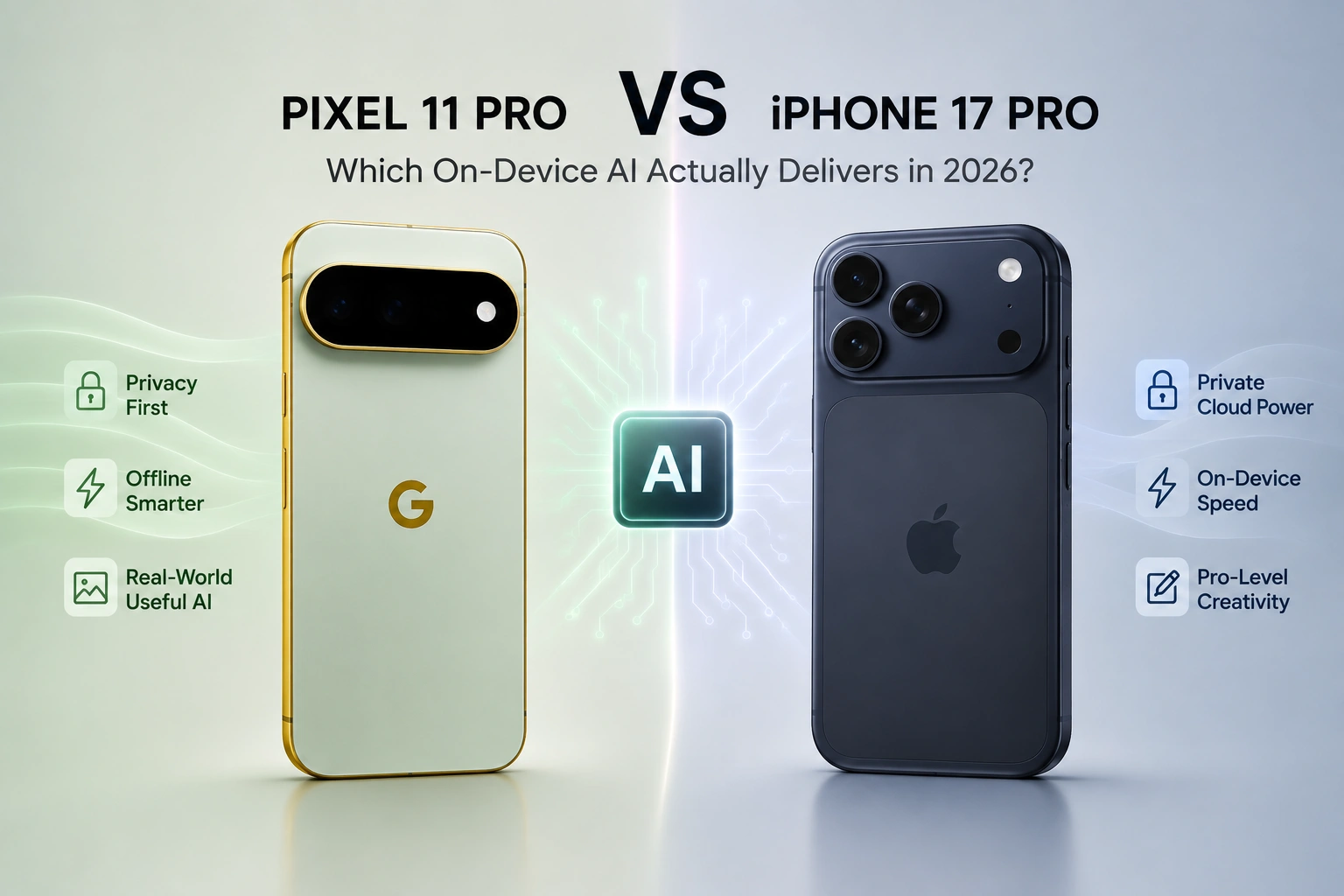
2026’s keynote slides all talk about “on-device AI” as if the problem has already been solved. It hasn’t. Google and Apple are taking very different approaches with the Pixel 11 Pro and iPhone 17 Pro, and the line between what runs directly on the phone and what gets quietly pushed to the cloud is far less clear than the marketing suggests. We broke down both platforms chip by chip and feature by feature to find out which one actually makes everyday tasks faster — and which one is simply better at looking impressive in a demo.
Let's go to fast answer
If you want fewer round trips to the cloud, faster translation and transcription, and an assistant that can genuinely act across apps, the Pixel 11 Pro's Tensor G6 and Gemini Nano combo wins on raw on-device throughput. If you want predictable, private, no-surprises AI that never phones home without telling you, Apple Intelligence on the A19 Pro is the more conservative and arguably more trustworthy build.
- Both phones share the same 3nm-class manufacturing node this generation, so the difference isn't the transistor count — it's software architecture.
- Gemini Nano on Tensor G6 handles more raw AI tasks locally, including live audio translation and sign-to-text, without pinging a server.
- Apple leans harder on Apple Intelligence's Private Cloud Compute for anything beyond basic writing tools and photo cleanup, which is more private than typical cloud AI but still isn't fully local.
- Neither phone's flashiest "agentic" feature — Gemini booking a table, Siri understanding your whole life — is fully on-device yet, and that matters more than the spec sheets suggest.
What On-Device AI Actually Means in 2026
On-device AI means the model weights, the inference, and the output all happen on the silicon in your pocket, with no data leaving the phone. That's the ideal. In practice, both Google and Apple mix local processing with cloud fallback, and the ratio between the two is exactly what determines whether a feature is fast, private, and works on a plane with no wifi — or none of those things.
The distinction matters because a feature can be marketed as "AI-powered" while actually routing your prompt to a data center three states away. That's not dishonest, exactly, but it's not what most people picture when a company says "runs on your phone."
The Silicon Behind the Marketing: Tensor G6 vs A19 Pro
Both chips landed within weeks of each other, and both quietly walked back 2nm rumors before launch. Tensor G6 ships on TSMC's refined N3P node — the same one we broke down in our Pixel 11 Pro vs Huawei Pura 90 Pro Max comparison — and the A19 Pro is built on essentially the same class of process. If you're curious how foundries got here, our TSMC vs Samsung 2nm foundry breakdown covers why 2nm wafers are still rationed and why both companies played it safe this cycle.
| Spec | Pixel 11 Pro (Tensor G6) | iPhone 17 Pro (A19 Pro) |
|---|---|---|
| Process node | TSMC N3P (3nm) | TSMC N3P-class (3nm) |
| AI silicon | Upgraded TPU, 50% more compute than Tensor G5 | 16-core Neural Engine + per-core GPU Neural Accelerators |
| Local AI model | Gemini Nano (latest) | Apple's on-device Foundation Model |
| RAM | 12GB (256GB tier), 16GB on 512GB/1TB | 12GB across the line |
| Cloud fallback | Gemini cloud models (Gemini Intelligence) | Private Cloud Compute |
| Starting price | $1,099 | $1,099 |
Google claims Tensor G6's TPU makes on-device AI tasks up to 3.5 times faster and 3.5 times more power efficient than the previous generation. Apple hasn't published an equivalent headline number for the A19 Pro's AI throughput specifically, but says the chip delivers up to 40% better sustained performance overall thanks to its new vapor chamber cooling, which indirectly benefits any AI workload that runs longer than a few seconds.
One wrinkle worth flagging: Google trimmed the Pixel 11 Pro's base RAM from 16GB to 12GB this year, which we tested in depth in our Pixel 11 Pro camera and RAM deep dive. Google leans on zRAM compression and INT4-quantized Gemini Nano models to make 12GB behave close to what 16GB used to. It mostly works, but it's a software patch over a hardware cut, not a free lunch.
Where the Processing Actually Happens
Google's Path: Gemini Nano First, Cloud Gemini for the Heavy Lifting
Gemini Nano handles the tasks Google is confident the TPU can run without breaking a sweat: live audio translation and dubbing, Gboard's sign-language-to-text feature, notification summaries, and parts of the camera pipeline like Magic Capture. These genuinely run locally and genuinely work offline.
The more ambitious "Gemini Intelligence" features — ordering groceries, booking a rideshare, calling a restaurant on your behalf using screen-parsing across apps with no built-in Gemini support — are a different story. Google hasn't confirmed these agentic tasks run purely on-device, and the rollout is currently U.S.-only, which is a strong hint that a chunk of that reasoning happens in the cloud. It's an impressive party trick, but it's not the same category of "on-device" as translating a podcast with the wifi off.
Apple's Path: Apple Intelligence Plus Private Cloud Compute
Apple's on-device model handles Writing Tools, notification summaries, Clean Up in Photos, Genmoji, and basic Siri commands directly on the Neural Engine. Anything more complex routes to Private Cloud Compute, Apple's own server infrastructure built on Apple silicon with no data retention and third-party security audits — more private than a typical cloud API, but not local processing by definition.
As of iOS 26/27, Apple's genuinely most capable on-device model is gated to devices with 12GB of RAM or more — meaning the base iPhone 17 with 8GB doesn't get the full experience, while the iPhone 17 Pro does. There's also a genuinely interesting wrinkle here: Bloomberg's Mark Gurman has reported Apple is in talks with Google about building a future version of Siri on top of Gemini, which would mean Apple's cloud fallback might one day be powered by the same company it's competing against on-device.
Everyday AI Features Compared
Voice Assistant
Gemini feels noticeably more capable right now — it can reason across apps, hold context, and complete multi-step requests. Siri is still catching up; the promised deep personal-context overhaul has slipped multiple times, and most of what's genuinely new on iPhone 17 Pro today is faster dictation and better Live Translate, not a smarter conversational assistant.
Photo and Video Editing
Both phones do heavy AI reconstruction behind the scenes rather than capturing a "pure" image — we go deep on exactly how much of a Pixel photo is real light versus AI best-guessing in this breakdown, and you can see how both phones stack up against a third rival in our Pixel 11 Pro vs Galaxy S26 Ultra vs iPhone 17 Pro Max camera comparison. Google's Magic Editor and Instant Night Sight lean harder on generative fill; Apple's Clean Up is more conservative and less likely to invent detail that wasn't there.
Writing, Summarization, and Translation
Apple's Writing Tools are quick and fully local for basic rewrites. Gemini Nano's Live Translate goes further, translating full videos and podcasts with real-time dubbing entirely on-device — a feature Apple simply doesn't have an equivalent for yet on iPhone 17 Pro.
Contextual Actions
Apple's App Intents framework lets Siri trigger actions inside apps that specifically support it. Gemini's screen-parsing approach works across apps that never built any Gemini integration at all, which is more powerful in theory but also the part most likely to be leaning on cloud compute rather than the TPU alone.
Speed: Does It Actually Save You Time?
For the fully local features — translation, transcription, summarization, quick photo edits — both phones respond in under a second and the difference isn't something most people will consciously notice day to day. Where speed actually diverges is on anything that needs a network round trip: Gemini's agentic tasks and Siri's more complex requests both introduce a noticeable delay compared to the instant feel of true on-device processing, because they're waiting on a server response, not local inference.
Privacy: What Actually Leaves the Phone
Neither company is doing anything shady, but neither is fully local either. Apple's Private Cloud Compute is genuinely stronger on paper — stateless processing, no logging, independently auditable — while Google's cloud Gemini requests follow standard account-based privacy controls, which most users won't dig into. If privacy is your top priority, look at which specific feature you're using rather than trusting the "on-device AI" label as a blanket promise from either company.
Offline Capabilities
This is where Tensor G6 has a real, measurable edge. Live Translate, sign-to-text, notification summaries, and Gemini Nano's basic writing help all keep working in airplane mode. Apple's on-device Foundation Model covers Writing Tools and Photos cleanup offline too, but anything routed through Private Cloud Compute — which includes more Siri queries than Google routes to the cloud for equivalent tasks — simply stops working without a connection.
Pixel 11 Pro: Pros and Cons
- Pros: More genuinely local AI features, faster real-world translation and transcription, agentic Gemini that works across third-party apps, efficient TPU that sips battery.
- Cons: Base RAM cut to 12GB versus last year's 16GB, the flashiest agentic features still lean on the cloud and are U.S.-only at launch, Gemini's screen-parsing occasionally misreads unusual app layouts.
iPhone 17 Pro: Pros and Cons
- Pros: Stronger, more auditable privacy story via Private Cloud Compute, consistent 12GB RAM across every configuration, more conservative photo AI that rarely over-invents detail.
- Cons: Siri's real overhaul keeps slipping, fewer fully-offline AI features than the Pixel, no equivalent to Gemini's cross-app agentic actions yet.
Alternatives Worth Considering
If neither ecosystem's AI trade-offs sit right with you, it's worth reading how the broader cloud AI landscape compares in our ChatGPT vs Claude vs Gemini breakdown, since the assistant behind your phone is only half the picture. Apple loyalists curious about where hardware is headed next might also want to check our iPhone Fold release date and price guide, and anyone chasing the truly next-gen 2nm chips should see our Apple A20 Pro vs Snapdragon 8 Elite Gen 6 comparison — neither the Tensor G6 nor the A19 Pro are actually 2nm parts, despite what pre-launch rumors implied. Heavy AI use also drains battery faster than most people expect, which our silicon-carbon vs lithium-ion battery explainer covers in more detail.
Finally
For most buyers: the Pixel 11 Pro delivers more useful on-device AI right now — more features that genuinely run locally, faster translation, and an assistant that can act across apps without needing every developer on board.
For privacy-first buyers who value predictability over flash: the iPhone 17 Pro's more conservative approach and auditable Private Cloud Compute system make it the safer choice, even if Siri still lags behind conversationally.
Bottom line: Google is currently ahead on genuine on-device throughput, but a meaningful chunk of each platform's headline AI features still depend on a server somewhere — neither company has fully delivered the "your phone thinks for itself" promise yet, no matter what the keynote slides implied.
Frequently Asked Questions
Does the Pixel 11 Pro's Gemini run entirely on-device?
No. Gemini Nano handles specific local tasks like translation and summarization on-device, but Gemini Intelligence's more advanced agentic features, like booking a table or ordering groceries, likely rely on cloud processing at least in part.
Is Apple Intelligence on the iPhone 17 Pro private?
Mostly, yes. On-device tasks never leave the phone, and anything routed to Private Cloud Compute uses stateless, audited servers with no data retention, which is a stronger privacy model than typical cloud AI, though it's still not local processing.
Which phone has faster AI processing?
For tasks that run fully on-device, Tensor G6's TPU generally responds faster and more consistently than the A19 Pro's Neural Engine, largely because Google has optimized more everyday features to skip the cloud entirely.
Does either phone's AI work with no internet connection?
Partially, on both. The Pixel 11 Pro keeps more features working offline, including Live Translate and sign-to-text. The iPhone 17 Pro's Writing Tools and Photos Clean Up also work offline, but more of Siri's requests need a connection.
Is 12GB of RAM enough for on-device AI on either phone?
Yes for daily use on both. Apple keeps 12GB standard across the iPhone 17 Pro line, while Google's Pixel 11 Pro starts at 12GB and leans on software compression to compensate; heavier multitaskers may prefer the Pixel's 16GB tier.
Will Siri ever use Google's Gemini model?
It's unconfirmed, but reporting from Bloomberg suggests Apple has explored building a future Siri overhaul on top of Gemini's technology for cloud-side reasoning, which would be a notable shift if it happens.

Comments 0
Be the first to comment!