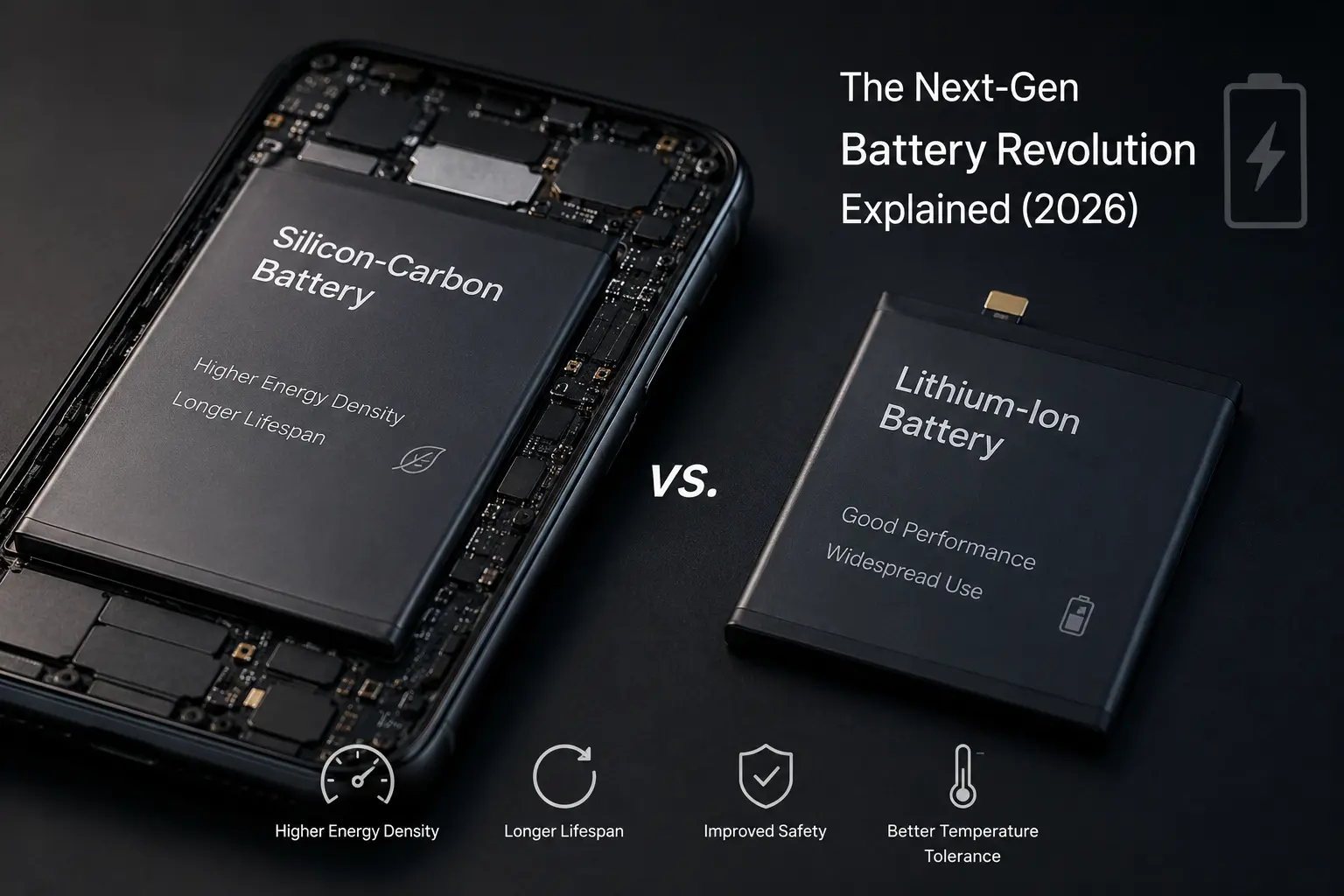
Open the spec sheet of almost any 2026 flagship and you'll see a battery number that looks slightly absurd next to last year's model. 6,500mAh. 7,150mAh. In a few cases, over 10,000mAh — in a phone that's barely thicker than a stack of coins. That jump didn't come from a bigger battery compartment. It came from swapping out what's inside the cell.
That swap is the silicon-carbon anode, and it's the real story behind why 2026 phones last longer without getting chunkier. This article skips the marketing language and goes into what actually changes at the chemistry level, and why some of it matters a lot more than the mAh number does.
So, Let's talk more about it
Silicon-carbon batteries replace part of the graphite anode inside a lithium-ion cell with a silicon-carbon composite, which stores more lithium per gram. The result is roughly 20-40% more capacity in the same physical space, often with faster charging and better heat behavior — but silicon expands when it absorbs lithium, which is the hard engineering problem manufacturers have had to solve before this tech could ship at scale. It's still a lithium-ion battery underneath, just with a smarter anode.
Behind the Anode: What Actually Changed
Every lithium-ion battery, silicon-carbon included, works the same basic way: lithium ions shuttle between a cathode and an anode through an electrolyte, and that movement is what generates current. The U.S. Department of Energy explains the mechanism in plain terms — nothing about that fundamental process has changed in silicon-carbon cells.
Graphite Hit a Wall
What changed is the anode material. For roughly a decade, phone batteries used graphite anodes almost exclusively, and graphite has a hard ceiling on how many lithium ions it can hold per gram. Engineers could shave milliwatts here and there through software, but the physical storage limit stayed put. That's why flagship batteries were stuck around 4,500-5,000mAh for so long — it wasn't laziness, it was chemistry.
Silicon Changes the Math
Silicon can theoretically hold about ten times more lithium than graphite, gram for gram. The problem is that pure silicon swells dramatically — up to 300% — as it absorbs lithium during charging, which cracks the anode structure after repeated cycles and kills the battery fast. So instead of pure silicon, manufacturers blend a small percentage of silicon (typically 5-32% depending on the brand) into a carbon scaffold that buffers the expansion. Companies like Group14 Technologies, whose SCC55 material is one of the industry's most licensed silicon-anode formulas, have spent years engineering that scaffold so it doesn't degrade after a few hundred cycles.
Energy Density: Why the mAh Number Only Tells Half the Story
Capacity (mAh) tells you how much charge a battery holds. Energy density tells you how much of that charge fits into a given size or weight — and that's the number that actually explains why phones aren't getting thicker.
| Metric | Traditional Graphite Li-ion | Silicon-Carbon Composite |
|---|---|---|
| Typical volumetric density | ~650-750 Wh/L | ~850-921 Wh/L |
| Flagship capacity (2024-25 baseline vs 2026) | 4,500-5,000mAh | 6,500-7,300mAh (common), 10,000mAh+ in showcase models |
| Silicon content in anode | 0% (pure graphite) | 5-32%, brand dependent |
| Typical thickness impact | Baseline | Same or thinner at higher capacity |
| Cycle life before ~80% capacity | 800-1,000 cycles (typical) | 1,000-1,500+ cycles (higher-silicon-ratio cells still catching up) |
Honor's global Magic V6, for example, packs a 6,660mAh cell using a 25% silicon anode with an energy density the brand says beats a Tesla 4680 cell, all inside a foldable body. That's the pattern across the industry right now: same footprint, noticeably more capacity, per BGR's rundown of current silicon-carbon phones.
Charging Speed: The Part the Spec Sheet Doesn't Explain
Here's something that surprises people: silicon-carbon isn't primarily a fast-charging technology, but it often enables faster charging indirectly. Because the anode absorbs lithium more efficiently, it can tolerate higher current without lithium plating (a failure mode where lithium metal builds up on the anode instead of properly intercalating — a major cause of degradation and, in worst cases, short circuits).
That's part of why phones like the Xiaomi 17 Ultra can push 90W wired charging on a 6,000mAh silicon-carbon cell without the thermal drama that would come from trying the same current on an older graphite pack. It isn't magic — it's that the anode has more headroom to absorb ions quickly without stressing the structure.
Thermal Behavior: Does More Density Mean More Heat?
Counterintuitively, silicon-carbon cells generally run cooler under load than you'd expect from a pack with more capacity crammed into the same volume. The composite's internal resistance profile is different from pure graphite, and better ion mobility means less energy gets wasted as heat during both charging and heavy discharge (gaming, camera use, 5G data transfer).
That said, it's not a free pass. Higher silicon ratios still generate more localized heat at the anode during fast charging, wich is why most phones cap their absolute peak wattage even when the cell could theoretically take more current in short bursts. Thermal management (vapor chambers, graphite sheets, software throttling) still does most of the heavy lifting — the battery chemistry just gives engineers more room to work with.
Longevity: The Tradeoff Nobody Fully Solved Yet
This is the part marketing slides tend to skip. Silicon expansion, even when buffered by a carbon scaffold, still causes more mechanical stress over hundreds of charge cycles than graphite does. Lower-silicon-content cells (5-15%) tend to hold up closer to traditional lithium-ion longevity. Higher-silicon cells (25%+) can offer huge early capacity gains but may show slightly faster degradation past the 800-cycle mark, unless the manufacturer has invested heavily in binder and scaffold engineering.
In practice, most 2026 flagships land somewhere in the middle: better real-world longevity than early 2023-era silicon-carbon prototypes, but not yet a guaranteed multi-year advantage over a well-optimized graphite pack. This is an area where brand and manufacturing quality matters more than the "silicon-carbon" label alone.
Manufacturing Challenges: Why Your Phone Might Not Have This Yet
If silicon-carbon is this much better, why isn't every phone using it already? A few real reasons:
- Cost: Silicon-carbon anode material and the tighter manufacturing tolerances it requires still cost more than commodity graphite.
- Supply chain maturity: Only a handful of suppliers currently produce silicon-anode material at real smartphone-battery scale.
- Regulatory and safety validation: Cell designs need extensive cycle-life and thermal testing before mass certification, especially for markets with strict battery import rules.
- Regional rollout order: Chinese OEMs (Honor, Xiaomi, OPPO, vivo, Realme) adopted first and fastest, partly because of domestic supply chains and looser battery-capacity import regulations than some other markets.
This uneven rollout is also why chipset efficiency still matters just as much as battery chemistry for real-world endurance — a point we cover in our breakdown of which budget chipsets are actually worth buying in 2026, since a power-hungry processor can undercut even a great battery.
Pros and Cons
Pros
- Meaningfully higher energy density in the same or smaller volume
- Enables thinner or lighter phones without sacrificing battery life
- Generally supports faster charging with less thermal stress
- Compatible with existing lithium-ion manufacturing infrastructure (it's a drop-in anode upgrade, not an entirely new battery format)
Cons
- Higher production cost than standard graphite anodes
- Long-term degradation at high silicon ratios is still being proven out over years, not months
- Marketing sometimes overstates "silicon-carbon" when actual silicon content is minimal
- Global availability is uneven — many models remain China-exclusive for now
Which 2026 Phones Actually Use It
Not every phone advertising "silicon-carbon" delivers the same real-world jump, so it helps to compare actual devices rather than the label alone. Our Apple A20 Pro vs Snapdragon 8 Elite Gen 6 battery life comparison shows how much the chipset's efficiency profile still shapes endurance even on similar-capacity cells. Meanwhile our look at the Pixel 11 Pro vs Huawei Pura 90 Pro Max highlights how differently Western and Chinese flagships are approaching battery strategy right now.
Thickness is where the tech shows up most visibly. Our coverage of the iPhone Fold's release timeline and design tradeoffs touches on exactly this tension — foldables live or die by how much battery they can fit into a slim hinge, which is precisely the problem silicon-carbon was built to help solve.
Alternatives Worth Watching
Silicon-carbon isn't the only next-gen anode approach in development. A few others worth knowing about:
- Silicon-oxide (SiOx) anodes: An earlier approach with less expansion but also smaller density gains than silicon-carbon composites.
- Graphene-enhanced graphite: Boosts conductivity and charging speed without silicon's expansion problem, but offers smaller capacity gains.
- Solid-state batteries: Replace the liquid electrolyte entirely; promise higher safety and density but remain mostly in prototype and low-volume EV stages, not mainstream phones, as of 2026.
- Silicon-dominant anodes (50%+ silicon): The next step past today's composites, already being tested by companies like Group14 for EV and industrial use, with phone adoption likely a few years out.
Finally
Is silicon-carbon a real upgrade or just a marketing term? Genuinely real, but not universal. When a manufacturer uses a meaningful silicon ratio (15%+) with proper anode engineering, you get real gains in capacity, thickness, and often charging behavior. When a brand slaps the label on a cell with a token silicon percentage, the difference is barely noticeable. Check the actual mAh-to-thickness ratio and cycle-life claims before assuming the badge alone means anything.
Frequently Asked Questions
Is a silicon-carbon battery the same as a solid-state battery?
No. Silicon-carbon batteries are still liquid-electrolyte lithium-ion cells — only the anode material changed. Solid-state batteries replace the electrolyte itself and are a separate, still-maturing technology.
Do silicon-carbon batteries degrade faster than normal lithium-ion?
It depends on silicon content and manufacturing quality. Lower-silicon composites (under 15%) generally match or slightly beat graphite longevity. Very high-silicon cells can degrade a bit faster unless the manufacturer has invested in scaffold and binder engineering to manage expansion.
Why do most silicon-carbon phones launch in China first?
Partly supply-chain maturity, and partly because import and certification rules for battery capacity and chemistry differ by region, which slows global rollout even when the technology itself is ready.
Does silicon-carbon make phones charge faster automatically?
Not by itself. It gives engineers more thermal and structural headroom to support faster charging, but the actual wattage still depends on the charging controller, cooling design, and safety limits the manufacturer sets.
Will Apple and Samsung eventually use silicon-carbon batteries?
Industry reporting suggests both are evaluating it, with wider adoption expected as supply chains mature and long-term cycle data builds up. Chinese brands remain roughly 12-18 months ahead in shipping volume.
Should I buy a phone specifically because it has a silicon-carbon battery?
Look at the real-world battery life and charging numbers reviewers report, not the label. A well-implemented graphite battery in a power-efficient phone can still outlast a poorly optimized silicon-carbon one.
Battery chemistry rarely gets this much attention, but 2026 is the year it earned it. The anode swap happening quietly inside these cells is arguably a bigger real-world upgrade for most people than another camera sensor or a slightly faster chip — you just have to look past the mAh number to see why.



Comments 0
Be the first to comment!