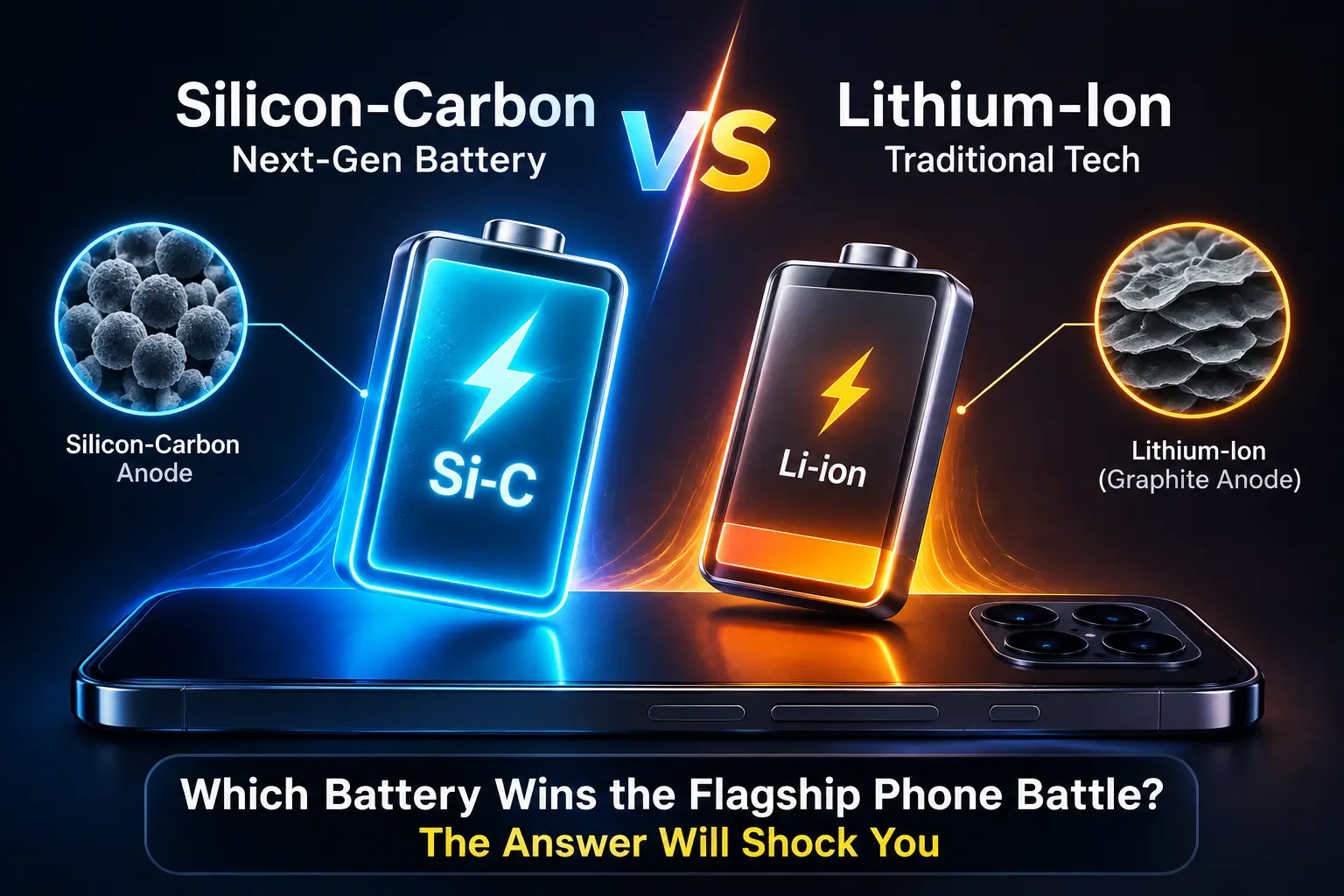
Two phones launch the same month. Both carry a battery in the same ballpark, say 6,000mAh give or take a few hundred. One of them survives a brutal 14-hour day of calls, scrolling, and a couple of gaming sessions with juice to spare. The other is begging for a charger by dinner time. Same capacity, wildly different outcome, and the mAh number on the spec sheet had almost nothing to do with it.
That gap is the actual story behind flagship battery life in 2026. It isn't about who stuffed in the biggest cell. It's about seven or eight quieter decisions an engineering team makes long before the battery even gets soldered in.
Okay let's get start
Battery capacity (mAh) is only the starting point. Real-world endurance is decided by anode chemistry (silicon-carbon vs standard lithium-ion), chipset efficiency at the manufacturing node level, display technology and refresh-rate management, modem power draw, thermal design, charging circuitry, and how aggressively the software manages background tasks. A phone with a smaller battery and a genuinely efficient chipset can outlast a rival with 20% more capacity and a power-hungry processor.
The mAh Obsession Is Misleading You
Every spec sheet leads with the battery number because it's the easiest thing to compare. It's also the least useful one on its own. Capacity tells you how much energy is stored, not how fast that energy gets spent, and spending rate is where flagships actually seperate from each other.
Think of two cars with identical fuel tanks. One sips fuel on the highway, the other guzzles it idling at every red light. The tank size was never the deciding factor for the road trip.
Why identical capacities can still produce different screen-on-times
A phone's total daily drain comes from several components pulling power at the same time: the display, the SoC, the modem, the camera stack when it's active, and background processes the OS refuses to fully sleep. Shave 10% off draw from three of those components at once and you can easily add an hour or two of screen-on-time without touching battery size at all.
Silicon-Carbon Anodes: Why Batteries Got Bigger Without Getting Fatter
The single biggest physical shift in flagship batteries over the last two years has been the move away from graphite anodes toward silicon-carbon composites. Standard lithium-ion cells use graphite, which can only hold so many lithium ions before it maxes out. Silicon can theoretically hold close to ten times more lithium per gram, which is why manufacturers have been racing to blend it into the anode without the swelling problems that pure silicon causes over repeated charge cycles.
Chinese brands got here first and got here fast. Xiaomi, Oppo, and Honor were shipping silicon-carbon cells in flagship and even mid-range phones well before Western brands started experimenting seriously, which is exactly why phones like the Xiaomi 17 Ultra can pack 6,000-7,000mAh into a body that's barely thicker than an iPhone with a 4,700mAh cell. We covered this shift in more depth in our breakdown of silicon-carbon vs lithium-ion battery chemistry, and the short version is: it's the reason 10,000mAh phones exist without being bricks.
According to IEEE Spectrum, silicon anode cells are already shipping with meaningfully higher energy density than the lithium-ion packs that dominated phones for two decades, and the technology is still nowhere near its ceiling.
The Chipset Factor: Why a 2nm Processor Can Save You Hours a Day
Silicon-carbon batteries solve the "how much energy can we store" half of the equation. The chipset decides how fast that energy disappears, and this is where the real separation between flagship phones happens.
Every time a chipmaker shrinks the manufacturing node, from 3nm down toward the 2nm process both Qualcomm and MediaTek are chasing this year, the transistors switch faster while leaking less power as heat. That efficiency gain compounds across millions of operations per second. It's the difference between a chip that sips power during normal scrolling and one that's constantly working harder than it needs to.
We put this exact question to the test in our Dimensity 9600 vs Snapdragon 8 Elite Gen 6 comparison, and the efficiency gap between the two 2nm rivals was noticeably larger than the raw benchmark scores suggested. Qualcomm's own product page leans hard on efficiency claims for exactly this reason, a faster chip that also burns less power per task is worth more to daily battery life than a faster chip that just runs hotter.
Apple's approach tells a similar story from a different angle. In our A20 Pro vs Snapdragon 8 Elite Gen 6 battery life piece, we found Apple's tighter hardware-software integration lets it match or beat Android flagships on endurance despite shipping meaningfully smaller batteries, sometimes 1,500-2,000mAh smaller. That's chipset and software efficiency doing the heavy lifting that raw capacity usually gets credit for.
RedMagic and the gaming-phone paradox
Gaming phones like the RedMagic 11 Pro are the clearest proof that mAh isn't destiny. These phones often carry the largest batteries in the entire flagship category, sometimes north of 7,000mAh, plus active cooling fans most rivals don't have. Yet during sustained gaming, that huge cell can drain faster than a smaller battery in a phone that isn't being pushed to its thermal limit.
The reason is simple: a chipset running at full clock speed for 45 minutes straight draws several times more power than the same chip during normal browsing. RedMagic's fan helps manage heat, which actually protects long-term efficiency, but it also spends a few percent of battery just keeping the phone cool enough to keep performing. It's a trade-off aimed squarely at gamers, not all-day mixed use.
Display Power Draw: The Quiet Battery Killer
The screen is usually the single biggest power consumer on a modern flagship, often eating more energy across a full day than the chipset itself. Three things decide how much it drains: panel technology, refresh-rate behavior, and peak brightness.
- LTPO panels can drop refresh rate down to 1Hz on a static screen, cutting power dramatically compared to a fixed 120Hz panel.
- Peak brightness for outdoor visibility, often 2,000 to 3,000 nits on 2026 flagships, is fantastic for readability but expensive in direct sunlight use.
- Resolution matters less than most people assume; how often the panel refreshes matters far more.
A phone with an aggressive, well-tuned LTPO implementation can claw back 15-20% more screen-on-time than a rival with the exact same battery size but a less intelligent refresh-rate controller.
Modem Efficiency: The Radio Nobody Talks About
5G modems are notorious battery hogs, especially on weak signal, where the radio ramps up transmission power to hold onto a connection. Newer modem generations paired with 2nm chipsets have gotten meaningfully better at scaling power down during idle periods and light data use, but modem efficiency still varies a lot between chipset generations and even between carrier bands in the same country.
This is one reason two identical phone models sometimes report different battery life depending on region: the modem is working harder in areas with patchier 5G coverage, and that shows up directly in daily drain.
Thermal Management: Heat Is the Enemy of Efficiency
Every chipset has an efficiency sweet spot, and heat pushes it out of that zone. Once a phone's internal temperature climbs, the SoC throttles clock speeds to protect itself, but it also starts wasting more energy as heat rather than useful work. Vapor chambers, graphite sheets, and in gaming phones actual fans, all exist to keep the chip closer to its efficient operating range for longer.
Silicon-carbon batteries actually help here too. They tend to run cooler under heavy load than older lithium-ion cells, partly because the anode chemistry handles rapid charge and discharge more gracefully, which is part of why 2026 flagships can sustain high performance for longer without the battery itself becoming a heat problem.
Charging Behavior and Long-Term Battery Health
Fast charging and battery longevity have always been in tension. Pumping 80-100W into a cell generates heat, and heat accelerates capacity fade over hundreds of cycles. Silicon-carbon chemistry handles this better than older lithium-ion, according to TechRadar, which is part of why brands have been comfortable pushing charging speeds higher without the same degradation penalty seen a couple of years ago.
Software also plays a role most people never notice: adaptive charging algorithms that slow down the last 10-20% of a charge, or that learn your alarm time and finish charging right before you wake up, meaningfully extend the number of cycles a battery can handle before it noticeably degrades.
Software Optimization: The Invisible Difference
Hardware gets all the marketing attention, but software is often the deciding factor in real-world battery life. Aggressive background app management, smarter task scheduling, and AI-based usage prediction can all squeeze extra hours out of identical hardware.
This is also where trade-offs get personal. Some Android skins, including versions of HyperOS and ColorOS, are known for killing background apps agressively to save power, which is great for battery life but can mean delayed notifications. Apple and Google both take a more conservative approach, prioritizing consistency over maximum endurance. Neither approach is objectively better, it depends what you value more.
We touched on how far this software gap can go in our Pixel 11 Pro vs iPhone 17 Pro on-device AI comparison, where always-on AI features quietly became one of the newest battery drains nobody was warning buyers about.
2026 Flagship Battery Comparison Table
| Phone | Battery (approx.) | Chipset | Display Tech | Real-World Endurance |
|---|---|---|---|---|
| iPhone 17 Pro Max | ~4,700mAh | Apple A19 Pro | LTPO OLED | Strong, thanks to tight software-hardware integration |
| Samsung Galaxy S26 Ultra | ~5,500mAh | Snapdragon 8 Elite Gen 6 | LTPO AMOLED | Very good, helped by 2nm efficiency |
| Xiaomi 17 Ultra | ~6,300mAh (Si-C) | Snapdragon 8 Elite Gen 6 | LTPO AMOLED | Excellent, among the longest-lasting flagships |
| Oppo Find X9 Pro | ~6,100mAh (Si-C) | Dimensity 9600 | LTPO AMOLED | Excellent, strong all-day battery |
| RedMagic 11 Pro | ~7,200mAh (Si-C) | Snapdragon 8 Elite Gen 6 | Fixed 120Hz AMOLED | Great for mixed use, drops fast under sustained gaming |
| Google Pixel 11 Pro | ~5,000mAh | Tensor G6 | LTPO OLED | Good, improved over previous Tensor generations |
Figures are rounded approximations based on publicly available specs and early reporting. Exact capacities vary by market and configuration.
Pros and Cons of Silicon-Carbon Battery Technology
Pros
- Significantly higher energy density than graphite anodes
- Allows bigger batteries without added thickness or weight
- Runs cooler under fast charging and heavy load
- Supports faster charging speeds with less long-term degradation
Cons
- More expensive to manufacture at scale, at least for now
- Still newer technology with less multi-year degradation data available
- Some conservative brands have been slower to adopt it fully
- Doesn't fix inefficiency elsewhere; a weak chipset or display still wastes the extra capacity
Alternatives If Battery Life Is Your Only Priority
- Budget-efficient flagships: Some sub-$500 phones now use efficient mid-tier chipsets that outlast pricier flagships simply by not chasing peak performance. We covered a few of these in The $500 Phone Trap: 3 Chipsets Actually Worth Buying.
- Gaming phones with huge cells: If sustained performance matters more than slimness, a RedMagic-style phone with a 7,000mAh+ battery and active cooling is a reasonable trade.
- A good power bank: Sometimes the simplest fix beats chasing marginal battery gains between flagship models.
Verdict
The real battery powerhouse isn't the phone with the biggest number on the spec sheet. It's the one where battery chemistry, chipset, display, modem, and software were all tuned to work together. In 2026, that combination increasingly favors phones using silicon-carbon cells paired with genuinely efficient 2nm silicon, more than it favors raw capacity alone. If you had to trust just one spec, chipset efficiency and display refresh-rate management matter more than mAh.
Frequently Asked Questions
Does a bigger mAh number always mean better battery life?
No. A phone with a smaller battery and a more efficient chipset, display, and modem can easily outlast a phone with 20% more capacity but weaker efficiency across those components.
Why do Chinese phones like Xiaomi and Oppo have such huge batteries?
Chinese manufacturers adopted silicon-carbon anode technology earlier and more aggressively than Western brands, letting them fit significantly more capacity into similarly sized phone bodies.
Are silicon-carbon batteries safe long-term?
Early data suggests silicon-carbon cells handle heat and fast charging better than standard lithium-ion, though they're still newer, so multi-year degradation data is more limited than for graphite-anode batteries.
Do gaming phones actually have the best battery life?
They have the biggest batteries, but not necessarily the best all-day endurance. Under sustained gaming loads, high-performance chipsets can drain a large battery faster than a smaller battery in a phone optimized for everyday efficiency.
Does fast charging damage battery health?
It can, over hundreds of cycles, mainly due to heat. Silicon-carbon chemistry and smarter charging software have both reduced this effect compared to phones from just a couple of years ago.
Final Thoughts
The battery war in 2026 stopped being about who could cram in the most mAh a while ago. It's now a systems problem: chemistry, silicon, display, radio, and software all pulling in the same direction, or fighting each other. Next time a spec sheet brags about a massive battery, the real question worth asking is what chipset and display are sitting next to it. That's where the actual endurance story lives.



Comments 0
Be the first to comment!