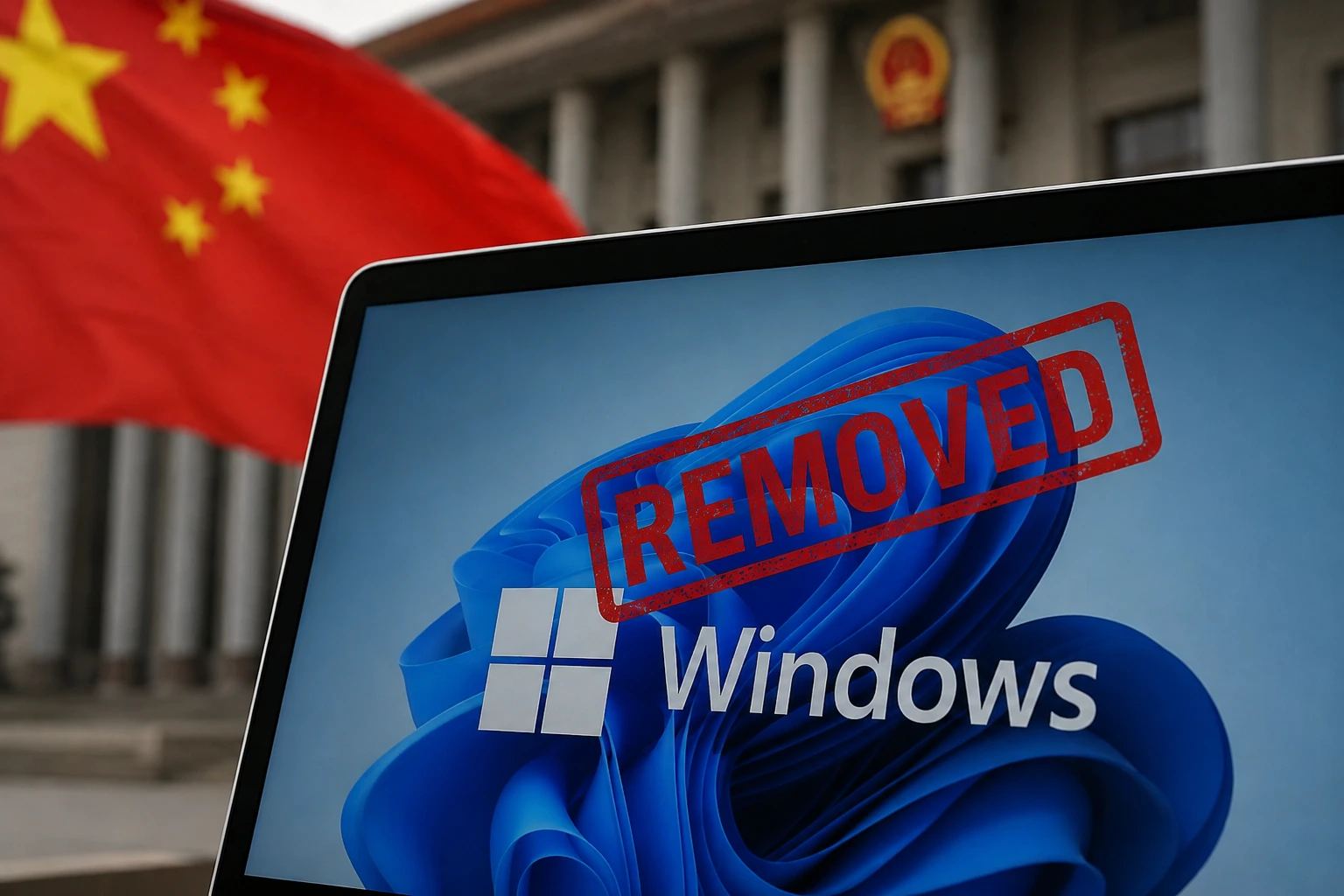
China just moved the deadline on one of the biggest tech breakups in the world, and it happened quietly. No press conference, no white paper — just an internal order from a security ministry telling state-linked organizations to rip out a version of Windows 10 that was months away from a scheduled retirement anyway. That small detail is the whole story. This wasn't Beijing announcing a new plan. It was Beijing deciding it couldn't wait for the old one.
Okay let's get start Quickly
China's Ministry of State Security has told some state-linked entities to uninstall a customized edition of Windows 10 built specifically for government use, months ahead of its planned February 2027 retirement. The software, developed by C&M Information Technologies (a joint venture between Microsoft and a state-owned defense contractor), is being replaced by domestic operating systems like Kylin OS and UnionTech's UOS, running on Chinese-made chips. It's part of a decade-long "xinchuang" campaign to remove foreign IT from Chinese government and state-owned systems, and the acceleration lands weeks before a planned Trump–Xi meeting.
So What Actually Happened
According to Bloomberg, which broke the story on August 18, 2026, China's Ministry of State Security recently instructed a number of state-linked entities to uninstall a customised version of Windows 10 from their machines. That single directive moved up the retirement schedule for the software by several months, and it's the clearest sign yet that Beijing's patience with foreign operating systems on government hardware is running out faster than anyone outside China expected.
The operating system in question isn't the consumer Windows 10 most people are familliar with. It's a special build called Windows 10 China Government Edition, developed by C&M Information Technologies Co (CMIT) — a joint venture Microsoft set up in 2016 with the state-owned China Electronics Technology Group Corp (CETC), precisely so Windows could pass Beijing's security requirements for official use. CMIT had already scheduled the product's retirement for February 2027. The new order simply moved that date forward, without much explanation.
The Software Nobody Outside China Had Heard Of
CMIT's version of Windows 10 was Microsoft's attempt to stay relevant inside Chinese government procurement after Beijing started tightening the rules around foreign software. It stripped out features Chinese regulators objected to and added local encryption and monitoring requirements. On paper, it was supposed to be the compromise that let Microsoft keep a foothold in one of its most important markets.
In practice, it never really took off. Reuters reviewed six Chinese government procurement guides published between December 2023 and May 2026 and found that five of them didn't recommend Microsoft software at all. The sixth mentioned the China Government Edition of Windows 10, but only with extra management requirements layered on top. That's not exactly a ringing endorsement from the buyer that mattered most.
Okay Why Now — And Why the Silence?
No Official Reason Given
Here's the part that makes this story more interesting than a routine software sunset: nobody in Beijing has said publicly what triggered the acceleration. People familiar with the matter told Bloomberg the move was linked to data-security concerns, but they didn't specify what those concerns actually were. Microsoft, for its part, says it isn't aware of any security incident tied to the product, and that it continues to receive regular security updates.
That gap — a government citing security risk without naming the risk — is fairly typical of how Beijing handles sensitive tech decisions. It leaves outside observers guessing whether this is about a specific vulnerability, a general loss of confidence in foreign-built software, or simply politics dressed up as a technical decision.
The Timing Question
The order also lands just weeks ahead of a planned meeting between US President Donald Trump and Chinese leader Xi Jinping, where trade and security friction are expected to dominate the agenda. Whether that's coincidence or leverage is impossible to say from the outside, but it fits a pattern this site has tracked closely — the same pattern behind China's gallium and germanium export controls, where a supposedly technical decision doubled as a message ahead of a diplomatic milestone.
This Isn't New — It's an Old Plan Running Ahead of Schedule
If you're picturing China suddenly deciding to ditch Microsoft, that's not really what's going on. This has been building for over a decade, under a program most Westerners have never heard of: xinchuang (??), short for "IT application innovation." It's Beijing's umbrella strategy for swapping out foreign hardware, operating systems, databases and chips across government, the military, and state-owned enterprises.
A Short Timeline
| Year | Milestone |
|---|---|
| 2014 | Windows 8 banned from Chinese government procurement |
| 2016 | Microsoft and CETC form CMIT to build a government-approved Windows 10 |
| 2019 | Beijing orders a three-year replacement plan for foreign PCs in government offices |
| 2022 | Central agencies and state firms told to scrap foreign-branded computers entirely |
| 2023 | New procurement rules require "safe and reliable" domestic processors and operating systems |
| 2027 (original plan) | CMIT's Windows 10 China Government Edition scheduled for retirement |
| Aug 2026 (actual) | Ministry of State Security orders early uninstall, months ahead of plan |
By 2023, the approved CPU list for government machines was entirely Chinese — think Huawei Kunpeng, Phytium, and Loongson chips — with Intel and AMD explicitly being phased out. If that sounds familliar, it's the same self-sufficiency logic driving the broader chip race this site covered in China's push to compete in advanced chip manufacturing. Windows was never going to be the exception.
What's Replacing Windows on State Machines
The domestic stack that's absorbing this demand is more mature than most people assume. It isn't one single "Chinese Windows" — it's a small ecosystem of Linux-based systems, most of them built with military and government use in mind from day one.
| Product | Developer | Base | Typical Use |
|---|---|---|---|
| Kylin OS (Kylin V10 / openKylin) | Kylinsoft / National University of Defense Technology | Linux | Government desktops, claims the largest share of state-sector installs |
| UOS | UnionTech | Linux (Debian-based) | Government and enterprise desktops |
| HarmonyOS 5 (PC edition) | Huawei | Huawei-built kernel | Laptops and desktops paired with Huawei's own chips |
| Tongxin (NeoKylin) | Tongxin Software Technology | Linux | Government and defense-sector deployments |
Pair those with Chinese silicon — Kunpeng, Loongson, or Huawei's Kirin 9000X in machines like its Qingyun desktops — and you get a full stack, from processor to operating system, with no American or European component in the chain. That's the actual goal here, and it goes well beyond swapping one desktop icon for another.
The Real Motivations, Behind the Headline
1. Control Over Critical Infrastructure
Chinese law already treats operating systems on government and state-enterprise machines as part of "critical information infrastructure." Under that framework, agencies are required to prefer software they can audit, patch, and — if needed — inspect down to the source code. A foreign-built OS, no matter how customized, doesn't offer that same level of assurance, and Beijing has made that trade-off explicit since at least 2023.
2. Reducing Reliance on a Single Foreign Supplier
This is the same logic behind China's moves on rare earth exports and semiconductor sourcing — don't let one country's decisions determine whether your systems keep running. The Windows shift is really the software half of a supply-chain story this site has followed closely, including in how global supply chains are quietly repositioning around China. Beijing is applying the same self-sufficiency instinct inward, to its own government tech stack.
3. Geopolitical Signaling
Timing a quiet software order to land just before a high-stakes meeting with the US president isn't subtle once you notice it. It tells Washington that China's tech independence push isn't slowing down for trade talks — it's accelerating regardless of them. That mirrors the broader tone of the tech standoff covered in how chip export bans are reshaping global power, where both sides increasingly treat technology policy as a form of diplomacy.
Pros and Cons of the Push Away From Windows
- Pro — Security control: Domestic OS vendors can be audited and patched on Beijing's terms, not Microsoft's release schedule.
- Pro — Industrial policy payoff: Guaranteed government demand gives Kylin, UOS and Chinese chipmakers the scale to keep improving.
- Pro — Reduced exposure: Fewer critical systems depend on a foreign company's decisions, sanctions, or outages.
- Con — Compatibility pain: Legacy software built for Windows often needs to be rewritten or run through compatibility layers.
- Con — Retraining costs: Millions of government employees need to relearn workflows on unfamiliar interfaces.
- Con — Consumer gap remains huge: StatCounter data shows Windows still runs roughly 87% of Chinese desktop web traffic overall — this shift barely touches ordinary consumers or private businesses.
What This Means for Microsoft
Microsoft's China government business was never the crown jewel of its revenue, but it mattered strategically — it kept Microsoft inside a market of 1.4 billion people at a moment when Beijing was actively deciding whether foreign tech companies belonged there at all. Losing even the symbolic government-edition product is a signal that the compromise-and-comply approach has limits.
It's worth noting the reaction wasn't limited to Microsoft's side of the ledger. Chinese domestic OS and security stocks reportedly jumped sharply on the news, with some hitting daily trading limits — a sign investors read this as the start of faster substitution, not a one-off order. Microsoft's own statement was notably calm: no known security incident, and the product keeps receiving updates regardless of what state agencies decide to do with it.
For Microsoft, the bigger risk isn't this one product — it's precedent. If "ahead of schedule" becomes the pattern for other foreign software categories (databases, cloud services, productivity suites), the timeline for the whole xinchuang program compresses, and Western vendors lose whatever runway they thought they had left.
The Reality Verdict
This is not a one-off software recall — it's an acceleration of a strategy China has been executing since 2014. The headline event (uninstalling one government edition of Windows 10) is small. The context (a decade-long push for full-stack tech sovereignty, sped up right before a major US-China meeting) is what actually matters. Expect more "ahead of schedule" announcements across other foreign software categories over the next 12–18 months, not fewer.
Frequently Asked Questions
Is China banning Windows completely?
No. This order applies to state-linked entities using a specific customized government edition of Windows 10. Ordinary consumers and private businesses in China still overwhelmingly run standard Windows, and nothing in this order changes that.
Why did Beijing move the timeline up instead of waiting until 2027?
Officials haven't said publicly. Sources cited data-security concerns without naming a specific vulnerability, and Microsoft says it isn't aware of any incident. The most likely explanation is a mix of genuine security caution and a political decision to accelerate an existing plan.
What operating systems are replacing Windows?
Mainly Kylin OS, UnionTech's UOS, Tongxin/NeoKylin, and increasingly Huawei's HarmonyOS on PC hardware — all typically paired with Chinese-made processors instead of Intel or AMD chips.
Does this affect Microsoft's global business?
Directly, the financial impact is limited — China's government edition of Windows was a small slice of Microsoft's overall revenue. Indirectly, it's a warning sign for how much longer Microsoft can expect to operate inside China's public sector at all.
Is this related to the broader US-China tech war?
Yes. It sits alongside chip export controls, rare-earth restrictions, and reciprocal tech bans as part of a wider decoupling trend on both sides. It's less about Windows specifically and more about which country controls the technology running critical systems.
Where This Fits in the Bigger Picture
Taken on its own, one government-edition operating system getting uninstalled early looks like a footnote. Taken alongside the chip bans, the export controls, and the broader realignment covered in what 2026's global crises really mean, it reads as one more brick in a wall China has been building for over ten years — quietly, deliberately, and now, apparently, a little faster than planned.
Sources:



Comments 0
Be the first to comment!