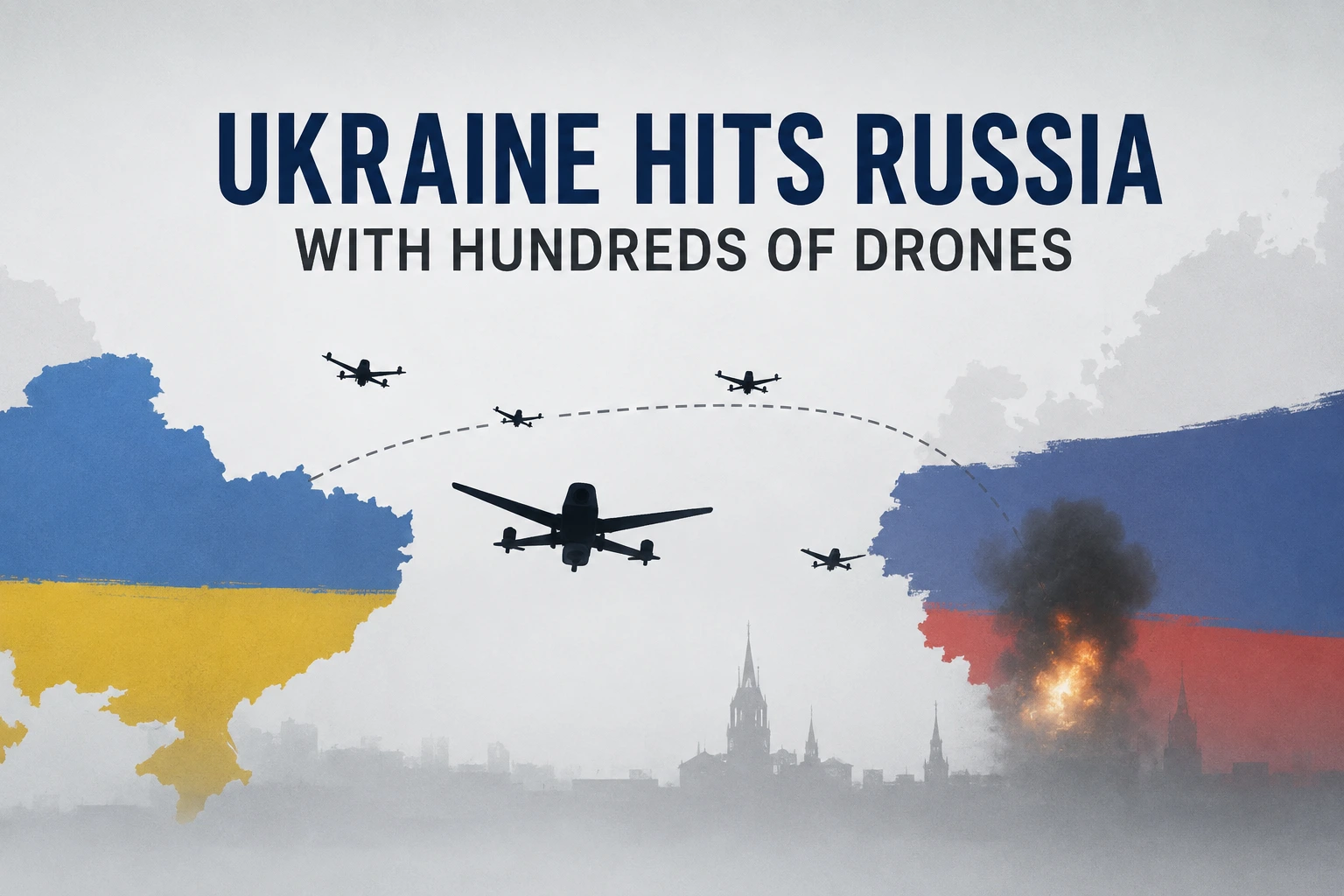
On August 16, 2026, Ukraine launched one of its largest drone assaults of the war, sending hundreds of drones toward Russia, with Moscow's defense ministry claiming 822 were destroyed. At least six people were killed in Russia. Hours later, Russia answered with over 1,500 attack drones and roughly 1,560 guided bombs plus ballistic missiles against Ukrainian cities, killing civilians in Kryvyi Rih, Sumy, and Zaporizhzhia. This wasn't a random spike — it's the latest step in a deep-strike drone campaign that has been quietly reshaping the war since early 2026.
So What Actually Happened Overnight ?
The numbers from this one night are worth sitting with. Moscow's Ministry of Defense said it shot down 822 Ukrainian drones, with around 600 of them detected heading toward the capital and roughly a third of those neutralized over the Moscow region itself. An elderly man was killed when a drone hit a private home outside Moscow. In Russia's Rostov region, a separate swarm of more than 150 drones hit three towns, killing five people and damaging a railway station.
Ukraine wasn't spared either. Russian ballistic missiles and drones struck Kryvyi Rih, killing two people and wounding fourteen, including workers at the ArcelorMittal steel plant, which had to partially suspend operations. A missile hit Sumy, and a home in Zaporizhzhia was destroyed, killing a man and a woman. Fires broke out across Kyiv, including at the city's well-known book market.
| Metric | Ukraine's Strike on Russia | Russia's Retaliation |
|---|---|---|
| Drones launched | Hundreds (800+ reportedly intercepted) | Over 1,500 |
| Other munitions | N/A | ~1,560 guided bombs, plus ballistic missiles |
| Reported deaths | 6 in Russia | 4+ in Ukraine |
| Main targets | Moscow region, Rostov region | Kryvyi Rih, Sumy, Kyiv, Zaporizhzhia |
Russian state media outlet TASS called it Ukraine's largest drone attack since the start of the year. That's a striking claim given how routine large barrages have becomme this year — which says a lot about how far the drone war has escalated.
Why Ukraine Keeps Pushing Deeper Into Russian Territory
It Was Never Really About the Drone Count
Headlines love the raw numbers — 600 drones, 822 shot down — but the number itself isn't the story. Kyiv's long-range drone campaign, which accelerated hard through 2026, has been aimed almost entirely at Russia's energy sector: refineries, export terminals, and pipeline infrastructure that fund a large share of the Russian state budget through oil revenue.
Ukrainian forces reportedly struck nearly 700 targets inside Russia in just the first half of 2026, and officials say the campaign knocked out a record share of the country's refining capacity. Reuters estimates from earlier this year put the damage at roughly 17% of Russian refining capacity, or about 1.1 million barrels per day. Whatever the exact figure, independent trackers and Russian sources broadly agree the trend line is real: Russia is losing refining output faster than it can rebuild it.
The Wildberries Warehouses Keep Showing Up in the Headlines
One recurring target that confuses casual readers is Wildberries, Russia's largest online retailer. Ukraine has repeatedly hit its logistics warehouses, burning through billions of dollars of merchandise. It's not really about the socks and electronics sitting in those depots — these facilities double as logistics and storage hubs tied to the broader economy that keeps the war funded, and hitting them puts pressure on ordinary Russian consumers and businesses in a way that front-line fighting never reaches.
Why Russia's Air Defense Keeps Getting Overwhelmed
Russia claims impressive shoot-down rates almost every week, yet the strikes keep landing. Both things can be true at once, and understanding why matters more than the headline numbers.
- Swarm saturation: Sending hundreds of drones at once forces air defense crews to prioritize — some targets simply get through by volume alone.
- Decoys mixed with real strike drones: Ukraine mixes cheap decoy drones with more capable long-range models like the Liutyi, making it harder to know which threats matter most in real time.
- Interceptor shortages: Russia is reportedly burning through surface-to-air interceptor stock faster than it can replace it, especially around high-value industrial sites.
- Geography works against Moscow: Defending thousands of kilometers of refineries, depots, and terminals spread across the country stretches even a large, layered air defense network thin.
How Moscow Hits Back — And Why It's Getting Fiercer
Russia's answer to deep strikes has consistently been to escalate against Ukrainian cities rather than match Kyiv target-for-target on military-industrial sites. The pattern after this latest attack fit that mold: over 1,500 drones and nearly 1,560 guided bombs, plus ballistic missiles Ukraine's air force admitted it did not intercept a single one of, a detail that quietly underlines just how short Ukraine still is on interceptor supply.
President Zelenskyy pointed to a familiar dynamic after the strikes: wherever Russian ballistic missiles can reach, they tend to land on civilian infrastructure rather than purely military targets. That's become something of a pattern through 2026 — Russia's retaliatory waves increasingly favor volume and psychological pressure on Ukrainian civilians over precision strikes on military assets.
Pros and Cons of Ukraine's Deep-Strike Drone Strategy
| Pros | Cons |
|---|---|
| Cuts into Russian oil export revenue, a core war-funding source | Invites larger retaliatory strikes on Ukrainian cities |
| Cheap drones cost far less than the damage they inflict | Ukraine still lacks enough interceptors to stop Russia's counter-barrages |
| Forces Russia to spread air defenses thin across a huge territory | Refineries are often rebuilt or partially restored within months |
| Brings the war's cost home to the Russian public directly | Raises the risk of drones straying into NATO airspace |
Could This Escalation Actually Change the War's Direction?
Peace talks have circled this conflict for most of 2026 without landing anywhere solid. Territory and security guarantees remain the two sticking points nobody has managed to bridge, and short truces around Orthodox Easter and Victory Day earlier this year mostly collapsed within hours of taking effect. Against that backdrop, a night like August 16 doesn't read as an isolated flare-up — it reads as both sides negotiating through firepower instead of at a table.
Three Ways This Could Play Out
- Grinding continuation: Both sides keep escalating air campaigns while ground lines barely move, and diplomacy stays stuck exactly where it's been for months.
- Forced negotiation through economic pain: If Ukraine's refinery campaign keeps compounding, fuel shortages and lost export revenue could eventually push Moscow toward a more serious negotiating posture.
- Wider regional risk: Continued drone incursions near NATO members' airspace raise the odds of an incident that pulls outside powers more directly into the conflict.
The Wider Ripple Effect
This escalation doesn't sit in isolation from the rest of 2026's geopolitical turbulence. It's part of the same broader pattern we broke down in our look at this year's global crises and the new world order taking shape, where regional conflicts increasingly ripple into energy markets, supply chains, and trade policy far beyond their borders.
The pressure on Russian oil exports also echoes dynamics we've covered around chip export bans reshaping global power and China's gallium and germanium export controls — different resources, same underlying story: nations are increasingly weaponizing the physical infrastructure their rivals depend on. And just as the Middle East's fragile calm proved fragile in our piece on whether the US-Iran-Israel confrontation really ended, the Ukraine-Russia war shows how quickly "de-escalation" can reverse overnight.
finally
This wasn't the war's turning point — it was another data point in a trend that's been building all year. Ukraine's drone campaign is genuinely hurting Russia's oil economy and forcing real strategic costs onto Moscow, but it hasn't yet been enough to force serious concessions at the negotiating table. Russia's retaliation strategy, meanwhile, keeps leaning on volume and civilian pressure rather than matching Kyiv's precision. Expect more nights like August 16, not fewer, unless one side's economic pain becomes too heavy to keep absorbing.
Frequently Asked Questions
Why does Ukraine target oil refineries instead of just military bases?
Oil revenue funds a significant share of the Russian state budget and, by extension, the war itself. Damaging refining capacity hits that funding source directly, in a way that's harder for Russia to quickly replace than a single military depot.
How many drones did Russia actually shoot down?
Russia's Ministry of Defense claimed 822 drones were destroyed overnight, though independent verification of exact intercept numbers is difficult, and Ukraine does not always confirm Russian tallies.
Why didn't Ukraine intercept any of Russia's ballistic missiles?
Ukraine's air force has repeatedly said it lacks sufficient missile interceptors, which are far more expensive and limited in supply than the drone-jamming and anti-drone systems it uses against smaller threats.
Is this the biggest drone attack of the entire war?
It's among the largest, according to Russian state media, but not necessarily the single biggest ever recorded — drone barrage sizes have grown substantially throughout 2026, making comparisons a moving target.
Could this escalation trigger NATO involvement?
Not directly, but drones straying into airspace near NATO members remains a real risk factor that analysts continue to flag as the deep-strike campaign expands geographically.
Are peace talks still happening?
Yes, intermittently, but territory and security guarantees remain unresolved sticking points, and previous short truces in 2026 largely collapsed within their agreed windows.



Comments 0
Be the first to comment!